

September 2010 – Volume 14, Number 2
Multilinguals are…? |
|||
| Author: | Madalena Cruz-Ferreira (2010) | 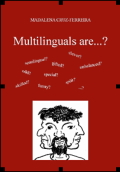 |
|
| Publisher: | London & Colombo: Battlebridge Publications | ||
| Pages | ISBN | Price | |
|---|---|---|---|
| Pp. vi + 90; more than 40 illustrations (mainly cartoons); |
9781903292204 (paper) | £9.95 | |
Value-laden terms like “semi-lingual,” “native-like” and “balanced bilingual” permeate commentaries on multilingualism. Multilinguals are…? contends that the research community, anchored mainly in monolingual moorings, has assigned misleading labels to the world multilinguals inhabit. As language about language founders in its attempts to characterize multilingual competence, Madalena Cruz-Ferreira frames the discussion around multilinguals themselves, challenging the terminology imposed upon them. In this text, these characterizations are laid bare as stipulations requiring multilinguals to behave as monolinguals in each of their languages. This user-friendly, playful book engages the reader in dialogue through thought-provoking quotations, analogies and direct questions, through musings delivered in first person, as well as assertions of carefully researched linguistic tenets. Cruz-Ferreira presents in her exploration of multilingualism a springboard for conversations with parents of mono- and multilingual children alike, with linguists, educators, policy-makers, and perhaps most importantly, with multilinguals.
Multilinguals are…? is organized into thirteen concise chapters, along with an engaging foreword and afterward. Humorously paradoxical titles like, “Chapter 6: Multilingual Competence Means Erasing Signs of Multilingualism from the Speech of Multilinguals,” “Chapter 10: In Order to Raise Multilingual Children, You Must Speak to Them in Only One Language” and “Chapter 13: Multilingualism Is a Boon, but Also a Bane, or Vice Versa” unfold into the ruminations and experiences of Cruz-Ferreira and many other multilinguals. Drawing upon linguistic and cognitive research, Cruz-Ferreira lays open assumption after unfounded assumption made about why multilingualism should be judged according to the standard of “normality” (read: monolingualism). Although she refrains from citing academic sources in this work, she grounds her arguments in thorough research and invites readers to contact her to obtain references. Whimsical illustrations and comics, provocative in their simplicity, provide light-hearted points of reflection to reinforce the author’s insights.
In this work, Cruz-Ferreira returns to many themes previously explored in her 2006 research piece Three is a Crowd?: Acquiring Portuguese in a Trilingual Environment, such as OPOL (one person-one language) policy in multilingual homes, questions of how language mixing ultimately affects the development of children acquiring many languages under a single roof, and the value judgments contained in terms such as “semi-lingual” and “bilingual imbalance.” Articulating her motivation for crafting a treatise on multilingualism, she states: “My everyday observations as a parent, educator and scholar made me realize the amount and scope of confusion that seeps through when people talk about multilingualism, in technical as well as lay settings, in official as well as informal ones, where baffling labels top it all” (p. 1). Because of these labels, there exists a perception that “multilingualism is a deviation with suspected pathological implications for the overall development of multilingual children and the overall welfare of multilingual adults… a ‘condition’ to be feared or, at best, to be addressed by specialists” (p. 6). Cruz-Ferreira draws upon first-hand experience with these concerns as a teacher of English in Singapore, as a parent of multilinguals, and as a multilingual herself.
When it comes to understanding multilingualism, “label” is the operative word for Cruz-Ferreira. She argues that “multilinguals have been called all sorts of names, which have cast more shadows than light on what they are, thereby portraying them as very, very odd creatures” (p. 1). Language mixing has been particularly condemned by monolingual culture as deficiency: “either you toe the single language line and produce unmistakably monolingual speech, or you can kiss goodbye any aspirations of being counted among proper users of language” (p. 42). Indeed, “it is a bit unsettling, to say the least, to be required to show competence by means of denying competence in the resources you’ve got” (p. 36). As she dissects popular theories about multilinguals, she employs metaphors like chimeras and unicorns, containers and computers. Of paramount importance to Cruz-Ferreira is debunking the notion that monolinguals are the “normal” and multilinguals are the “special.” Emphasizing in multiple instances that multilingualism is a normal part of growing up in many parts of the world, Cruz-Ferreira unmasks words like “deficient” and “semi-lingual” as value judgments promulgated in the linguistic community to the detriment of “real-world” multilinguals, and, she stresses, “what we need to do is to find out what people do with different languages, not what different languages do to people” (p. 10).
In addition to the concept of labeling and its function in understanding multilinguals in our world, two other themes are also carefully woven throughout: 1-how the multi- (and mono-) lingual brain actually works and, 2- how and why multilinguals learn and use their languages. Confronting head-on the “brain-as- computer” analogy, where there is limited space available, she muses that this is why we fear the havoc learning multiple languages will unleash on the brain. Rather, “it’s how the brain qualitatively adapts to the stimulation that is there to make it work… languages cannot take up brain space from anything, because they do not have allotted slots in the brain: they communicate with each other” (p.51). Thus, there is no need to seek out clinical assistance when a multilingual child mixes languages or chooses one language for play and one language for math. Indeed, “children learn the language(s) around them in the same way they learn the social behaviours and cultural traditions to which they are exposed, which is through experiencing them in meaningful practice” (p. 59-60). Multilingualism is neither detrimental to the brain, nor a sign of special talent. It is a normal way of life for humans throughout history.
Cruz-Ferreira writes with passion and urgency about real-world implications inherent in holding multilinguals up to the standard set by monolinguals. She unravels circular logic traps, which assert multilinguals have no native language and must be perfectly “balanced” to prove themselves worthy of the term multilingual. With reassuring words of encouragement, she reminds us that multilinguals are successfully navigating the world every day; it is possible to mix languages and not be actually “unbalanced;” language learning is not a feat of intellectual alacrity, but a natural response to the need to interact in daily life. Monolingualism need not be the “default setting” of linguistic capacity. Parents of multilinguals can relax their efforts to “balance” input to the last cubic centimeter of language: children will develop and use language(s) as they need them. Multilinguals are… presses the reader to extend understanding of multilingual, multicultural competence beyond the terminology. Educators, linguists, parents and anyone interested in language acquisition will benefit from the common-sense tenets of multilingualism presented in this entertaining and insightful work.
Reviewed by
Stacy T. Feldstein
University of North Carolina at Charlotte, USA
<stfeldstein yahoo.com>
| © Copyright rests with authors. Please cite TESL-EJ appropriately.
Editor’s Note: The HTML version contains no page numbers. Please use the PDF version of this article for citations. |