

September 2008 — Volume 12, Number 2
|
|||
| Author: | Tim Collins (2008) | 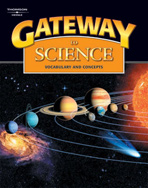 |
|
| Publisher: | Boston: Heinle Cengage | ||
| Pages | ISBN | Price | |
|---|---|---|---|
| Pp. xvii + 279 | 978-1-4240-0331-0 | $46.95 U.S. | |
Tim Collins’ Gateway to Science: Vocabulary and Concepts is a content-based science textbook aimed at helping U.S. ELLs achieve grade-level science standards in preparation for mainstream classes and textbooks. The text uses an instructional design that relies mainly on content-matter learning and vocabulary development to introduce learners to basic science study. Collins uses SIOP (Sheltered Instruction Observation Protocol) and CALLA (Cognitive Academic Language Learning Approach) as his foundation for designing content-based material. The four-unit book takes the learner on a scientific journey that begins with the precepts of the scientific method and continues on with detailed yet comprehensible explanations of over 50 topics, including the human body, the solar system, and electricity and magnetism.
Each unit in Gateway to Science has a balanced collection of lessons (chapters) that cover the standard topics associated with a well-rounded introduction to science:
- Science Basics introduces learners to scientific theory, method, and tools.
- Life Science presents the reader with good biological background information ranging from single-celled organisms to reproduction, genetics, and ecosystems.
- Earth Science covers topics like space, the earth’s structure, weather, and natural resources.
- Physical Science delves into atoms and molecules, chemistry, and forms of energy.
Collins consulted various academics and scientists to ensure solid content was the base for his scientific materials and used his expertise as an ESL professional to make the information accessible to ELLs. This accessibility is achieved through five effective SIOP and CALLA techniques used in every lesson:
- the activation of prior knowledge via focus questions at the beginning of each lesson
- the development of content and academic vocabulary throughout each lesson
- the development of graphic literacy through the use of charts, tables, and graphs
- the introduction of hands-on active learning activities and labs
- frequent comprehension assessments
Collins integrates reading, writing, listening (through an accompanying CD), speaking, and critical thinking skills within each lesson in a comprehensive layout that doesn’t overwhelm the reader with heavy doses of dense reading passages, yet doesn’t over-rely on visuals either. The first two pages of each lesson concentrate on vocabulary and are designed to develop “key vocabulary prior to reading,” which increases the learner’s chances of reading success (p. xvi). Labeled pictures and graphics of concepts found in the readings make sure no stone is left unturned that might help the ELL learn about the topic at hand.
The vocabulary pages begin with a vocabulary list previewing important words that will reappear throughout each chapter. A “Word Study” area highlights different vocabulary skills like word roots, prefixes, suffixes, deriving meaning from context, and multiple-meaning words to help students build their vocabularies. “Focus Questions” show the main idea of each chapter, and students are asked to use the questions and previously learned vocabulary to direct their work during the lesson. A “Vocabulary in Context” section presents new words in a short reading passage to help the reader assimilate new vocabulary. At the end of each vocabulary segment is a “Check Your Understanding” passage that assesses whether or not the reader has absorbed the new information.
The second two pages of each lesson use the previously learned key words to build conceptual knowledge of the specific topic. The reading selection in each chapter presents new information about science and vocabulary while incorporating “Science Skills,” which details the different techniques scientists use in their respective fields. Charts, graphs, pictures, diagrams and lists help learners reinforce key knowledge acquired in the reading. An “Academic Vocabulary” section presents key words often found in ESL and mainstream textbooks. External topics available for study on the internet, in the library, or in other textbooks are presented in the “Research and Inquiry” section, and a “Writing” prompt invites students to begin building their scientific-writing skills.
Although the structure of each lesson does engage the learner systematically with various aspects of language acquisition, the design doesn’t change throughout the text, giving ELLs a familiar layout but not offering much variety. Fortunately for the reader, the wide variety of scientific topics covered throughout the book ensures that almost any ESL student will find something of interest in the book. Each unit progresses from lesson to lesson, topic to topic in a rational order, making skipping lessons potentially disruptive, especially in the Life Science unit where the complexity of the topics increases as the unit advances. The units themselves could be taught in any order, as every lesson in every unit consists of four pages that don’t seem to vary in reading difficulty or language content.
While vocabulary lists in each lesson highlight key words for each topic, little is done to reinforce the use of previously learned words in subsequent chapters. Granted, this would be difficult to accomplish considering the wide breadth of topics covered in the book, but to me the text missed an excellent opportunity to use the content found in subsequent chapters as a base for recycling less topic-specific science vocabulary across topics. Teachers could then easily use such common science words to encourage vocabulary retention through exercises and quizzes. As is, for a book that emphasizes content-based learning to limit the number of times essential science vocabulary is repeated in the text is perhaps the book’s greatest shortcoming. The possible exceptions to this weak link are the vocabulary terms in the “Science Basics” unit, which cover metric units, science tools, and data analysis methods. These items are frequently found throughout the lessons in all units.
The glossary at the end of the textbook offers a complete list of each lesson’s key words complete with definition, part of speech, and reference page. Spanish equivalents are the only translations given for each glossary entry, a big tip-off as to whom this textbook is aimed at: Spanish-speaking ESL students in the U.S educational system. This textbook is mainly for middle and high school students not reading at grade level, but also claims that ELLs at all levels can use the book to acquire language and/or science skills to “succeed in mainstream classrooms or textbooks” (p. xvii). I have even achieved positive results using the book on a limited basis to introduce vocabulary terms to first year college students majoring in science and technology at a Japanese university.
Collins’ textbook is extremely well organized – though perhaps a bit formulaic for some tastes – but when its goals are taken into account, it is quite clear that every aspect of the book was chosen for a valid reason, and the function of each feature achieves its goal. As a science textbook, Gateway to Science builds upon the solid foundations of science provided by the consultants in respective fields who came up with authentic yet accessible examples of native English in the science textbook writing field.
Matthew Rooks
Kwansei Gakuin University, Japan
<mrooks kwansei.ac.jp>
|
© Copyright rests with authors. Please cite TESL-EJ appropriately. Editor’s Note: The HTML version contains no page numbers. Please use the PDF version of this article for citations. |