• Skip to primary navigation
  • Skip to main content

site logo
The Electronic Journal for English as a Second Language
search
  • Home
  • About TESL-EJ
  • Vols. 1-15 (1994-2012)
    • Volume 1
      • Volume 1, Number 1
      • Volume 1, Number 2
      • Volume 1, Number 3
      • Volume 1, Number 4
    • Volume 2
      • Volume 2, Number 1 — March 1996
      • Volume 2, Number 2 — September 1996
      • Volume 2, Number 3 — January 1997
      • Volume 2, Number 4 — June 1997
    • Volume 3
      • Volume 3, Number 1 — November 1997
      • Volume 3, Number 2 — March 1998
      • Volume 3, Number 3 — September 1998
      • Volume 3, Number 4 — January 1999
    • Volume 4
      • Volume 4, Number 1 — July 1999
      • Volume 4, Number 2 — November 1999
      • Volume 4, Number 3 — May 2000
      • Volume 4, Number 4 — December 2000
    • Volume 5
      • Volume 5, Number 1 — April 2001
      • Volume 5, Number 2 — September 2001
      • Volume 5, Number 3 — December 2001
      • Volume 5, Number 4 — March 2002
    • Volume 6
      • Volume 6, Number 1 — June 2002
      • Volume 6, Number 2 — September 2002
      • Volume 6, Number 3 — December 2002
      • Volume 6, Number 4 — March 2003
    • Volume 7
      • Volume 7, Number 1 — June 2003
      • Volume 7, Number 2 — September 2003
      • Volume 7, Number 3 — December 2003
      • Volume 7, Number 4 — March 2004
    • Volume 8
      • Volume 8, Number 1 — June 2004
      • Volume 8, Number 2 — September 2004
      • Volume 8, Number 3 — December 2004
      • Volume 8, Number 4 — March 2005
    • Volume 9
      • Volume 9, Number 1 — June 2005
      • Volume 9, Number 2 — September 2005
      • Volume 9, Number 3 — December 2005
      • Volume 9, Number 4 — March 2006
    • Volume 10
      • Volume 10, Number 1 — June 2006
      • Volume 10, Number 2 — September 2006
      • Volume 10, Number 3 — December 2006
      • Volume 10, Number 4 — March 2007
    • Volume 11
      • Volume 11, Number 1 — June 2007
      • Volume 11, Number 2 — September 2007
      • Volume 11, Number 3 — December 2007
      • Volume 11, Number 4 — March 2008
    • Volume 12
      • Volume 12, Number 1 — June 2008
      • Volume 12, Number 2 — September 2008
      • Volume 12, Number 3 — December 2008
      • Volume 12, Number 4 — March 2009
    • Volume 13
      • Volume 13, Number 1 — June 2009
      • Volume 13, Number 2 — September 2009
      • Volume 13, Number 3 — December 2009
      • Volume 13, Number 4 — March 2010
    • Volume 14
      • Volume 14, Number 1 — June 2010
      • Volume 14, Number 2 – September 2010
      • Volume 14, Number 3 – December 2010
      • Volume 14, Number 4 – March 2011
    • Volume 15
      • Volume 15, Number 1 — June 2011
      • Volume 15, Number 2 — September 2011
      • Volume 15, Number 3 — December 2011
      • Volume 15, Number 4 — March 2012
  • Vols. 16-Current
    • Volume 16
      • Volume 16, Number 1 — June 2012
      • Volume 16, Number 2 — September 2012
      • Volume 16, Number 3 — December 2012
      • Volume 16, Number 4 – March 2013
    • Volume 17
      • Volume 17, Number 1 – May 2013
      • Volume 17, Number 2 – August 2013
      • Volume 17, Number 3 – November 2013
      • Volume 17, Number 4 – February 2014
    • Volume 18
      • Volume 18, Number 1 – May 2014
      • Volume 18, Number 2 – August 2014
      • Volume 18, Number 3 – November 2014
      • Volume 18, Number 4 – February 2015
    • Volume 19
      • Volume 19, Number 1 – May 2015
      • Volume 19, Number 2 – August 2015
      • Volume 19, Number 3 – November 2015
      • Volume 19, Number 4 – February 2016
    • Volume 20
      • Volume 20, Number 1 – May 2016
      • Volume 20, Number 2 – August 2016
      • Volume 20, Number 3 – November 2016
      • Volume 20, Number 4 – February 2017
    • Volume 21
      • Volume 21, Number 1 – May 2017
      • Volume 21, Number 2 – August 2017
      • Volume 21, Number 3 – November 2017
      • Volume 21, Number 4 – February 2018
    • Volume 22
      • Volume 22, Number 1 – May 2018
      • Volume 22, Number 2 – August 2018
      • Volume 22, Number 3 – November 2018
      • Volume 22, Number 4 – February 2019
    • Volume 23
      • Volume 23, Number 1 – May 2019
      • Volume 23, Number 2 – August 2019
      • Volume 23, Number 3 – November 2019
      • Volume 23, Number 4 – February 2020
    • Volume 24
      • Volume 24, Number 1 – May 2020
      • Volume 24, Number 2 – August 2020
      • Volume 24, Number 3 – November 2020
      • Volume 24, Number 4 – February 2021
    • Volume 25
      • Volume 25, Number 1 – May 2021
      • Volume 25, Number 2 – August 2021
      • Volume 25, Number 3 – November 2021
      • Volume 25, Number 4 – February 2022
    • Volume 26
      • Volume 26, Number 1 – May 2022
      • Volume 26, Number 2 – August 2022
      • Volume 26, Number 3 – November 2022
      • Volume 26, Number 4 – February 2023
    • Volume 27
      • Volume 27, Number 1 – May 2023
      • Volume 27, Number 2 – August 2023
      • Volume 27, Number 3 – November 2023
      • Volume 27, Number 4 – February 2024
    • Volume 28
      • Volume 28, Number 1 – May 2024
      • Volume 28, Number 2 – August 2024
      • Volume 28, Number 3 – November 2024
      • Volume 28, Number 4 – February 2025
    • Volume 29
      • Volume 29, Number 1 – May 2025
      • Volume 29, Number 2 – August 2025
      • Volume 29, Number 3 – November 2025
      • Volume 29, Number 4 – February 2026
  • Books
  • How to Submit
    • Submission Info
    • Ethical Standards for Authors and Reviewers
    • TESL-EJ Style Sheet for Authors
    • TESL-EJ Tips for Authors
    • Book Review Policy
    • Media Review Policy
    • TESL-EJ Special issues
    • APA Style Guide
  • Editorial Board
  • Support

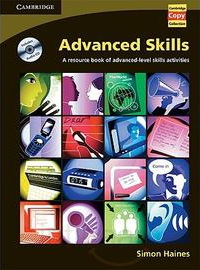
Advanced Skills: A Resource Book of Advanced-Level Skills Activities

June 2009 – Volume 13, Number 1


Advanced Skills: A Resource Book of Advanced-Level Skills Activities

Author:

Simon Haines (2006)

Publisher: Cambridge, UK: Cambridge UP
Pages ISBN Price
pp. x + 139 978-0-521-60848-0 $45 U.S.

Advanced Skills is a recent title in the Cambridge Copy Collection series. This series provides teachers with photocopiable materials to use in their ESL/EFL lessons. There are over 30 titles in the series, and this is the first one to focus exclusively on advanced level students.

Advanced Skills consists of four sections. Each section deals with a different language skill (reading, listening, speaking, and writing). Each of the four sections covers the same nine themes: Dreams, Technology, Work-Life Balance, Relationship, Futures, Emotions, Rights and Wrongs, Narratives, and The Unexpected. Each unit contains teacher’s notes, instructions for using the materials, and answer keys. Each of the 36 lessons (according to the notes in the front of the book) takes approximately 45-60 minutes. A CD and corresponding tapescript comprises the listening exercises. According to the introduction, the book is intended for students “who have completed an upper intermediate general coursebook and/or have passed the Cambridge FCE (First Certificate in English) or an equivalent exam” (p. 8). The author also points out that the material can help students prepare for tasks in the Cambridge CAE or IELTS exams.

Overall, the book is well thought out. The introduction is complemented by a table of contents (referred to as a “map of the book”), which lists skills, key language, and duration of each lesson. Each lesson gives the teacher a great deal of support, including lists of vocabulary to pre-teach, answer keys, and clear instructions for each step of the lessons. Frequent use of drawings and photographs will appeal to visual learners. In addition there is a strong language component in each lesson, such as lists of useful language and collocation exercises.

The author took care to provide pre-reading tasks for the reading lessons. For example, before students read the article “The futile pursuit of happiness,” which describes Harvard professor Daniel Gilbert’s views on happiness, they first discuss a number of quotes about happiness, then reflect on what could make them happier. This interchange among students can help them activate their previous knowledge, making them more prepared to read the article. Similarly, the author also includes warm-up tasks for the listening activities. In “Men’s work,” students complete a chart about the ages at which men and women do things such as starting school, starting work, and getting married, before listening to an interview with a woman who works as a crane operator.

Another strength of this book is the numerous opportunities for personalizing topics. In the speaking lesson titled “Are you a workaholic?” students answer a questionnaire about their work habits, then share their answers with another student. Another example is the reading lesson “Dream on!”, where students are asked to write about their dreams and how they hope to achieve them. Personalizing language learning can be motivating for students, as they are more likely to be interested in expressing themselves than writing about unfamiliar people and topics.

I was also impressed by the inclusion of several intriguing topics, such as exclusive residential areas, traffic calming, and the future relationship of humans and computers. Students tired of talking about shopping, food, and travel will find these a welcome change of pace. These more unusual topics present opportunities for students to talk about a range of thoughts and ideas they hadn’t expressed before.

Although the book is professional and well-written, I had a few problems with it. The introduction is less than a page and a half. It answers four questions: “Who is Advanced Skills for?” “How will Advanced Skills help my students?” “How is Advanced Skills organized?” and “What is the best way to use Advanced Skills in the classroom?” These questions are answered briefly, and some parts are a bit obvious for teachers familiar with teacher resource books, such as the suggestion that teachers “dip into the book from time to time to supplement either a general coursebook or exam practice material” (p. 8). Perhaps the author could have answered additional questions, such as What does second language research have to say about advanced learners? or How do we differentiate between intermediate learners and advanced learners? or What special needs do advanced learners have? Also, he could have provided some tips for teaching advanced students, and given some suggestions for alternative uses for the material. The introduction mentions additional activities contained in the teacher’s notes, but after looking through the book carefully, I noticed such extras in only a few lessons. Perhaps the author could have added some variations or follow-up activities as well. Considering the price of the book, as well as possible photocopying costs, the book could have included more support for the teacher.

Another problem concerns the audio CD. While the voices on the CD provide clear models for advanced level students, as well as a fair assortment of listening texts (speeches, monologues, conversations, and interviews), they represent only British English. I think including several varieties of English would have given the listener a greater challenge, as well as a more appealing mix of voices.

Despite these few shortcomings, Advanced Skills is a well-constructed resource book for teachers of advanced level classes.

Hall Houston
Kainan University, Taiwan
<hallhoustonatmarkyahoo.com>

© Copyright rests with authors. Please cite TESL-EJ appropriately.

Editor’s Note: The HTML version contains no page numbers. Please use the PDF version of this article for citations.

© 1994–2026 TESL-EJ, ISSN 1072-4303
Copyright of articles rests with the authors.