

September 2010 – Volume 14, Number 2
* On the Internet *
Listening Plus: A Social Approach to Learning English Online
Carla Arena
Casa Thomas Jefferson Binational Center, Brazil
<carlaarena gmail.com>
Introduction
The potential that e-learning holds in a learning environment is widely acknowledged. However, some educators in the online community believe that the benefits of using a Learning Management System (LMS) might be reduced due to issues related to ownership of content and considerations about the controlled aspect of “closed” environments—called walled gardens—in which students interact in an institutionally-controlled space that reproduces the predictability of a regular, face-to-face classroom. However, the role of an LMS in an online course doesn’t have to replicate traditional learning transposed to an online environment; it could be a virtual learning space that is a starting point, a road map to guide students and lead them to autonomous, meaningful, connected learning that results in tangible outcomes. Our work demonstrates that an LMS can be matched with Web 2.0 tools to enhance students’ production and enable them to collectively share their findings and their learning paths. Thus ownership, audience, and availability of resources are taken into another dimension not institutionally bound, but collectively appropriated by the students with the facilitative guidance of an e-tutor.
The five-week online EFL course Listening Plus, devised by teachers at Casa Thomas Jefferson, a Binational Center in Brasilia, Brazil, was designed with a student-centered approach in which oral comprehension and production were enhanced through individual work. It was also designed in order not to lose sight of the essential elements in an educational setting of interaction and the group’s sense of belonging. Moodle, the open source LMS, was used to give guidelines and set tasks for the students, as well as to be a central point for communication and interaction within the group (http://thomas.org.br/online/). Moodle was therefore the starting point—the road map for students to take a step forward in their listening skills in English.
The LMS platform could easily have been set up to fall into the same " industrial" approach to education as in a brick and mortar setting with a broadcast model into which the expert-facilitator would supply information allowing students practice their oral skills; they would be recipients of audio files and videos as a way of improving their understanding of the target language. While designing the course, the educators involved in the process made sure this was not the case. Combined with Web tools such as wikis, blogs, Voicethreads, graphic organizers, and slide shows, and the more traditional broadcast media—podcasts and videos—participants in the course could communicate with each other, see each other’s oral and written production, and keep their own content after the course ended. The course had the main goal of improving participants’ oral skills in English by tapping into their diverse learning styles through balancing pre-determined tasks against a number of choices on how to accomplish them, and through a flexible schedule of language practice according to the daily routine of the participants who had decided for an online mode of learning. Plus, thanks to the editing and publishing alternatives for their audio and text files made possible by Web 2.0 tools outside the walled garden of the institutional Moodle, the students were able to learn different technological/digital skills that are a vitally important area of any e-learning endeavor. Thus they gained essential abilities that 21st century students should master in order to succeed in an educational, as well as a professional setting.
EFL e-learning contexts are still in their infancy; teachers and students are in general experimenting with effective parameters that enhance learning through engagement via online connections. An ideal configuration would be a kind of rhizomatic approach to e-learning endeavors in which:
[The] curriculum is not driven by predefined inputs from experts; it is constructed and negotiated in real time by the contributions of those engaged in the learning process. This community acts as the curriculum, spontaneously shaping, constructing, and reconstructing itself and the subject of its learning in the same way that the rhizome responds to changing environmental conditions. (Cormier, 2008)
In practice, students still need some sort of organization to guide their learning process. In the design of the Listening Plus course, despite the affordances of social construction of knowledge and connections within the group, students consistently requested a more guided type of learning to make them feel safer while exploring their online course on listening, which was for many of those students their first formal online learning experience. Ideally, even if students could each determine how they would pursue their own learning goals to improve their oral comprehension skills, most of the Brazilian learners are still raw in terms of institutional online learning environments. The LMS was their safe port as they started navigating the unknown but exciting world of new possibilities on their English learning journey.
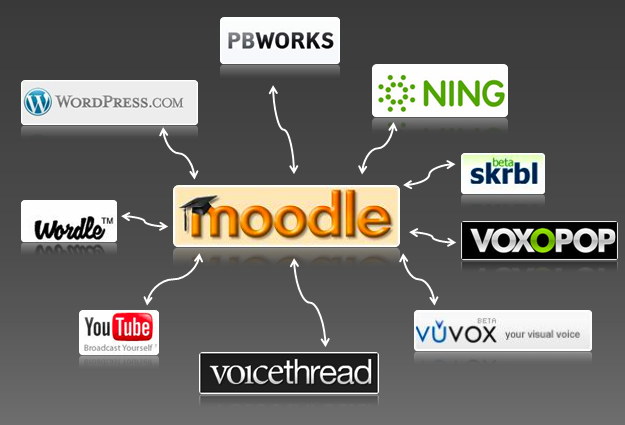
Figure 1. LMS as Center of Learning Experience
This malleable approach to an EFL e-learning context is what Richard Culatta calls a “mash-up LMS/Modular LMS” (Culatta, 2010). Using this approach, our Binational Center could offer a course that was structured according to the students’ needs and adaptable according to the group as it relied not just on a monolithic LMS, but also on web tools that could be used and changed as required, ensuring that the learners would keep their content once the course was over.
According to Culatta (2010):
A mash-up or modularized LMS would have the potential to be both infinitely customizable as well as take advantage of current best-of-breed tools. To distinguish from the traditional LMS, we might refer to this approach as a Modular LMS. In order to understand the idea of a Modular Leaning Management System, it is important to first modify our use of the word “system” (as in Learning Management System). In the legacy LMS paradigm, “system” was synonymous with a single all-encompassing tool or software application made up of a variety of different internal functions. The modular approach shifts the definition of “system” to mean a collection of interoperable items that comprise a learning platform. A Modular LMS applies the model of “loosely coupled systems”, often used to describe educational organizations, to a technical context. Loosely coupled systems are those whose component parts are responsive to each other, but retain their individual identity. In this sense, the parts of a Modular LMS retain their own specialized functionality, but work together to deliver a tailored learning experience.
In fact, the e-learning experience revolved around finding the tools that could facilitate learning while meeting the high standards we were looking for to help learners achieve their personal goals.
The Structure of the Listening Plus Course
The Listening Plus course was initially divided into five lessons of up-to-date topics: generosity, places, people and stereotypes, news around the globe, and a listening practice site a day. These topics aimed to provide participants with a number of e-activities that could enhance the learners’ abilities to better understand the “Englishes” spoken in different parts of the world. However, due to our learners’ interest in continuing longer than five weeks, a new online module was devised with another range of topics: learning a foreign language, beliefs, the workplace, the slow movement, and a how-to series. Though the learners were there to focus on their listening skills, all the lessons were set in such a way as to make the students feel a part of a learning community in which they would have the chance to communicate, collaborate, and share their findings and productions. Not only was oral production fostered by the use of web tools, such as Skype (http://skype.com), Voicethread (http://voicethread.com), Voxopop (http://voxopop.com), and Evoca (http://evoca.com—now a paid voice platform), but also they were also highly encouraged to write in the class blog, forums, and text chats.
Another element that permeated the course social architecture was the idea that the learners needed more than just topics and language practice. They needed to develop new digital skills that would help them keep on their learning path even when the course was over. So, besides getting ample language practice, they learned about bookmarking their online resources in social bookmarking platforms, such as Delicious (http://delicious.com). They learned what podcasts were and how to download them to their computers and mp3 players (http://e-learningctj.bloxi.jp/week-5/). Writing in forums and blogs, and even Skyping, were all first-time experiences for them. There were many challenges at first, but this experience was rich in opportunities to go beyond their knowledge, not only in terms of language, but also in using the tools that could take them to the next level in their language learning process. Another aspect of the course was the balance of asynchronous interactions and weekly synchronous get-togethers. The group had the chance to meet online in Skype, and sometimes in Elluminate (http://elluminate.com), a web conferencing platform. Besides eagerly practicing English, the learners were also interested in interacting, getting to know each other, and understanding at a deeper level the tools they were using to learn the target language. Another addition to the course was having international guests in order to show learners English being used authentically as a powerful connective means of communicating to people around the globe. Thus, in these real-time activities, the students had the chance to meet and talk to those international guests with whom they had interacted in the class blog and forums.

Figure 2. Voicethread Example
Web 2.0 and Learning Outcomes
A learning tool is nothing more than a tool, and it is only effective if it serves a specific pedagogical purpose in promoting language learning through conversations and connections. That’s exactly where the power of the Web 2.0 tools lie. Used as a means to promote optimum levels of interaction and learners’ production, these emergent tools have proven to be of invaluable support to online classes. A clear example in the Listening Plus course of how the use of digital tools that promote interaction can considerably affect learning outcomes was the combination of a blog, a Youtube video, and a Voicethread about love stories around the globe. First, the students had the video input. They listened to a story about how a woman met her husband. Then, they read a blog post on the same topic from their online tutor (http://e-learningctj.bloxi.jp/a/how-we-met-each-other/). The learners took such delight in feeling so closely related to those stories that when they were invited to add their own stories to the blog, they felt compelled to do so.
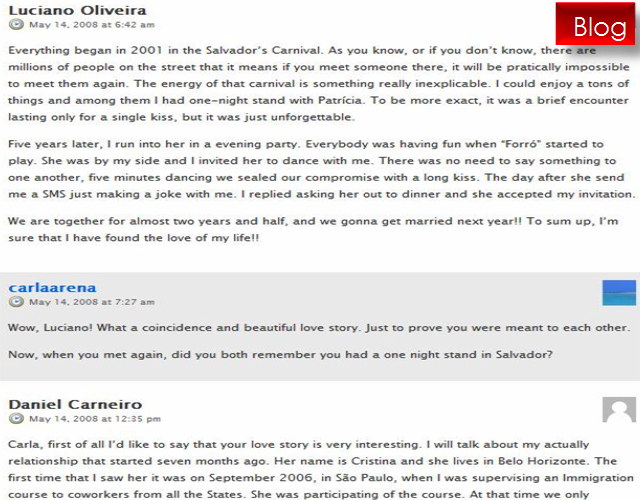
Figure 3. Blog Story Interactions
After following the conversations that took place around the blog posts, the students listened and contributed to a Voicethread that allowed them to express their interest in the stories. The e-tutor had invited international friends to tell their own romantic stories, so the result was a patchwork quilt of passionate accounts of people from all over the globe, including those of the students. After all those deep ties the group developed their skills in English because of a topic to which they felt instantly connected, using the tools that promoted those genuine interactions. The students wrapped up the theme-based week by collectively creating a glossary in Moodle. Conclusion Who other than the students themselves to better evaluate the effectiveness of this balance between a Learning Management System, Web 2.0 tools, and the students’ own needs and interests we’d been trying to cater to from the start of our online endeavor? From their feedback at the end of the course, it seems that our good intentions of providing the best pedagogy immersed in an online environment of camaraderie, choices, intensive language learning, acquisition of learning strategies, and mastery of technical skills have been paying off. The positive feedback at the end of the Listening Plus course included statements such as:
- “I liked e-learning course because you feel free to listen and read whenever you want, but mainly it gives us the opportunity to talk with other students.”
- “I loved this online course. It was amazing and very helpful. I strongly believe that it is a complete course that I would recommend to everyone.”
- “It was very, very useful to my knowledge the use of the bookmarks and the podcasts. And also the site Voice of America.”
- “One more time, I loved our course. The Listening Course was an excellent tool to practice and improve my English. We connected, interacted, listened, spoke, wrote and in my case learned lot about Internet and computer.”
The students’ perceptions meet exactly what we had in mind when the Listening Plus course was devised—promoting learning through interactions that were meaningful and contextualized, made possible by the combination of tools to make our learners feel safe, using the Moodle LMS, but combined with other second generation web tools that carried so many possibilities of significant communication within the group and with the world. Helping students to turn themselves into lifelong learners has also been a goal of the course. Although it’s early for us to gather data on lifelong learning, we hope that we have at least partially succeeded in that. Our study suggests that we in the educational community should focus more on the ways we can give support to students to become multiliterate as opposed to focusing on the tools themselves. Through our example we see that such tools only have meaning through the social use learners give them.
References
Cormier, D. (2008). Rhizomatic education: Community as curriculum. Innovate 4(5). Retrieved September 3, 2010 from http://www.innovateonline.info/index.php?view=article&id=550.
Culatta, R. (2010). The traditional LMS is dead: Looking to a modularized future. Innovative Learning. Retrieved September 3, 2010 from http://www.innovative-learning.com/learning_management/modular-lms.html.
About the Author
Carla Arena is a Brazilian EFL teacher who has been exploring the potential of technology integration into language learning since 1997. She is a teacher trainer and Educational Technology Supervisor at Casa Thomas Jefferson, a Binational Center in Brasilia. She teaches online courses and gives support to a group of e-tutors. She’s part of the TESOL CALL-IS’s Electronic Village Online (EVO) Coordinating Team [http://evosessions.pbworks.com/Coordination-Team/] and has been co-moderating EVO online sessions for educators all over the globe for the past few years. She’s a blogging fan (or addict!) and enthusiastic Webhead [http://groups.yahoo.com/group/evonline2002_webheads/]. Carla blogs at http://collablogatorium.blogspot.com and tweets at http://twitter.com/carlaarena/.
|
© Copyright rests with authors. Please cite TESL-EJ appropriately.
Editor’s Note: The HTML version contains no page numbers. Please use the PDF version of this article for citations. |