

June 2012 – Volume 16, Number 1
Teaching Literacy for Love and Wisdom: Being the Book and Being the Change |
|||
| Author: | Jeffery D. Wilhelm & Bruce Novak (2011) | 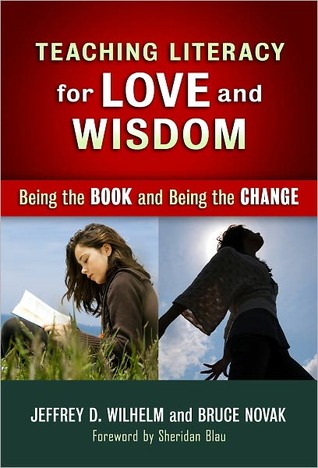 |
|
| Publisher: | Teachers College Press | ||
| Pages | ISBN | Price | |
|---|---|---|---|
| 253 pages | 978-0-8077-5236-4 | $27.95 USD | |
In Teaching Literacy for Love and Wisdom: Being the Book and Being the Change, authors Jeffrey Wilhelm and Bruce Novak present a compelling defense for the transformative power of literature. This inspiring book calls us to remember literature’s unique ability to confer humanizing wisdom, and it challenges us to enact practices in our lives and classrooms that utilize its life-changing power. Wilhelm and Novak integrate ideas from philosophy, science, history, and education to establish the central role of literature as a source of wisdom able to inform the way we live and guide us into a hopeful future. Although it is primarily directed toward Language Arts teachers, the book is a good read for all teachers and readers, alike.
The book is divided into three sections. In Part 1, “What Is ‘English’?” Wilhelm and Novak present a brief modern history of the discipline of “English” or Language Arts. They trace the changes in the purposes of English within the profession from 1921 to the present. They identify three primary agendas proposed by English professionals; “language for national unity”, “language for personal growth”, and “democracy through language.” Wilhelm and Novak use the remainder of Part 1 to uncover the deficits of the stated agendas in order to arrive at a fuller and deeper understanding of the purpose of “English.” They claim that “English” isn’t fundamentally about language, but about the meaning of human life; Literature and literacy are, in fact, the conduits of human wisdom from the past, to the present, and into the future.
Wilhelm and Novak give a balanced and insightful critique of the two agendas that currently dominate the discipline of language arts:
According to a distinguished international symposium at the 2010 meeting of the American Educational Research Association, entitled “Curriculum Theory: Dead Man Walking?” (Westbury et al.) pointed out that there are now basically only two schools of thinking about the nature of what is taught in schools; a radically conservative one coming from government, concerned almost totally with the implementation of mindless standardization and accountability; and a radically subversive one coming from universities concerned almost totally with the sophisticated critical theory undermining the same standardization and accountability, but having negligible impact on actual schools. Blind power exerted by truly powerful forces on the one hand; trenchant but powerless criticism, emptily endorsed by the highest intellectual powers-that-be on the other. (p. 52)
The authors state that neither extreme is beneficial. While the former is the source of what is “deadening in education,” critical theory seeks to supplant deadening standardization, especially in the forms of social and political domination, only with “highly intelligent forms of anarchy.” Neither agenda results in a pedagogy that brings forth more meaning and more life.
In Part II, “The Way Life Teaches: Revisiting the Three Dimensions of Aesthetic, Transactional Responsiveness,” Wilhelm and Novak walk us through the three dimensions of “story time,” or teacher/student encounters with literature. First, they describe the process of leading students to “enter into” a book – the evocative dimension of literature. The evocative dimension includes pre-reading activities “designed to evoke students’ lives in ways that will help make their reading come alive for them” and prepare them to successfully negotiate any challenges of the text. This section is full of excellent examples of classroom activities. Of particular note are the “frontloading” activities that, among other things, develop student motivation by developing student competence and focus on the pleasure of reading before critically analyzing the text.
Next, Wilhelm and Novak explain how to enable students to personally learn from the book and respond to the author as a type of mentor – the connective dimension. They elicit the sense of an almost spiritual connection between the reader and the author via the text, or transitional object, “It is not just the flow of life evoked by immersion in the story world, but also the flow of life from one person to others through the story world that art evokes” (p. 98).
Finally, they describe the requisite process of guiding students to revise and elaborate upon what they’ve learned in personally meaningful ways in order to “take new responsibility, to somehow live more artfully and meaningfully in the real world”—the reflective dimension. This section provides a variety of activities designed to develop reflection as a “habit of heart and mind”. Novak gives examples of how he used re-creation assignments in addition to essays as responses to literature. For example, rather than assign an essay, he asked his class to write a parody of Anna Karenina, set in their high school around the upcoming Homecoming Dance. Novak believes that narrative assignments have the power to stimulate deeper thought than traditional argumentative assignments. Wilhelm and Novak summarize the three dimensions of story time as, “The intensely personal is connected intimately to the material at hand, and this is connected back to the world. The interconnectedness and interdependence of the self, text, and world is explored and highlighted” (p. 78).
In Part 3, “Reading beyond the Book: Moving from a Transactional Worldview to a Transactional World,” Wilhelm and Novak explore the larger implications of cultivating wisdom through literature. They describe the potentialities open to teachers, communities, and individuals who adopt a wisdom seeking approach to reading. Any teacher, no matter her discipline, will be affirmed by the authors’ description of the role and importance of the teacher.
Teaching – real, humane, vital teaching which, of course, doesn’t just occur in classrooms—could be considered the literature of life. All of us, insofar as we are aware of our lives transacting with others around us for mutual benefit, are teachers and learners.… The fundamental fact about teaching, considered transactionally, is that we are ourselves personal figures in the dramas of our students’ lives, and the way we play the parts we are given in those lives may make all the difference to them. (pp. 149-150)
For someone like me who is neither trained in philosophy or literature, Part 1 may be difficult to read. Wilhelm and Novak draw heavily from philosophers and leaders in the field of Language Arts education to build their defense, but it is worth the mental effort to labor through their arguments. You will be rewarded in the end with dozens of classroom anecdotes and illustrations that will illuminate their philosophical points.
Although I do not teach Language Arts (I teach English as a Second Language at the post-secondary level), I found the defense of literature to be personally invigorating. If a book or author has ever “spoken to you,” the truths in this book will resonate as well. As a teacher, however, my primary take away from the book was a renewed passion and vision for the possibilities of what it means to be teacher. Teaching Literacy for Love and Wisdom: Being the Book and Being the Change is a book every teacher should read.
Reviewed by
Corie Crouch
English Language Training Institute, University of North Carolina Charlotte
<ccrouch1 uncc.edu>
| © Copyright rests with authors. Please cite TESL-EJ appropriately.Editor’s Note: The HTML version contains no page numbers. Please use the PDF version of this article for citations. |