

February 2017 – Volume 20, Number 4
Q: Skills for Success – Listening and Speaking 3 (Second Edition) |
|||
| Author: | Miles Craven & Kristin Donnalley Sherman (2015) | 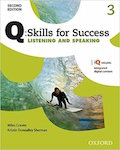 |
|
| Publisher: | Oxford University Press | ||
| Pages | ISBN-13 | Price | |
|---|---|---|---|
| 202 pages | 978-0-19-481904-6 | $60.25 USD | |
Listening and speaking abilities are an indispensable aspect of second language proficiency. These two skills are commonly interconnected in real life, so English language learners need a lot of practice when the skills are integrated (Murphy, 1991). It is important to use authentic teaching materials that merge listening and speaking. The Q: Skills for Success (Second Edition) – Listening and Speaking strand offers all the necessary instruments for integrated instruction, and it is a research-based textbook designed for adults and young adults who study English for academic purposes. Level three is the fourth out of six books, and it correlates with B1 on CEFR (Common European Framework of Reference; Council of Europe, 2001). Engaging unit topics and question-centered approach provoke critical thinking in order to prepare students for mainstream university classes conducted in English. The book has the right number of bright pictures to make it colorful while not distracting students from the learning process.
The set of student materials is available as a Student Book, Split Edition Student Book (A and B), and as an E-book. Each student book has a code for iQ Online, which provides yearly access to audios, videos, games, discussion board, and supplementary interactive activities with instant feedback. Students can also download graphic organizers and video transcripts as well as track their progress using iQ Online. The interface of the online tool is user-friendly, but if questions arise, the program offers help documents in English, Spanish, Arabic, Korean, Chinese, Turkish, and Japanese.
This edition of the book has supplemental materials for instructors, who can use the same book paired up with iTools (provided on a USB stick) and a teacher access to iQ Online. The Teacher’s code for iQ Online provides additional resources such as tests, communicative grammar worksheets, and a teacher’s handbook. The iQ Online website allows teachers to give tests, track students’ progress, and print out reports. Tests include a placement test, a midterm, a final, and two tests per unit, all of which can be given either online or downloaded, edited, and printed. The Teacher’s Handbook has expansion activities, multilevel options, background notes, skill notes, rubrics, answer keys, and tips for using the book and the discussion board. The other teacher resource, USB iTools, enables instructors to present book material to the entire class using either a projector or an interactive board.
The book is divided into eight units discussing topics from sociology, marketing, economics, psychology, philosophy, and nutritional and behavioral science. Each unit includes two parts: Listening and speaking, which are introduced with a preview and concluded with a reflection. Inside these two parts there are particular sections featuring vocabulary, grammar, note-taking, and pronunciation as well as specific listening and speaking skills. These sections are not always introduced in the same order, which gives a sense of novelty to units. The preview part, which is essential to building critical thinking skills, is called Unit Question. It has from five to six activities to help students to become familiar with the topic and brainstorm ideas. The activities include introductory questions, discussion questions based on an audio, and other activities such as proverbs, checklists, and questionnaires. Moreover, the book invites students to share their opinions on the Online Discussion Board. A clearly stated unit objective is given on the second page of every unit, which helps familiarize students with the focus of the unit.
The Listening part has two major audio recordings and an authentic video from the British Broadcasting Corporation or Columbia Broadcasting System. The audios for this book include lectures, presentations, seminars, and other forms of spoken academic language. Each listening has several written and oral exercises for pre-, during, and post-listening, which can be done individually, in pairs, or groups. These activities aim to help students to comprehend main ideas, details, and make inferences. The activities also emphasize note-taking while listening and allow integrating listening and speaking by providing questions, which enable students to share their opinions. Moreover, explicit information on various listening skills is provided, for instance, how to focus attention on specific information such as examples, numbers, or time markers. The book helps future university students acquire a very important skill that is the ability to synthesize information from different sources. Learners have several tasks where they integrate information from an audio with information from a short reading passage or a video. Every listening part has a specific structure, but at the same time, the activities are not identical and vary slightly in each unit, which enhances students’ motivation and does not allow them to get bored.
Q: Skills for Success 3 – Listening and Speaking has specific sections that give explicit information about a skill and then provide activities to practice using it. Such sections are: Note-Taking Skill, Vocabulary Skill (which are part of the Listening section), and Grammar, Pronunciation, and Speaking Skill (which are part of the Speaking section). Note-taking techniques focus on using and organizing notes to summarize a listening or a short reading utilizing mind maps, charts, and Venn diagrams. Vocabulary Skill explains how to use one particular vocabulary feature such as suffixes, adjective-noun collocations, or word families. Vocabulary lists that accompany the first and second audios correlate to CEFR, Oxford 3000, and Academic Word List. Grammar describes the usage of tag questions, modals of attitude, or gerunds followed by exercises. Pronunciation covers the suprasegmental level, giving information on contractions and intonation. In the Speaking Skill, students learn some specific skills, for example, how to ask for or give a clarification, agree, or disagree. Each section is followed by exercises, and iQ Online has more additional activities for interactive practice.
At the end of each unit, there is a unit assignment that is a comprehensive speaking activity done in four steps: consider, gather, organize ideas, and speak. Students can record their answers at home using iQ online, and teachers can listen to them and provide written feedback. In the classroom, unit assignments can be used as either class discussions or presentations. This assignment is followed by a reflection stage where students review vocabulary and skills learned in the unit and perform a self-assessment using a checklist or online discussion board. Students who learn English come from various cultures, which is why it is so important to teach pragmatics in the classroom (Hinkel, 2013). While pragmatics is not explicitly addressed in every unit, small tips addressing pragmatics can be seen throughout the book such as giving learners advice how to maintain eye-contact or use back-channeling.
Overall, the book effectively demonstrates how to integrate listening and speaking, which is its strength. For instance, besides comprehension and gap filling tasks, activities for audio and video have discussion questions; and similarly, speaking exercises are based on audio materials. Another strong point is the amount of the information and materials for teachers and students; however, this may appear to be a weakness because all the units cannot be covered in one semester of instruction. In addition, this book does not expose learners to a variety of World Englishes because different accents and dialects are not included. Another limitation of the book is its dependence on modern technology: All the media and teacher materials should be accessed online, which requires specific skills, electronic devices, and access to the Internet. Accessing these resources can become a problem for the classrooms that are not equipped with technology or for some teachers who do not feel comfortable using computers. On the other hand, the availability of online materials can be engaging for students and enhance their motivation for learning. In sum, Q: Skills for Success 3 – Listening and Speaking is a great book with a variety of interesting activities and authentic media.
References
Council of Europe (2001). Common European framework of reference for languages: Learning, teaching, assessment. Retrieved from: http://www.coe.int/t/dg4/education/elp/elp-reg/Source/Key_reference/CEFR_EN.pdf
Flowerdew, J., & Miller, L. (2013). Dimensions of academic listening. In M. Celce-Murcia (Ed.), Teaching English as a second or foreign language, fourth edition (pp. 90-103). Boston: Heinle ELT.
Hinkel, E. (2013). Culture and pragmatics in language teaching and learning. In M. Celce-Murcia (Ed.), Teaching English as a second or foreign language, fourth edition (pp. 394-409). Boston: Heinle ELT.
Murphy, J.M. (1991). Oral communication in TESOL: Integrating speaking, listening, and pronunciation. TESOL Quarterly, 25(1), 51-75.
Reviewed by
Valeriia Bogorevich
Northern Arizona University, Flagstaff, AZ, USA
<vb283 nau.edu>
| © Copyright rests with authors. Please cite TESL-EJ appropriately. Editor’s Note: The HTML version contains no page numbers. Please use the PDF version of this article for citations. |