

Vol. 8. No. 1 — June 2004
Real English Online (REO)
 |
||
| Title | Real English Online (REO): The web site and community | |
| Product Type | Website with videos & interactive exercises Online community of teachers and learners |
|
| Platform | Windows, Macintosh | |
| Minimum System Requirements:   | Mac or PC Netscape or Internet Explorer 56K Modem (Cable or DSL preferred) Basic Real One Player |
|
| Subscriptions | REO – free subscription; Gold Pass & Gold Pass for Teachers: $179 USD per year; “Coupons” (as regular promotions): $89 USD per year. |
|
| Contact | Real English L.L.C. – http://www.real-english.com/ The Marzio School – http://www.realenglish.tm.fr Email: Mike Marzio mike@realenglish.com |
|
Background
Readers may be acquainted with the Real English CD-ROMs (and DVDs, from a more recent date) when these materials were reviewed by several other authors (Sokolik, 1999; Morales, 1999; Tatsumi, 2001). However, now the Real English Online (REO) authoring team has put together a web site allowing access to the videos and lessons via three modes of delivery: Free Access, fee-based Gold Pass for Learners, and fee-based Gold Pass for Teachers. In addition, a vibrant guidance and support Yahoo Group[1] has been created for the growing community of users (647 members to date).
Web Site Interface
A very colorful page welcomes the visitor to the REO web site, which is easy to navigate and contains all the necessary information for visitors. The site is lively and attractive for youthful learners. The designer or webmaster might be wise, however, to check the site on usability criteria, especially those formulated out of concern with access to the Internet by visually impaired people.
Videos
Together with the community of users (more about this later in the review) the videos are arguably the main and most valuable assets of the Real English Online program.
What is special about the videos? Unlike the majority of listening materials found in other courses, these videos excel in authenticity and freshness. “Real people” are randomly met and addressed in the street, and spontaneously answer questions posed to them by the interviewers. The interviews are therefore unscripted to a large extent. There is some indirect scripting, or rather prompting, in the questions the interviewer asks, because they are meant to invoke responses containing the target grammatical or idiomatic forms relevant to the themes that structure the range of videos. Apart from this thematic arrangement, the videos are created for different learner levels: beginner, pre-intermediate, intermediate, upper-intermediate and advanced. The grammar contained in the language advances with each level in a way which is consistent with traditional structural approaches to language learning (from simple to complex structures).
Pedagogical Considerations and Classroom Use
The use of authentic language of a varied nature is a real bonus for language learners, especially so for EFL students who often do not have the chance to listen to native speakers actually speak English. In Second Language Acquisition (SLA) literature, exposure to authentic language is generally considered to be a crucial element in the language learning process. Exposure to a variety of accents, also provided in the videos, is important in a world where teachers should prepare their students to learn English as a global language. Seen in this light, the ratio of provided American accents (85% of the speakers) to the accents of the ‘rest of the world’ (15%) might be redressed.
 |
 |
Figure 1
Besides their main function—increasing and refining learners’ listening comprehension – the videos can also serve well as starter materials for discussions of cultural and social issues. There are, for instance, a couple of videos about nationalities, “Five Nationalities – What are the Germans / Italians / French / Americans / British like?”. These are an excellent resource for a discussion of the stereotypes we often use when talking about people of other nationalities. Using the videos in this way, too, might well increase their value as scene-setting and input for communicative language learning activities.
Technical Considerations
The audio quality of the videos is very good; needless to say this is extremely important in language learning materials. The videos can be viewed in “streaming mode”, but can also be downloaded for easy use–this is the preferred choice as it prevents problems from occurring during presentation due to Internet congestion and downloading interferences. For the sake of user-friendliness, the authoring team might consider bundling some videos that go together (e.g. based on level).
Additional Materials: Interactive lessons and exercises
The lesson accompanying each video consists of a number of interactive exercises developed with Hot Potatoes [2] software. These exercises are meant to check comprehension of the language in the video and they do that well via gap-fill, multiple choice and matching exercises. However, the exercises provide ‘wrong’ or ‘right’ feedback without specifying the nature of the mistake when the answer is ‘wrong’. An ill-placed letter or comma renders a sentence “wrong”, even if the content of the response is quite correct. But even more problematic is the fact that these types of exercises, not unlike those from the audiolingual school, do not engage the learners in any meaningful or communicative language use. Just like the videos (through offering authentic language), these exercises could do with some more contextualization; the lessons would benefit from activities that enable the learners to both use the language and be productive.
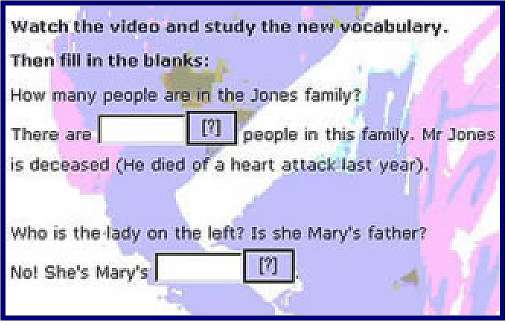
Figure 2
Learners who feel that repeating structures and idiomatic phrases are the best way to learn a language may benefit from the lessons more than learners who believe they have to use the language in a meaningful context right from the start. As they stand, the videos offer enough cues for further imagined contextualization, beyond what the footage actually shows. If that challenge is exploited (by teachers and learners), there are many opportunities for enriching post-viewing activities.
Real English Online also provides other services such as vocational customized training modules for entry-level workers, special support activities for institutions (e.g. chat-based tutorials with online teachers), and the Real English e-newsletter, E-SLANG.
Online Community of Teachers and Learners
The Real English Online team have created a Yahoo Group for English teachers and learners worldwide. The group is moderated by Mike Marzio, one of the partners of REO, and Elizabeth Hanson-Smith, an expert in Computer-Assisted Language Learning (CALL) and Computer-Mediated Communication (CMC). The purpose of the group is threefold:
- “to promote the best use of the REO videos and lessons.”
- “to help teachers create their own exercises using Hot Potatoes and other online exercise creators.”
- “to guide and help students while learning with the REO resources.”
Communication takes place asynchronously through the distribution list of the Yahoo Group (via email and posted bulletin board messages) and synchronously in frequent chat sessions using Yahoo Messenger [3]or Tapped In[4]. Members learn and work collaboratively by answering each other’s questions and sharing the materials they produce. The messages deal with both technological and pedagogical issues regarding the use of the videos and lessons. This community may be a good place to start for those who want to get the most out of the REO materials.
Conclusion
The Real English Online materials are a great resource for English language teachers and learners who want to supplement and infuse their own courses or units of instruction with lively and authentic videos. They are ideal materials for learners to train and refine their listening comprehension, and become more aware of specific language points–in line with the SLA “noticing hypothesis” (Schmidt, 1995). Training can be achieved through independent self-instruction, but if the materials are part of group work, so much the better. If they are used in a creative manner, the videos can be the starting point of meaningful and communicative language use among a group of learners.
One of the authors of this review integrated two of the videos into an online video-chat unit[5] for intermediate-level university students. The videos and lessons were supplemented with extra activities:
- after-viewing chat sessions
- story writing based on the videos
- writing reflections on the usefulness of the exercises
An anonymous survey completed afterwards revealed that most students preferred the above-mentioned added activities to the exercises provided in the unit lessons. However, they still found both videos very helpful for refining their listening skills.
Notes
[1] REO Yahoo Group. Yahoo! Inc. http://groups.yahoo.com/group/Real_English_Online/.
[2] HotPotatoes. Half-Baked Software. http://web.uvic.ca/hrd/halfbaked/.
[3] Yahoo Messenger. Yahoo! Inc. http://messenger.yahoo.com/ .
[4] Tapped In. SRI International. http://www.tappedin.org/new.
[5] Video-chat unit. Dafne Gonzalez. http://dafnegon.tripod.com/videochat/videochat-unit.htm.
References
Morales, M. (1999). Real English Interactive Level 1 Version 2.0. CALICO Software Review. Retrieved May 2004, from http://www.calico.org/CALICO_Review/review/realeng00.htm
Schmidt, R. (1995). Consciousness and foreign language learning: A tutorial on the role of attention and awareness. In R. Schmidt (Ed.), Attention and awareness in foreign language teaching and learning (Technical Report No. 9) (pp. 1-64). Honolulu: University of Hawai’i at Manoa.
Sokolik, M. (1999). Real English Review. CALL Chorus. Retrieved May 2004, from http://www-writing.berkeley.edu/chorus/call/reviews/real_english/index.html
Tatsumi, T. (2001). Review of Real English. Language Learning & Technology. Vol. 5, No. 1, January 2001, pp. 37-45. Retrieved May 2004, from http://llt.msu.edu/vol5num1/review2/default.html
About the Reviewers
Dafne González is a member of TESOL’s Technology Advisory Committee (TAC), and part of the TESOL Electronic Village Online Coordination Team. She is an active member of the “Webheads in Action” online community, and has experience with online and blended teaching; her PhD dissertation concerned e-course design and evaluation.
Dafne González
EST/ESP Associate professor
Universidad Simon Bolivar,
Caracas, Venezuela
<dygonza@yahoo.com>
Arnold Mühren has taught English at the secondary and tertiary levels; currently he freelances as an e-learning designer and adviser. He has a Master’s degree in Open and Distance Education (OU UK), and is an online tutor for the University of London’s Institute of Education for their Certificate of Online Education and Training.
Arnold Mühren
e-Learning Designer & Adviser
Alkmaar, The Netherlands
<amuhren@planet.nl >
|
© Copyright rests with authors. Please cite TESL-EJ appropriately. Editor’s Note: Dashed numbers in square brackets indicate the end of each page for purposes of citation.. |