

December 2005 – Volume 9, Number 3
| Title: | Understanding and Using English Grammar: Interactive | 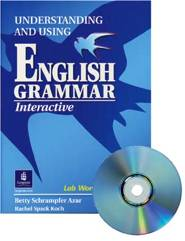 |
| Authors | Azar, Betty Schrampfer and Koch, Rachel Spack | |
| Contact information | http://www.altaesl.com/Detail.cfm?CatalogID=11920& | |
| Minimum system requirements and plug-ins | Windows 98/XP/2000 with Service Pack 2 or Windows NT 4.0 with Service Pack 5 Pentium II processor 400+ MHz 128 + MB RAM (256 MB recommended) 16-bit graphics card 800 x 600 monitor resolution or higher Sound card, microphone, and speakers (mics plugged into USB are not supported), 10X CD-ROM drive Floppy disc drive (for saving student data) Internet Explorer 5.5 (or higher) |
|
| Price | Single user: $209.95; Network version: $5,028.95 (US) | |
| ISBN | CDROM program: 0-13-110109-9; Network version: 0-13-191572-X; Single user CDROM: 0-13-191641-6 |
|
Short description
Based on the series of grammar books with the same title, Understanding and Using English Grammar: Interactive is a CD-ROM computer program designed to teach grammar patterns to upper-intermediate to advanced learners.
The package
The package includes a CD-ROM and an Access File which is delivered upon purchase as a license to run the program. The CD-ROM contains a PDF orientation file that explains the technical steps of running the program, ranging from how to set up one’s microphone to how to navigate and make good use of the program’s features. This file can be printed and used as a reference until the user gets used to using the program. There is also a Help page within the software that provides further help, while additional answers can be found in the FAQ (frequently asked questions) section dealing with potential technical problems. The publisher’s website provides free teacher support, as well as online PDF documents such as detailed descriptions of the content of the program and synopses of units. These can be found at http://www.longman.com/ae/multimedia/pdf/UUEGI_scope_seq.pdf . In addition, an online guided tour, with sound and images describing what the CD-ROM offers in terms of content and exercises, is available at http://www.longman.com/ae/multimedia/tours/index.htm.
Overview of the contents
The content consists of an introductory chapter which reviews verb tenses, and nineteen other chapters, each of which deals with a specific grammar point (see Figure 1). There are five more chapters that deal with basic grammar terminology, questions, contractions, negatives, and prepositions. Clicking the “+” preceding each chapter title expands the chapter to show the sub-points (see Figure 2).
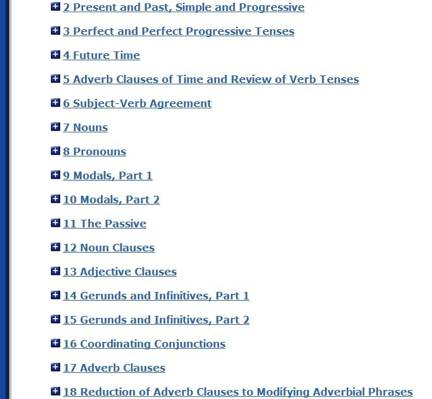
Figure 1: Course Outline
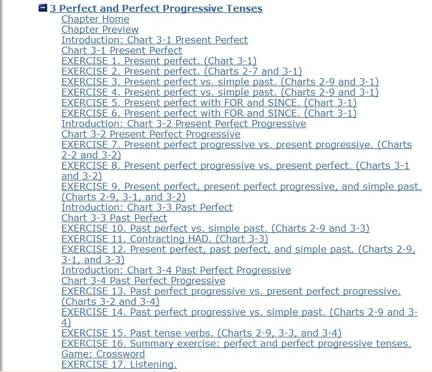
Figure 2: Detailed contents of a chapter
Each of the chapters consists of eight main components:
- Chapter Home, which contains a cartoon character that identifies the grammar point at hand and provides an introduction to that point (see Figure 3; rolling over colored text causes explanations to appear)
- Chapter Overview, in which two cartoon characters contextualize the grammar point in a dialogue (see Figure 4)
- Introduction, which features another cartoon character that explains the target grammar point (see Figure 5)
- A Chart, which visually summarizes the different points given in the previous components (see Figure 6)
- Exercises related to the explanations provided by the cartoon characters and the chart
- A Game, which is either a game of concentration or a crossword puzzle
- Exercises that are based on reading/listening activities
- Tests, whose records the user can choose to keep in a floppy disc so as to check her/his progress.

Figure 3: Chapter Home
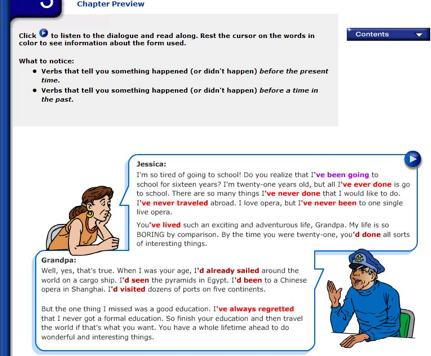
Figure 4: Chapter Preview
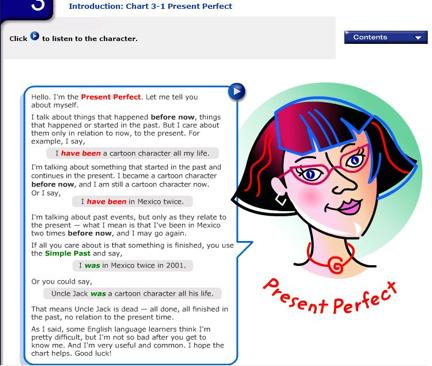
Figure 5: Chapter Introduction
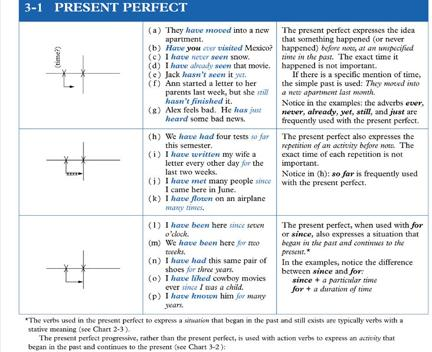
Figure 6: Chart
A typical lesson within a chapter includes four major steps: Presentation, practice, production, and evaluation. The presentation stage is provided by the cartoon characters and the chart (see Figures 3 to 6 above). Users can refer to the explanations given at this stage at any point of their practice using the hyperlinks available in each page of exercises (see Figure 7). Although the Chart hyperlink displays the chart using a pop-up window that can be closed after use, the Content hyperlink changes the page and therefore may interrupt navigation.
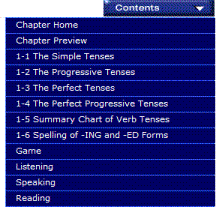
Figure 7: Intra-chapter links
The practice stage includes various exercises, such as drag-and-drop exercises, fill-in-the-blank exercises, and selection/editing exercises. This last type of exercise makes use of multiple choice questions in which the user is asked to double click on the wrong item and type in the correct version (see Figure 8).
After completing each exercise, the user can check her/his answers and either go on or retry the exercise. Apart from the tests, in which there is no possibility of a second chance because the correct answers are provided, users are given a second chance to try to find the correct answer, or to check why their answer was wrong (such as in the case of true/false exercises).
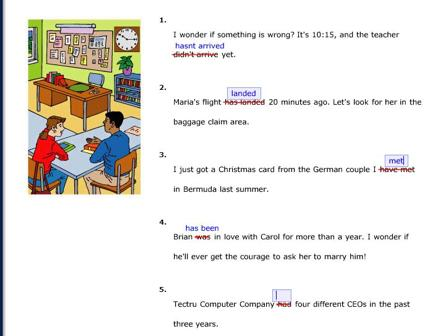
Figure 8: Editing exercise
Some exercises integrate different skills such as reading, listening, and speaking in order to give learners further opportunities to work with the structure. In order to allow learners to concentrate most on the target grammar point, reading passages have hyperlinks to a glossary that explains words deemed to be potentially problematic. Similarly, most of the listening activities have a hyperlink to a pop-up window that contains the transcript and links from the transcript to the glossary. These glossed materials will help to keep the user’s motivation high especially as the target structures occur within meaningful contexts.
The production stage consists of reacting to written and/or oral prompts. Users are given opportunities to work out their answers using the target structure and check their performance against the provided model answer. In the speaking activities, they can record their voices and compare the recordings to a model.
Evaluation comes towards the end of each chapter and contains twenty multiple-choice questions. After having finished each test, the user can check her/his score (see Figure 9) and see the correction of any wrong answers. Explanations of why answers are either correct or incorrect are provided in pop-ups. Users can also save their records and check their progress over time and across chapters.
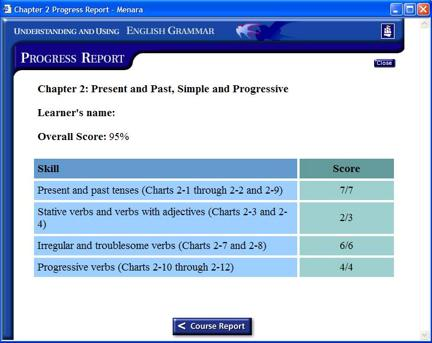
Figure 9: Scores of Test 1
The description of the program, as elaborated so far, suggests that it is a varied and rich resource with relevant content. However, the underlying methodology of the program also must be considered.
Analysis of the program’s content
The introduction of new approaches and methods, and the findings of second/foreign language acquisition research have resulted in enormous changes in both the content and the methodology of grammar teaching. As a result of these changes, the status of grammar has fluctuated over the years. As Celce-Murcia (1991) states:
During the past 25 years we have seen grammar move from a position of central importance in language teaching, to pariah status, and back to a position of renewed importance, but with some diminution when compared with the primacy it enjoyed 25 years ago and had enjoyed for so long before then. (p. 476)
The debate over what to teach has been around for quite a while. More recently, the assumptions emanating from this debate seem to suggest that grammar instruction is not simply the teaching of rules and that it must not be taught as an end in itself (Rutherford & Sharwood-Smith, 1988). Rather, it must be taught to serve communication and not the other way round. In this vein, Corder (1988) claims that
Pedagogical descriptions of the target language must be devised to help the learner learn whatever it is he learns, but not necessarily what he learns. Pedagogical descriptions are aids to learning, not the object of learning; so long as we keep that firmly in our minds we shall not get confused by the ambiguity of the expression “teaching grammar” (p. 30, italics original).
Other researchers have attempted to delineate what the scope of the teaching of grammar involves. For example, Celce-Murcia and Hilles (1988) suggest that the teaching of grammar entails helping learners perceive the relationship between the grammar structure and three other dimensions: Social function, semantics (meaning), and discourse pragmatics. Elsewhere, Larsen-Freeman (2001, p. 253) presents this three-dimensional relationship as follows:
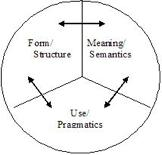
Figure 10: Three-perspective grammar content
Understanding and Using English Grammar: Interactive successfully covers the above dimensions. The cartoon characters help learners to understand the target form and the situations constraining its use. The practice and production exercises guide them to notice the conditions under which the rules are used both meaningfully and pragmatically. The evaluation stage (re)assures learners that they understand the structure’s usage in different contexts and situations.
However, the sequencing of the content in the program may need some refinement. The chapters all unfold linearly. That is, each structure is marked off from other structures, rather than integrated. However, learning does not always occur in a linear fashion. Nunan (1998) claims that:
Accuracy does not increase in a linear fashion, from 20% to 40% to 100%; at times, it actually decreases. A learner’s mastery of a particular language item is unstable, appearing to increase and decrease at different times during the learning process. For example, mastery of the simple present deteriorates (temporarily) at the point when learners are beginning to acquire the present continuous (pp. 101-2).
Nunan suggests what he terms an organic approach to teaching grammar and which he metaphorically portrays as growing a garden, rather than building a wall (referring to the linear approach). In this approach, Nunan insists on the role of authentic texts and contexts to give learners “the opportunity of seeing the systematic relationships that exist between form, meaning, and use” (1998, p. 102). Practically, he summarizes this approach when he points out that, “What we need is an appropriate balance between exercises that help learners come to grips with grammatical forms, and tasks for exploring the use of those forms to communicate effectively” (p. 109). Thus, for example, periodic review exercises which authentically combine structures that had previously been learned separately would be one way to realize the organic, non-linear nature of grammar learning. However, Understanding and Using English Grammar: Interactive lacks this sort of integrative activity. However, it should be pointed out that the rich and varied contexts used in the explanations and activities do exhibit some of the features described by Nunan.
On the other hand, one advantage of the program is that it responds to the perceived needs of its target users. From experience, adult learners seek to know the rules governing structures and generally ask for more grammar. They consider it an important component of language learning, as was confirmed by 94% of the respondents in Fortune’s (1992) study. Thus, advanced, self-motivated adult learners who are learning English for professional and/or academic purposes would most likely appreciate the approach and exercises of this program. These characteristics concur with the variables that Celce-Murcia (1991) suggests affect the importance of grammar: Grammar instruction is less important for younger learners and/or learners with little L2 proficiency and more important for advanced and/or adult learners.
In addition, the type of user to whom this software is meant to appeal is reported to prefer the way in which content is delivered in this program. Fortune (1996) states that, “Exercises incorporating a linguistic context, such as a continuous text, generally proved more popular than those involving uncontextualized sentences” (p. 168; emphasis original).
A further advantage of the contextualized content of the program is that it is delivered meaningfully in an entertaining way. The animated cartoons (or “talking heads”) that identify the target structure introduce the grammar concepts in a jargon-free manner. For example, explaining the nuances of “going to” and “will” in a dialogue-like format is an innovative and original idea (see Figures 11 and 12). Similarly, the manner in which the animated visuals guide users through situations is certainly likely to help them understand the target structure more fully.

Figure 11: Similarities between going to and will

Figure 12: Differences between going to and will
Analysis of methodology
The presentation-practice-production-evaluation pattern adopted by this program is a feature of the deductive approach to the teaching of grammar. By assigning those steps, the authors have assumed that potential users will understand the rule governing the target grammar pattern and, after enough practice, will internalize the rules and be able to utilize them spontaneously. This is not always the case, however. Actually, the process by which learners acquire rules and use them has been a controversial issue for a long time.
Controversy started when grammar was relegated to secondary status in language curricula as a result of the introduction of new approaches and methods in the late seventies. For example, Canale and Swain (1980) minimized the supremacy of grammatical competence when they considered it to be one component, among others, of communicative competence. In this same era, Krashen (1981) introduced his learning/acquisition dichotomy and then claimed (Krashen, 1982) that exposure to natural language is more effective for language acquisition than language instruction, especially when language is “picked up.” He and Terrell (1983) discourage overt error correction as “[i]t is likely to have a negative effect on the students’ willingness to try to express themselves” (p. 177). Ever since, many researchers have attempted to verify the role of formal instruction especially in the teaching of grammar. Some researchers have suggested that formal instruction may have an indirect effect on implicit knowledge (Fotos & Ellis, 1991).
Although the debate over explicit and implicit grammar instruction continues, it is beyond the scope of this review to analyze the issue in more depth. It is worth noting, however, that the approach taken in Understanding and Using English Grammar: Interactive is largely an explicit one. Given the fact that many SLA researchers have suggested a role for implicit instruction, it would seem reasonable to suggest the addition of some more implicit/inductive-type tasks in the program.
In the inductive approach to teaching grammar, instruction proceeds from examples, often contextualized so as to make grammar concepts salient enough to be noticed by learners. The learners are then to induce the rules underlying these concepts by themselves. Exercises developed within this approach are generally context-based and problem-driven. Fotos and Ellis (1991) suggest that this approach contributes to learning grammar at least in two ways: “. . . directly by providing opportunities for the kind of communication which is believed to promote the acquisition of implicit knowledge, and . . . indirectly by enabling learners to develop explicit knowledge of L2 rules which will later facilitate the acquisition of implicit knowledge” (p. 622).
Such tasks should be integrated into Understanding and Using English Grammar: Interactive for at least two reasons. First, some learners prefer this approach, especially advanced learners who have been exposed to it (Fortune, 1992). Second, the chaotic nature of learning a foreign/second language requires that a “both/and” type of instruction should be adopted instead of a mutually exclusive “either/or” type of instruction (Larsen-Freeman, 1997). In fact, the combination of both approaches should work to satisfy different learning styles.
Another way to make the program more effective would be to review previously introduced structures in subsequent chapters. As mentioned above, most of the content of the program is introduced in a linear way. Even the items that do get reviewed, the verb tenses (in Chapter 5), are reviewed as discretely as they were introduced. That is, future tenses are reviewed together, perfect tenses together, and so on. A chapter (or part of it) on mixed tenses would make the user’s task more challenging and realistic. Other structures also need revisiting in order to deepen learners’ knowledge of grammar and to give it a chance to sink in.
Conclusion
Understanding and Using English Grammar: Interactive has the ingredients to be a useful resource for its target users. Its original way of deductively presenting grammar patterns as well as the rich contexts of its practice, production, and testing phases are all conducive to facilitating the learning of grammar. The authors are to be commended for their jargon-free and straightforward grammatical descriptions. However, as mentioned above, since the teaching/learning of grammar is problematic and complex, some improvements might be made, such as introducing concepts using a combination of both deductive and inductive approaches and reviewing patterns so as to avoid an entirely linear presentation. Despite these shortcomings, the integration of grammar concepts with practice in the different language skills in various lively contexts will certainly create opportunities for learning to occur. Furthermore, the program is versatile in that it can be used for self-study, as a supplement to the book, in a self-access center, or even in a suitably equipped classroom. Its use of animation, audio, and interactive exercises using multimedia tools, make it an innovation that would be difficult to duplicate with paper-based materials.
References
Canale, M. & Swain, M. (1980). Theoretical bases of communicative approaches to second language teaching and testing. Applied Linguistics, 1(1), 1-47.
Celce-Murcia, M. (1991). Grammar pedagogy in second and foreign language teaching. TESOL Quarterly, 25(3), 459-480.
Celce-Murcia, M. & Hilles, S. (1988). Techniques and resources in teaching grammar. Oxford: Oxford University Press.
Corder, S. P. (1988). Pedagogic grammars. In Rutherford, W. and M. Sharwood-Smith (eds.), Grammar and Second Language Teaching: A Book of Readings (pp. 123-145). New York: Newbury House.
Fortune, A. (1992). Self-study grammar practice: Learners’ views and preferences. ELT Journal, 46
(2), 160-171.
Fotos, S. & Ellis, R. (1991). Communicating about grammar: A task-based approach. TESOL Quarterly, 25(4), 605-628.
Krashen, S. (1981). Second language acquisition and second language learning. Oxford: Pergamon Press.
Krashen, S. (1982). Principles and practice in second language acquisition. New York: Pergamon Press.
Krashen, S. & Terrell, T. D. (1983). The Natural approach. Hayward, CA: Alemany Press.
Larsen-Freeman, D. (1997). Chaos/complexity science and second language acquisition. Applied Linguistics, 18(2), 141-165.
Larsen-Freeman, D. (2001). Teaching grammar. In Celce-Murcia, M. (ed.) Teaching English as a second or foreign language (Third Edition) (pp. 251-266). Boston, MA: Heinle and Heinle.
Nunan, D. (1998). Teaching grammar in context. ELT Journal, 52(2), 101-109.
Rutherford, W. & Sharwood-Smith, M. eds. (1988). Grammar and second language teaching: A book of readings. New York: Newbury House.
About the reviewer
Abdelmajid Bouziane, Ph.D., is an Assistant Professor of Linguistics at the Hassan II University, in Casablanca, Morocco. He has been involved in teacher training, especially in Information and Communications Technology (ICT) and English-Language Teaching (ELT), for the last five years. Also, he is the MATE’s (Moroccan Association of Teachers of English) webmaster and ICT consultant, and the editor for the ELTeCSAME-L (List of English Language Teaching Contacts Scheme for Africa and the Middle East).
| © Copyright rests with authors. Please cite TESL-EJ appropriately.
Editor’s Note: The HTML version contains no page numbers. Please use the PDF version of this article for citations. |