

September 2012 – Volume 16, Number 2
Compelling Conversations: Questions and Quotations for Advanced
|
|||
| Author: | Eric H. Roth & Toni Aberson (2011) | 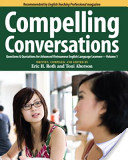 |
|
| Publisher: | Los Angeles: Chimayo Press | ||
| Pages | ISBN-13 | Price | |
|---|---|---|---|
| 108 pages | 9780982617816 | $20.95 USD | |
Often it is the duty of the ESL speaking and listening teacher to tailor the text to their class culture and demographics; therefore it is a novel idea to produce a textbook for speaking skills of a particular English language learner. When creating a curriculum for ESL speaking students, teachers should consider many demographic and cultural aspects of their students (Folse, 2006). Roth and Aberson have employed such an approach for Vietnamese ELLs in Compelling Conversations: Questions and Quotations for Advanced Vietnamese English Language Learners where careful knowledge of Vietnamese culture, customs and values, first- (L1) to second-language (L2) transference issues, and expertise in the field of ESL speaking have been well documented. Compelling Conversations is a text that encourages multiculturalism, that is flexible enough to use for all ages of advanced English language learners, and that gives a personally relevant, tailored experience for advanced Vietnamese ELLs to formulate their opinions in anticipation of present and future communications with English speakers.
In each of the 15 chapters, Compelling Conversations starts with a self-reflection for the student about the chapter’s content, and then turns the reflection outward to stimulate conversation. Through the text, students are given interesting quotations and proverbs related to the topic to discuss, as well as vocabulary to help them formulate answers and thoughts. The authors then give multiple helpful tips to students throughout the book to encourage extra practice between the students and with others. Perhaps the most convenient aspect of this textbook is that it is actually more of a workbook for students to practice their speaking skills first on paper in complete thoughts, and then in small groups, bridging the gap between thinking, writing, and speaking. It is complete with in-class speaking activities, individualized vocabulary, and practice of question formulation, as well as critical thinking activities that are suggested for outside of class.
The topics in each chapter are of every day, casual communication possibilities such as describing oneself, agreeing and disagreeing, and pet peeves. Each chapter starts with an accessible scenario. Following is a communicative activity based on that scenario. This class format is advantageous as the students are encouraged to speak as much as possible from the start to the end of class. The principle of speaking as much as possible in a speaking class is aligned with best practices (Folse, 2006). Further, each chapter has a small list of critical words related to the topic for students to know and practice in their written responses. With this present-practice-produce model, students are able to practice the often diametrically opposed concepts of accuracy and fluency at the same time using this textbook. Great resources for teachers are in the Appendices at the end of the book. These include reproducible worksheets for students, surveys for students to administer to international visitors, and a part of the Academic Word List divided into useful subsets to use in their conversations. Students can easily become comfortable with the consistent structure of a class revolving around Compelling Conversations.
As I taught a conversation class (an eikaiwa) in Japan to advanced ELLs, I can see and recommend this book as a backbone for a lively conversation class. Although it is tailored to Vietnamese culture with certain phrases and examples, if the teacher feels comfortable predicting the cultural issues that could arise and editing them before class, I would not hesitate to use this text for other cultures. Depending on the instruction style of the teacher, and the culture of the students, the cultural differences could provide interesting comparison and contrast debate topics as well. As this book was intended for a Vietnamese audience, students from other cultures may feel as if they were not the intended audience. Therefore, if the students are not of Vietnamese descent, this text could be problematic to use in a conversation classroom as-is. However, the text targets advanced Vietnamese ELLs with culturally relevant content that understands and validates the bicultural transformation that Vietnamese ELLs undergo.
Perhaps my most favored aspect of the book arrives in the first few pages where the authors send a personal message to the students emphasizing their desire for the students to speak in English, although not by admonishing Vietnamese. This personal message to the student stressing the importance of both languages is paramount the inextricable link between language and culture must not be violated; instead bilingualism and bi-culturalism should be fostered within the student (Dicker, 2003). Roth and Aberson graciously encourage multicultural curiosity within this text by their interviewing techniques and soft cultural reminders to the students not to be intimidated of foreigners and to encourage one another. Students are advised in the beginning as well that the goal of any speaking activity is the level of intelligibility that they can speak with, instead of the native-sounding phonological aims that many students have (Derwing & Munro, 2005). Compelling Conversations establishes a classroom culture revolving around respect and encouragement from the beginning.
This text is convenient for instructors because it also emphasizes the importance of communicative activities complete with language in the task, such as target vocabulary, but also with language for the task, such as target forms (Folse, 2006). As an example, in Chapter 1, students are encouraged to answer questions about their English-speaking experiences and for the recipients to use phrases like “You are right!” or “That is interesting!” to stimulate the conversation between themselves. Even phrases that are more colloquial are included, such as “Cool!” Compelling Conversations gives a plethora of fluency-building responses, including vocabulary for each chapter and multiple questions for each target form and reminders to create the target form of the answer or to create another question.
True to form, the textbook is full of multicultural quotations and proverbs that stimulate advanced learners’ critical thinking skills in English. The quotes have the potential to give insights to many different inner- and outer – circle cultures that use English as a lingua franca. The proverbs give the English language learners (ELLs) communicative confidence and competence in the subject matter. Many quotes are from the United States; however, there are also many quotes from Vietnamese culture as well as China, Europe, Japan, Korea and Italy. The quotes are representative of the subject matter in the chapter and serve as ideal starting points for conversations. For example, in the ninth chapter “Being a Child — And Becoming a Parent” Roth and Aberson quoted Mark Twain, “When I was a boy of fourteen, my father was so ignorant I could hardly stand to have the old man around. But when I got to be twenty-one, I was astonished at how much he had learned in seven years” (p. 45). In addition to being comically juxtaposed, Twain’s quote in Compelling Conversations has the ability to stimulate multi-generational communication within a single classroom, as advanced ELLs can be of any age.
Since the text focuses on fluency in conversation, teachers are afforded the opportunity to supplement phonology and grammar materials for the speaking classroom. Compelling Conversations is meant for an instructor who feels comfortable teaching English phonology and grammar by their own conventions. Although teaching phonology and grammar independently from a textbook is a difficult endeavor, it can be an advantage for most classrooms as students have different needs and teachers have different methods of teaching these two critical areas of English acquisition. Grammar and phonology should be included in a conversation class as these two elements are required for fluent and comprehensible conversation.
Compelling Conversations: Questions and Quotations for Advanced Vietnamese English Language Learners gently but firmly encourages advanced Vietnamese students to think critically about their own culture, and those of others around the world in English so that they can more effectively communicate in an advanced manner with other speakers of English.
References
Derwing, T. M., & Munro, M. J. (2005). Second language accent and pronunciation teaching: A research-based approach. TESOL Quarterly, 39(3): 379-397.
Dicker, S. J. (2003). Languages in America: A pluralist view (2nd ed). Tonawanda, NY: Multilingual Matters Ltd.
Folse, K. S. (2006). The art of teaching speaking: Research and pedagogy for the ESL/EFL classroom. Ann Arbor, MI: University of Michigan Press.
Reviewed by
Sarah Elizabeth Snyder
Northern Arizona University, USA
<sarah.snyder nau.edu>
| © Copyright rests with authors. Please cite TESL-EJ appropriately.Editor’s Note: The HTML version contains no page numbers. Please use the PDF version of this article for citations. |