

April 1994 — Volume 1, Number 1
A Guide to Learning Disabilities for the ESL Classroom Practitioner
Christine Root
Harvard University
<croot@husc.harvard.edu>
Abstract
It is estimated that in the United States 15% of the general population has a learning disability (Monarez 1992, p. F3). It is possible that many of the ESL students whom we view as poor language learners are struggling because they too have a learning disability. In many countries, learning disabilities are not recognized or, in some cases, they are recognized but not dealt with. This paper is meant to be a basic primer on learning disabilities. It will describe classroom behaviors associated with several common learning problems, the results of research into them and it will offer practical suggestions to classroom teachers for working more profitably with these students.
Many of us who teach ESL have found ourselves wondering at one time or another whether a certain student might have a learning disability that is impeding his or her progress in English. Yet many of us work in settings where we do not have ready access to consultation, guidance or referral advice and special needs professionals. It is the purpose of this paper to provide basic information about learning disabilities (also commonly referred to as learning issues, learning differences and learning problems). It will focus on ESL teaching in terms of two considerations: classroom behaviors generally manifested by people who have learning disabilities and common sense techniques that can be incorporated into classroom routines to vastly improve the classroom environment for people having learning disabilities. Although much of the following is drawn from work with children (there being scant literature on this subject vis a vis adults), a lot of the information is of value to all teachers.
According to Dr. Melvin Levine, Director of the Clinical Center for the Study of Development and Learning at the University of North Carolina at Chapel Hill:
Learning Disability is the term currently used to describe a handicap that interferes with someones ability to store, process or produce information. Such disabilities affect both children and adults. The impairment can be quite subtle and go [-1-] undetected throughout life. But learning disabilities create a gap between a persons true capacity and his day to day production and performance. Its not always immediately obvious that a person has a learning disability. The most straightforward indication is academic failure or underachievement by someone who seems capable of more (Levine 1984, p.1).
Learning disabilities are probably inherited; it is thought that they are caused by a neurological malfunction or processing glitch which renders written text-deciphering, sound-symbol connections and/or the sequencing of information very difficult (Saltus 1992 p. 29,31). A learning disability is not indicative of less intelligence. In fact, people who have a learning disability are often very bright, even gifted, people. It is true, however, that their short circuit or processing glitch causes them to see things differently and sometimes obscures their intelligence (Vail 1987, p. xiv). While they cannot be cured, they can be taught compensatory strategies. We, as mainstream classroom teachers, can help in this process.
Many experts feel that language deficits begin early in life and eventually disappear, only to re-emerge later in life when there is a new circumstance to be dealt with that places different and/or unexpected demands on language and its use (Wallach and Butler 1984, p. 15). In our adult ESL programs, we may see, more often than we have realized, the successful ones, the ones who have a learning disability but ultimately did well in school because they were able to devise their own compensatory strategies as no diagnostic or remedial intervention had been available. These students may have since forgotten (it happens that people who overcome first language learning difficulties often do forget) about the problems that they had learning to read and write. Then, they have difficulties again when they arrive in a new circumstance (such as studying language in a foreign country) which places new, language-related demands on them. It is possible that a number of the students whom we view as poor language learners are struggling because they have a learning disability.
Dyslexia is the term that is usually used to cover a very broad range of learning disabilities which involve language processing deficits. In brief, Levine describes these dysfunctions in terms of problems relating to 1) attention, the most common kind of learning disability; 2) language, difficulty in interpreting and/or remembering verbal messages and instructions; 3) spatial orientation, poor reading and spelling skills because of difficulty with processing information visually and distinguishing similar-looking letters; 4) memory, difficulties with retrieval of presumably stored information because it is mis-stored and cant be found spontaneously; 5) fine motor control issues, which cause ideas to break down [-2-] between the head and the paper; and 6) sequencing or difficulty organizing information and instructions into an appropriate order so that tasks can be successfully completed (Levine 1984, pp.1-2).
Levine cautions us that, as is the case with all students, we must remember to look for what he refers to as intraindividual balancing strengths and focus on them. Looking at the learning disability is too limiting; we need to look at the profile of strengths and weaknesses (Levine, personal communication). Robert Brooks has also spoken about the need for teachers to look for what he calls students islands of competence (Brooks, personal communication) and play to each individuals strengths.
Martha-Sue Hoffman (1984) divides ways that learning problems manifest themselves in school into four categories of difficulties. Listed below in their entirety are those categories and their attendant behaviors. Although they were written to describe native-speaking, school-aged children, many of them provide helpful insights for all teachers. You will notice that some of these are more applicable than others to second language learners and that it is not always easy to distinguish between permanent language-learning problems and normal second language problems.
Table 1. Categories of Difficulty
- Classroom behaviors associated with word-retrieval difficulties:
- an appearance of persistent verbal reticence
- a diminishing of verbal spontaneity
- a tendency to raise ones hand presumably with the correct answer, but ending up not knowing when actually called upon
- a tendency to express the wrong answer (associative naming error)
- an increase in difficulty re: verbal organization (story telling, verbal explanations, verbal questions) as the content becomes more complex
- a tendency to appear forgetful as the consequence of inadequate access to actually well-stored information
- an increase in difficulty in getting started, both verbally and graphically (in terms of expressions and organization)
- an inordinate amount of difficulty with phonics acquisition and application [-3-]
- an inordinate amount of difficulty with arithmetic calculations (rapid response to flash cards, swift adding of columned numerals)
- Classroom behaviors associated with selective attention immaturities:
- inconsistent levels of task-attentiveness
- diminishing levels of concentration vigilance and maintenance
- variable levels of performance accuracy (with diminishing qualities occurring with increased group size and increased ambient noise levels)
- inconsistent levels of task-completeness
- an appearance of being forgetful, when in fact the information was never really received or processed
- an appearance of disorientation or confusion due to misperception of the linguistic signal (speech) presented under adverse listening conditions
- response delays as the student attempts to sort out verbal confusions
- Classroom behaviors associated with visual, association confusions:
- higher-level difficulties with if-then and causal relationships
- higher-level difficulties with inferential reasoning and reading between the lines
- excessive struggling to perform higher-level mathematic tasks (problem solving exercises) which require increased visuo-spatial organization
- irregularities regarding perception of conceptual gestalt
- tendencies toward being excessively attentive to non-salient/irrelevant details
- tendencies toward being pulled to salient details to the exclusion of other associated events
- Classroom behaviors associated with limited concept manipulation, inner language skills:
- limited self-generation and use of strategies
- reduced analogous and associative reasoning skills
- compromised memory styles
- reduced efficiency/accuracy re: information organization and re-organization
- compromised summarization/paraphrasing competencies
- restricted inferential reasoning skills
- tendencies towards being concrete with inordinate difficulties with abstract events
- questionable appreciation and use of humor [-4-]
- restricted competencies for reading between the lines
- limited appreciation of if-then relationships
- limited skill generalization from one event to another
- limited skill for offering alternatives
- limited skill at hypothesis generation
- limited skill at hypothesis testing
- compromised competencies re: predicting consequences
- impaired reading comprehension skills re: appreciating context and recognizing main themes, discriminating main ideas from lesser important items, recognizing and anticipating sequences of events, understanding the co-relation between paragraphs, remembering the story line, etc.
- restricted mathematic problem solving skills
(Table reprinted with permission of Martha-Sue Hoffman, MS,CCC)
We all know the student who constantly fidgets, who doesnt finish his/her work, never knows what page we are on, or doesnt hear the assignment. It may be true in some cases that people displaying these and other behaviors are simply unfocused or even lazy; learning disabled people are often termed lazy. They are always being told to try harder. Moreover, there is little understanding of the fact that it is not a matter of having students with learning difficulties do a class or activity over again; it is a matter of having them do it differently. Vulnerabilities in language skills are exacerbated for ESL students, especially those with learning disabilities, because those students are trying to learn not only language, but a new language. The burden is on us as teachers to ensure that the classroom environment does not perpetuate learning failure. Howard Gardners work on multiple intelligences and the different ways that we each learn, remember, perform, and understand may be helpful in this regard. To date, Gardner has identified seven human intelligences: linguistic, logical-math, spatial, musical, bodily-kinesthetic, interpersonal and intrapersonal (Gardner 1993a, pp. 11-12). Of similar relevance is Betty Edwards work on hemispheric implications, the roles that the left-brain and the right-brain play in our thinking, reasoning and complex mental functions. (Left-brain characteristics include verbal, analytic, symbolic, abstract, temporal, rational, digital and linear patterns of thought and behavior while the right-brain characteristics can be described as nonverbal, nontemporal, nonrational, spatial, intuitive and holistic approaches) (Edwards 1989, p. 12). Teachers can improve the learning climate for many students and most assuredly for those with a learning disability by planning tasks so that differing intelligences are called upon and by balancing the involvement required of each hemisphere of the brain. [-5-] Below are some suggestions that are easy to incorporate into classroom routine; naturally, different strategies will be of more or less value to different students, particularly with a culturally and linguistically diverse class.
- Give the gift of time whenever it is at all possible. Students with learning disabilities may require extra time to complete in-class and homework assignments as well as tests;
- Consider administering tests in alternative formats such as orally or on computer;
- Whenever appropriate, present material using graphic and/or sensory media;
- Combine both auditory and visual stimulisay it and write it on the board whenever possible;
- Have students use a word processor to whatever extent is possible. Because word processing makes rewriting and revising so much less laborious, its value is immeasurable for those students with fine-motor, sequencing, spelling and other language manipulation problems;
- Make it easy for students to ask for repetition; bear in mind that it is important to use the same language when you do repeat so that you do not change the construct and defeat the purpose of the repetition;
- Dont issue too many instructions at the same time. Break tasks down into their component parts and issue the instructions for each part one at a time;
- Allow time in advance for students to think about items to be covered in class. Provide plenty of pre-discussion, pre-writing, pre-reading lead time and other pre-teaching activities;
- Reduce the level of distraction in the room;
- Explicitly state the topic at hand and proceed in a structured, concrete manner; progress from the obvious to the concrete to the abstract; dont jump without warning from one topic to another;
- Frame material by relating it to past classroom or personal experience and highlighting new material;
- Whenever possible, cluster material so that it is organized by category; [-6-]
- Conduct frequent notebook checks of students work;
- Look for students intraindividual balancing strengths (Levine, personal communication); recognize, praise and reinforce students islands of competence (Brooks, personal communication);
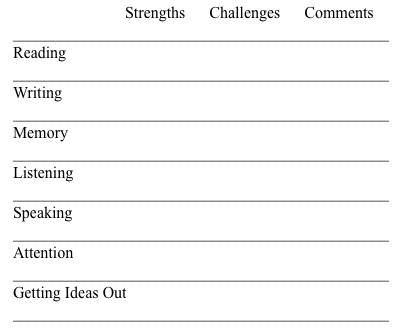
- Take an inventory of how students think they learn best. Have students make a chart similar to the one below of their strengths and challenges so that they, as well as you, can learn from their perceptions of how well they read, write, remember, listen, speak, attend and get ideas out (Michele Tissiere, personal communication):
It is probably fair to assume that the relatively high percentage of students found to be learning disabled in some way in the United States is mirrored in other countries. In most countries, however, learning disabilities are not recognized or are recognized but not dealt with. When we see a student floundering, a student who, in Levines words, seems capable of more (Levine 1984, p. 2), we have the best indication that the problem may be an L. D. problem. There is much that we as classroom teachers can in fact do to improve that students learning conditions. In the powerful and provocative video entitled F. A. T. (Frustration, Anger, Tension) City, How Difficult Can This Be? facilitator Richard Lavoie brings together a group of school psychologists, guidance counselors, college counselors, teachers and parents and creates a simulation of the real life challenges facing those with learning disabilities. They and we see what it is really like to walk in the shoes of people who have a learning disability. In closing, he tells us that the real challenge is in educating those who [-7-] dont have one to the facts about learning disabilities (Lavoie n.d.). Sensitization and advocacy are half of the treatment.
References
Brooks, R. (1991). The Self Esteem Teacher. Circle Pines, MN: American Guidance Service.
Brown, H. D. (1991). Breaking the Language Barrier. Yarmouth, ME: Intercultural Press.
Cloud, N. (1988). ESL in Special Education. ERIC Clearinghouse on Language and Linguistics , ERIC Microfiche Number 303044.
Edwards, B. (1989). Drawing on the Right Side of the Brain. Los Angeles, CA: Jeremy P. Tarcher, Inc.
Gardner, H. (1993a). Multiple Intelligences, The Theory in Practice. New York, NY: Basic Books, Inc.
Gardner, H. (1993b). The Unschooled Mind: How Children Learn and How Schools Should Teach. New York, NY: Basic Books, Inc.
Hoffman, M.-S. (1984). Practical planning for the language/learning disabled student. 1984 Massachusetts Speech and Hearing Association Convention.
Lavoie, R. (n.d.). F.A.T. City, How Difficult Can This Be? Understanding Learning Disabilities . PBS Video, 1320 Braddock Place, Alexandria, Virginia 22314-1698.
Levine, M. (1992). Developmental Variations and Learning Disorders. Cambridge, MA: Educators Publishing Service, Inc.
Levine, M. (1984, September). Learning abilities and disabilities, Harvard University Medical School Health Letter , pp. (1-2 ) Cambridge, MA: Harvard University.
Monarez, P. (1992, August 25) Im not a scatterbrain. Providence Journal-Bulletin, p. F3.
Ortiz, A. and Ramirez, B. (eds.) (1988). Schools and the Culturally Diverse Exceptional Student: Promising Practices and Future Directions . ERIC Clearinghouse.
Rubin, J. (1975). What the Good Language Learner Can Teach Us, TESOL Quarterly, 9, 1 , pp. 41-51. [-8-] Saltus, R. (1992, September 21). With some U. S. help, Japan tackles dyslexia. Boston Globe, pp. 29, 31.
Vail, P. (1987). Smart Kids with School Problems, Things to Know and Ways to Help. New York, NY: E. P. Dutton.
Wallach, G. and Butler, K. (eds.) (1992). Language Learning Disabilities in School-age Children. Baltimore, MD: Williams and Wilkins Publishers.
Wilhelm, I. (1992). Strategies to Promote Effective Learning in the Classroom, Concord Public Schools, Sabbatical Report.
Christine Root teaches ESL at Harvard University. She is the author of several ESL textbooks and articles and she is the wife and mother of people leading successful lives in spite of learning disabilities. She is a strong believer in the crucial role classroom teachers play in making a difference.
| © Copyright rests with authors. Please cite TESL-EJ appropriately.
Editor’s Note: Dashed numbers in square brackets indicate the end of each page in the paginated ASCII version of this article, which is the definitive edition. Please use these page numbers when citing this work. |