

March 2007 — Volume 10, Number 4
|
|||
| Author: | George Woolard (2004, 2005) | 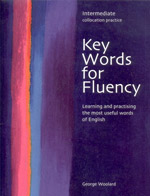 |
|
| Publisher: | London : Thomson ELT | ||
| Pages | ISBN | Price | |
|---|---|---|---|
| Pre-intermediate | 200 | 0-7593-9629-9 | |
| Intermediate | 196 | 0-7593-9628-0 | |
| Upper Intermediate | 175 | 0-7593-9627-2 | |
| Price: | $22.00 U.S. each | ||
The aim of this three book series is to work on collocations so as to improve vocabulary, necessary to achieve fluency in all four skills: speaking, listening, reading and writing. The books are addressed to learners and definitely not for class use but, rather, for self-study, thanks to a very simple structure and answer keys.
According to the author, key words are “the most common and useful words in English” and thus “the most important” to learn, all the more so as “they combine with lots of other words in short expressions”. He defines collocations as “the grammar of words”: “how words go together with other words”. To him, nouns are more important than any other type of words and carry most of the meaning, most of what we are talking about. Hence, the material is organised around key nouns, 270 in the first book, 208 in the second, 145 in the third plus 20 expressions on the model a + noun + of. With such numbers, these books are quite a rich resource: about 650 nouns altogether generating roughly 10,000 expressions.
Book 1 (pre-intermediate) presents 270 of the most useful, basic words, organised by topic in 22 sections (“Your house”, “Rooms and furniture”, “In the kitchen”, etc.) and totalling 2,500 expressions. The student can work on one topic per day and/or refer to it when the topic in a class matches one in the book. There is a test at the end of each section and, at the end of the book, the answer key is followed–for quick reference–by an alphabetical list of words with the pages on which they appear. The book is meant to be good preparation for the PET examination. For each noun, there is a list of collocations in a box, divided into categories: verb + keyword, or keyword + noun, or adjective + key word, or common expressions and sometimes prepositional phrases. Only two types of exercises are provided: matching the halves and fill in the blanks. Both are reassuring because familiar after a few pages and the answer can only be right or wrong, but extremely tedious for learners who prefer a more varied approach.
The main problem with this type of execution is that the collocations are not explained, so to do the exercises, the student, who may not yet know many words at the pre-intermediate level, has to do a huge amount of work with a dictionary or thesaurus first. For example, under the word “beach” we find “stroll along the beach” or “something is washed up on the beach”. In the drawing illustrating the former collocation the idea of strolling is not made any clearer because its difference with “walking” is impossible to show in a drawing in which speed of movement cannot be seen. Furthermore, the collocations are only used once in the exercises, not enough for acquisition. These exercises would have to be done several times and I am not sure there are many learners motivated enough to go through the same material time and time again, especially in self-study. Lastly, the forms and tenses of the verbs used cover the whole range: the present simple, the preterit, past participle of irregular verbs, the gerund, the passive, etc. Who has mastered these forms at this stage?
Book 2 (intermediate) is also organised into 22 sections with a number of one-page units in each, but without tests. For example, section 4 called “Work” offers one page on “job”, one on “career”, one on “staff and duty”, etc. The 200 or so words generate over 3,000 expressions. The level reached is that of the FCE examination. The format is the same as in Book 1: fill-in the-blanks with three to six collocations chosen from a box at the top and match-the-halves exercises. There are notes providing more collocations at the end of every page.
Book 3 (upper intermediate) is organised around key words in alphabetical order, one per page with four exercises on each page, and expressions at the end. The boxes at the top of each page in the other books have been replaced by a short list of collocations at the beginning of each exercise. Notes at the end of each page are of a kind with those in Book 2.
Two things are worth mentioning about the books’ drawings. First, as mentioned above, visuals, while they make for a more attractive page, are not explanatory in themselves and can even create confusion. On page 106 of Book 1 we find pictures of a tall, slim black man lying on the beach (the only black person to make an appearance in the books among various Caucasians.) The sentence associated with this picture is: I’ve got a great body. To most students at the pre-intermediate level, the meaning of great is the opposite of small and here we have a tall man. The idea of handsome, beautiful is not necessarily generated by the picture. Similarly, the little fishy things shown in the picture p. 85 are indiscernible and do not help understanding the expression. Still in Book I, which deals with very basic vocabulary, while the words are really basic, the collocations are not necessarily so: a clutch bag and a cake stand are easily understood because illustrated by drawings, but are these words really useful at this stage?
Secondly, there is one obvious shortcoming in all three books: too often, the pictures created for the books by Anna Macleod for the first and Bill Stott for the other two, use basic gender stereotypes: a woman flops into a chair after some heavy shopping (for clothes, not groceries) while a man leans back and puts his feet up at the office (real work). Women spend time in tearooms eating cakes while men stand at the bar drinking beer. Women are confined to home activities such as making the beds, drawing the curtains, cooking, taking care of the children, while men earn a living as soldiers, policemen, waiters (in chic restaurants), teachers (full of wisdom and experience), orchestra conductors. In their leisure time, women read fashion magazines, play tennis awkwardly, file their nails, put on lipstick. Men spend an afternoon fishing, paint a fence, drive big fast cars and . . . wait for women who are late. Still, there is an exception to this heap of clichés: a kiss between two men.
If we look at the sentences in the exercises at random, when gender is represented in Book 1, we find the same stereotyping: a man looks at himself in the mirror to try on a new suit; a woman never leaves the house without looking at herself in the hall mirror. In Book 2, 36 pictures show men and only seven women, with both men and women in thirteen and nine pictures of inanimate objects. In Book 3, there is a preponderance of he and his when gender is mentioned (mostly we have neutral words such as I, you, we, they). A president is associated with his country (p. 76, 3:6); a secretary is female (p. 77, 1:3). The subliminal message of this accumulation of gender stereotypes, to which must be added the lack of racial diversity, is not educational. Rather, it reinforces prejudice, and educators should be more aware than this. Materials writers and pedagogues should in particular pay attention to this.
I wonder if books such as Woolard’s are still of any use in book form. Their presentation is attractive (especially the covers) but it seems to me the monotony of the material does not help reconcile web-addicts to paper. Such mechanical exercises would be perfectly suited for Internet pages, with all the additional help this medium can offer: hypertext, pronunciation, video illustrations, songs, etc. I am not sure students–of any age–are going to buy such material in a bookshop, or, if they do, that they will really learn from it.
Nicole Décuré
LAIRDIL–Université de Toulouse, France
<decure cict.fr>
|
© Copyright rests with authors. Please cite TESL-EJ appropriately. Editor’s Note: The HTML version contains no page numbers. Please use the PDF version of this article for citations. |