

September 2008 — Volume 12, Number 2
|
|||
| Author: | H. M. McGarrell, Ed. (2007) | 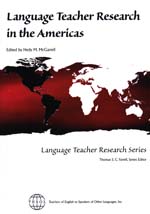 |
|
| Publisher: | Alexandria, VA: TESOL | ||
| Pages | ISBN | Price | |
|---|---|---|---|
| Pp. v + 203 | 978-193118542-4 (paper) | $29.95 U.S. | |
During the last decade, various issues related to professional development of language teachers have been addressed. While most studies focus on unidirectional flow of information from researchers or teacher educators to teachers, much less is known about how teachers (as users, holders, and developers of teacher knowledge) can contribute to an understanding of language-teacher education (Cole & Knowles, 2000). An important contribution to filling this gap is Language Teacher Research in the Americas (a volume in the Language Teacher Research Series). This collection, edited by Hedy McGarrell, and the other region-based ones combine to play integral roles in legitimizing “teachers’ ways of knowing and ways of coming to know” in the profession of language teacher education (Johnson, 2006, p. 241).
The book begins with an introductory chapter in which the editor does three things: (a) highlights the important role that language teachers play in their own professional development, (b) acknowledges significant contributions made by language teachers to the knowledge base of language teaching, and (c) argues for a widespread acceptance of teacher-driven research at all levels of language teaching as well as within a variety of teaching contexts.
Following this chapter, there are twelve chapters written by language professionals from seven countries throughout North and South America and surrounding islands. The framework of each chapter follows the same pattern. Each study begins with an issue that the teacher researcher wants to explore. The next section provides a literature review on research related to the issue in question. Subsequent sections contain procedures, results, and reflections. While sections about the issue and background literature are short, the last three sections provide a lot more discussion. For example, in the procedures section, the teacher researcher(s) list research goals, research questions, research methods, and analysis methodology.
Since the chapters in this book are not grouped into thematic or topic sections, for the purpose of this review I reorganized them according to several similar themes.
| Chapters | Themes |
|---|---|
| 2 & 6 | Examine the relationship between learning and teaching practices as well as student performance on language tests |
| 3, 8, 9, 10, 13 | Look into the methods of training and preparing language teachers |
| 4, 5, 7, 11, 12 | Investigate the effectiveness of various teaching practices in relation to all kinds of difficulties students have in learning English |
The field of language-teacher education has been undergoing some dramatic changes. A major shift concerns the knowledge-base upon which language-teacher training and teacher development draw. Freeman and Richards (1996) highlight this change and argue that “the field of language teaching will be considerably enriched by deeper and closer examinations of how language teachers come to know what they know and do what they do in their work” (Freeman and Richards, 1996, p. ix). Freeman and Johnson’s (1998) call for a reconceptualization of the knowledge-base of ESOL teacher education provides a good illustration of this effort:
The core of the new knowledge-base must focus on the activity of teaching itself; it should center on the teacher who does it, the contexts in which it is done, and the pedagogy by which it is done. (p. 397)
The teacher-driven research studies featured in Language Teacher Research in the Americas demonstrate that the collection makes an important and worthwhile effort to redefine teacher education in the field. This goal is best illustrated by McGarrell herself: “The Language Teacher Research Series highlights the role language teachers at all levels play as generators of knowledge concerning all aspects of language teaching around the world” (p. v). Every chapter describes teacher-researchers’ experience in asking why and how questions in order to improve their teaching performance. For instance, teacher-researchers in chapter 2 ask why many students in their English as a foreign language (EFL) program fail to achieve satisfactory TOEFL scores in reading and writing. By using the action research approach, they determine that some of the problems are related to their own teaching and suggest that teachers should augment whatever basic critical pedagogy approach they might be using. Another example is from chapter 4, in which the author reflects upon how effective using film in the language classroom can be. Results showed that students did share some of the same enthusiasm as teachers about the usefulness of film, encouraging the author to consider using more challenging movies. Such self-generated experiments and the narratives about them should increase a teacher’s confidence in teaching as well as encourage teachers around the world to reflect on their teaching practices and to share their important classroom experiences with one another.
This is a fine resource book for both language teachers and teacher educators. Even before reaching that professional level, pre-service teachers will find this book a good place to start familiarizing themselves with a range of situations they might encounter in the real teaching world. In-service teachers will also find this book helpful, not only because they can easily find their topic of interest in the book but also because the studies here set a good standard for teachers to replicate or adapt in conducting their own research. Furthermore, chapters from this book might also serve as supplementary readings in a Ph.D. seminar on language-teacher education.
The book, nevertheless, has a few limitations. First, the research settings are restricted to university-level institutions, thus neglecting other prominent teaching contexts such as primary schools and secondary schools. Only chapter 7 covers this territory: looking into teaching practices in vocabulary instruction in K-12 schools. As a result, the text does not serve its goal to reach teachers at different levels and within various teaching contexts well. Second, the background literature sections are generally short and as such do not give a comprehensive literature review of the topic. Readers who want to conduct their own research based on a study in this volume would have to seek out more literature on the topic. Lastly, chapters in the text are distributed neither according to theme nor region, thus resulting in what can only be called random chapter ordering. In addition, some titles do not clearly reveal what the researcher is really discussing. The title of chapter 12, for example, is “Are Nonnative Speakers Really Able to Converse?” While the title seems to indicate that the topic would be difficulties in nonnative speakers’ performance, the authors actually did a quantitative study on the difference between textbook and real-world conversations and found a noticeable lack of authentic models in teaching materials. I suspect I’m far from the only reader who looked in vain for a methodical organizing principle.
Despite these limitations, Language Teacher Research in the Americas contributes significantly to the ongoing dialogue on the professional development of language teachers practicing—in this case—throughout the American continents. The teacher-driven research promoted in this volume models for other teachers the value of searching for answers to the why and how questions arising in language teaching. By applying or adapting these research trials in their own classrooms, teachers might be able to improve their teaching practice and consequently better serve their language learners.
References
Freeman, D. & Johnson, K. E. (1998). Reconceptualizing the knowledge-base of
language teacher education. TESOL Quarterly, 32(3), 397-417.
Freeman, D. & Richards, J. (1996). Teacher learning in language teaching. Cambridge,
UK: Cambridge University Press.
Johnson, K. E. (2006). The sociocultural turn and its challenge for second language
teacher education. TESOL Quarterly, 40(1), 235-253.
Lijuan Ye
Georgia State University
<eslliyx langate.gsu.edu>
|
© Copyright rests with authors. Please cite TESL-EJ appropriately. Editor’s Note: The HTML version contains no page numbers. Please use the PDF version of this article for citations. |