

September 2008 — Volume 12, Number 2
|
|||
| Author: | Amy B. M. Tsui & James W. Tollefson, Eds. (2007) | 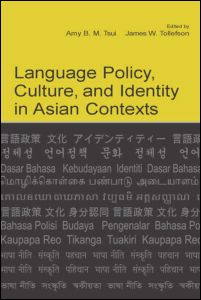 |
|
| Publisher: | New York: Routledge | ||
| Pages | ISBN | Price | |
|---|---|---|---|
| Pp. ix + 296 | 978-0-8058-5693-4 | $34.50 U.S. | |
Appropriately titled, Tsui and Tollefson’s edited volume Language Policy, Culture, and Identity in Asian Context addresses the role of language policies in the social construction of national cultural identities in a wide range of Asian sociopolitical contexts. The book includes twelve articles organized into three sections: (1) globalization and its impact on language policies, culture, and identity, (2) language policy and the social (re)construction of national cultural identity, and (3) language policy and language politics: the role of English. An evident strength of the book is that it provides a metaphorical space for scholars from countries underrepresented in research to give voice to their compatriots’ lived experiences. In this regard, the volume presents rich accounts of language policies in the following countries/ regions: Japan, South Korea, Malaysia, Singapore, Cambodia, Hong Kong, Brunei Darussalam, New Zealand, India, Nepal, Pakistan, and Bangladesh.
The editors recommend reading chapters 1 and 14 prior to exploring the individual countries’ accounts. The introductory chapter sets the stage for the following articles by situating them within the current unprecedented global spread of English. As a result of globalization, Asian countries found themselves confronted by the need to teach English as one part of a national strategy aimed at engaging with an increasingly globalized economy. However, while some countries may view globalization as a resource and thus English as an access tool, others see globalization as a threat with English as an imperial culture’s carrier. Discussions in the book do not fail to capture the paradoxical nature of national language policies; the very practices meant to control the hegemonic nature of English end up legitimizing it. Illustrative examples will follow later.
Based on the themes emerging from the articles, the concluding chapter provides a reframed understanding of the concept of identity. Informed by a postmodernist standpoint, the editors make it clear that an essentialist conceptualization of collective identities as fixed and well-defined entities does not accommodate the current realities where speakers may have access to multiple language systems and cultural codes, especially those who are members of a linguistic minority. Since national identities are being (re)constructed, articulated, and negotiated in different ways by the State and the individual, the editors promote a problematized understanding of identity as an ongoing process.
Contributors to this volume make it clear that language policies are always linked to broader national social, economic, and political agendas. However, such links are often strategically left unarticulated. Within such a holistic and critical look at the constitutive role language plays in national identity formation, a range of national approaches to English language teaching and planning are offered. Of particular interest in the first section is Kayoko Hashimoto’s article on Japan’s fight for economic and political independence. In constructing its cultural national Self, Japan unapologetically took an anti-Western stand. In other words, the significant Other against whom the Japanese national cultural Self was constructed has been the West. By promoting pride in Japaneseness, Japan has become a model for countries in the East for managing English as the handmaiden of economic globalization to prevent the de-culturation of their English language learners. Similarly, Yim Sungwon’s article on the influence of globalization on language policy in South Korea highlights the instrumentality of English language learning in his country. Sungwon’s analysis of the English textbooks in Korea reveals a strong non-Western orientation that emphasizes a sense of national pride in the Korean culture. Both the Japanese and the South Korean cases represent the growing international trend of contextualizing English within the learner’s own national cultural environment, not the West’s.
The hegemony of English as a cultural carrier is evident not only in contexts where it is taught as a foreign/ international language but also in contexts where an indigenous language is influenced. Richard Benton’s contribution in the second section of the book on the status of the Maori language in New Zealand presents a strong case where language plays significant symbolic and pragmatic roles in constructing an indigenous minority’s cultural identity. Denton’s discussion makes it clear that despite the efforts to revitalize the Maori language through New Zealand’s formal education system, the language, from the perspective of its indigenous speakers, has lost its purity and authenticity. The “Maoriness” of the language is being constantly threatened by the influx of lexical and semantic borrowings from English—in the name of modernization. That English is perceived as the language of science and technology potentially threatens the linguistic and thus the cultural identities of its Maori learners. Denton’s analysis of the Maori language case also demonstrates how in multicultural and multilinguistic contexts minority-language issues are sometimes manipulated by the State to achieve national unity and cohesiveness. Since internal nationalist efforts could function at the same time as repressive practices against linguistic minorities, Benton’s discussion implies that a sound national language policy has to pay attention to values of liberty and individual freedom.
The Janus face of national language policies is also captured in the last section of the book in an article from Pakistan by Tariq Rahman titled “The Role of English in Pakistan with Special Reference to Tolerance and Militancy.” Using a World Englishes perspective, Rahman deconstructs the power structures embedded in gaining access to the linguistic and cultural capitals represented by native English varieties. A World Englishes approach views all English language varieties as structurally equal, thus rejecting the superiority of the native varieties. Pakistani English as a non-native variety is spoken and written as three sub-varieties: the acrolect, the mesolect, and the basilect, the first being the closest to British Standard English. According to Rahman, the acrolect speakers, who constitute only 2% to 4% of the population (p. 221), are mostly the product of private elitist English-medium schools. The rest of the student population, who attend either the cadet colleges or the public schools, do not have equal access to English as a linguistic resource. Consequently they end up speaking a variety of English perceived as inferior.
Attempting to address the socio-economic inequalities resulting from such language distinctions, Rahman calls for pluralizing English and making it equally available and accessible to all learners. He suggests phasing out English-medium elitist schools and teaching English only as a subject, rather than as a medium of instruction, to all learners. However, Rahman warns that such a proposed policy could unintentionally result in making English, as a global transnational communication medium, available to a growing number of Pakistani religious/political ‘fundamentalists’ who might use English to further promote ideologies of intolerance and militancy by reaching larger audiences. In discussing his proposed pluralized English policy in the Pakistani context Rahman reminds national language planners to consider not only the positive impacts of a given policy but more importantly its potential spillovers and externalities.
The issues raised in Language Policy, Culture, and Identity in Asian Contexts should be of interest to students of (critical) applied linguistics as well as to students of nationalism. By situating national language policies in their complex sociopolitical settings, the book provides compelling analyses of some of the paradoxes engendered in forming national cultural identities via language and through identifying stakeholders, their (conflicting) interests, and the identity construction and negotiation processes at work. Linguists and language planners in education should benefit immensely by reading these case studies of various Asian countries and their recent language planning and management efforts.
Suad Alazzam-Alwidyan
Portland State University
<suad pdx.edu>
|
© Copyright rests with authors. Please cite TESL-EJ appropriately. Editor’s Note: The HTML version contains no page numbers. Please use the PDF version of this article for citations. |