

June 2009 – Volume 13, Number 1
|
|||
| Author: | Kim Sanabria & Carlos Sanabria (2008) | 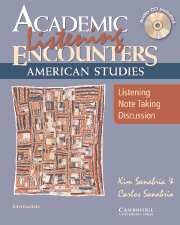 |
|
| Publisher: | Cambridge, UK: Cambridge UP | ||
| Pages | ISBN | Price | |
|---|---|---|---|
| Pp. xxv + 164 | 978-0-521-68432-3 (paper) | $29.00 U.S. | |
The overall goal of Academic Listening Encounters: American Studies is to introduce intermediate level high school and university students to American history and culture through a “listening, note taking, and discussion” (p. xix) based text that will give a “realistic sense of studying in an academic course” – and teach TOEFL iBT skills (p. xvii). The Sanabrias method attempts to have students “encounter concepts and terminology that overlap and grow more complex” (p. xvii) as their textbook progresses through five units of two chapters each. Each chapter is broken down into a four part format: “Getting Started,” “American Voices,” “In Your Own Voice,” and “Academic Listening and Note Taking,” the last section being the one in which the students listen to long, two-part lectures. Each part becomes slightly more difficult, so as to build vocabulary and academic concepts while also allowing for immediate use of new knowledge in discussions, most of which are partner based.
Each unit discusses a new theme of American culture or cultural development.
| Unit | Title | Focus |
|---|---|---|
| 1 | “Laws of the Land” | U.S. Constitution, government structure and the Bill of Rights |
| 2 | “A Diverse Nation” | “Old” (European) and “new” (rest of the world) immigration |
| 3 | “The Struggle for Equality” | Equality (gender- and race-based) and the 1960s Civil Rights Movement |
| 4 | “American Values” | Past (1950s America) and present, and intergenerational controversy |
| 5 | “Spotlight on Culture” | Cultural change, including a brief overview of the globalization of American culture and the rise of EFL |
One of the strengths of this book is the “Getting Started” sections. A short reading passage introduces and narrows the chapter topic; then strategies crucial for test taking listening skills are covered. They show how to listen for important information, such as dates and percentages. However, these strategies appear only in Units 1 and 2 and half of Unit 3. The authors missed a terrific opportunity to add notetaking examples, e.g. abbreviations, to this section to help students with the sections containing interview and lectures.
The next section, “American Voices,” is a terrific combination of test taking skills and everyday (or contextualized) language. It is composed of interviews that allow students to hear vocabulary words in context. In selected excerpts new vocabulary is given in bold within quotes from the interviews along with synonyms and a definition to help students grasp new words even faster. Next, students are asked to answer basic comprehension questions, and lastly move on to questions asking for their responses to the interviews. These questions set up the discussion based section of “In Your Own Voice” (which I will return to later).
The last section of each chapter, “Academic Listening and Note Taking,” is designed to mimic classroom and test lectures. Students are asked to take notes and respond to academic lectures on chapter related topics, for example “Checks and Balances” and “Globalization of American Slang.” The students are provided with model notes which are partially filled in with abbreviations to help students along. For example, “Checks and Balances” has words like freedom already abbreviated as “F’dom,” leaving students to fill in “F’dom of __________” as “F’dom of speech” while they listen to the lecture (p. 29). After the lecture, the students are then asked to answer questions and then work with partners to compare their (completed) notes. To practice at home, the students are provided with a transcript of all the lectures on the CD that comes with the student book. This section seems to be great preparation for students entering university classrooms. On the other hand, this same section lacks an adequate amount of test taking practice that would be beneficial to intermediate EFL students, instead only asking students to apply their knowledge in a classroom setting. One has a right to be surprised by this oversight, since one of the announced goals of the book is to teach TOEFL iBT skills.
The third section, “In Your Own Voice,” asks students to revisit or recall their responses to the interviews from “American Voices,” support them, and then make a presentation. I think this section would be more effective if it came last. “In Your Own Voice” ask students to “take creative control of the topic at hand” (p. xxi) prior to completing all the knowledge gathering process, i.e., listening to each chapter’s lecture on the same topic. With this section coming third instead of last, it asks students to make a partially informed response.
The authors take on a tough task with this book. The book’s controversial issues—immigration, racial/gender equality, and American values—are no longer seen in the same ideological light they once were: for example, while immigration was once an invisible topic in the United States, it is now a very heated debate around highly publicized immigration battles that have polarized at least part of the U.S. Even more importantly, the book, particularly chapters 5 and 6, sometimes treat ideas of equality at a middle school classroom level, never really rising to a level of critical analysis university and university-bound students will need. Instead, the book remains on the surface of its topics and avoids going into much detail: for example the Jim Crow laws are only presented as something that has been overcome, not as a historical representation of the overall racial attitude of the United States up to the time of their repeal.
Another example of oversimplification comes in Chapter 8’s discussion of Conservative and Liberal values. The lecture sticks to a stereotypical portrayal of the two sides’ values, not critically discussing how they have evolved. Liberal values are connected to the Democratic party and conservative values to the Republican party. The lecturer discusses the shifting of support of Democrats to the Republican party from 1964 to 1984 and their renewed support in 2000, while never developing the key historical reasons for the shift or discussing party diversity (p. 127). This could be seen as a total negative, but, I think, herein lies the true value of this book as a pedagogical tool. What it lacks in detailed note-taking skills, critical vocabulary, or depth, it more than makes up for in its stress on discussion as a necessary and demanding academic skill. The use of the interviews and lectures to spark discussion is truly the highlight of this book, as it is sure to engage students and require them to use all their new, albeit limited, knowledge immediately.
James Smith
Chung Dahm Holdings, Mapo-gu, South Korea
<smithj57 gmail.com>
© Copyright rests with authors. Please cite TESL-EJ appropriately.
Editor’s Note: The HTML version contains no page numbers. Please use the PDF version of this article for citations.