

June 2009 – Volume 13, Number 1
Writing Myths:
|
|||
| Author: | Joy Reid (ed.) (2008) | 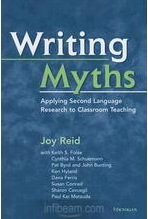 |
|
| Publisher: | Ann Arbor: University of Michigan Press | ||
| Pages | ISBN | Price | |
|---|---|---|---|
| Pp. x + 207 | 978-0-472-03257-0 (paper) | $24.95 U.S. | |
According to its back-cover synopsis, Writing Myths: Applying Second Language Research to Classroom Teaching (hereafter referred to as Writing Myths) provides a resource of “best practices” geared toward helping writing instructors avoid perpetuating some commonly held myths about the teaching of writing, especially to second language learners.
Each of the first eight chapters of this nine-chapter book, all written by highly authoritative figures in the field of second language writing, deals with a different myth:
- Teaching vocabulary is not the writing teacher’s job (K. S. Folse)
- Teaching citation is someone else’s job (C. M. Schuemann)
- Where grammar is concerned, one size fits all (P. Byrd and J. Bunting)
- Academic writing should be assertive and certain (K. Hyland)
- Students must learn to correct all their writing errors (D. Ferris)
- Corpus-based research is too complicated to be useful for writing teachers (S. Conrad)
- Academic writing courses should focus on paragraph and essay development (S. Cavusgil)
- International and U.S. resident ESL writers cannot be taught in the same class (P. K. Matsuda)
The concluding chapter by Joy Reid, who conceived this book project, discusses both commonly known and tacit myths that students hold about academic writing and teaching.
This book’s many strengths include:
- asking each author to draw on personal classroom experience and expertise relevant to his/her chosen myth;
- providing pertinent empirical research to discredit each myth, accompanied with helpful, theoretically informed recommendations based on each author’s own proven, practical, and actionable pedagogical strategies and practices;
- incorporating both instructors’ and learners’ perspectives in its consideration of the myths;
- offering content written in non-technical language, with any specialized terms clearly defined, thus making the volume accessible to aspiring, novice, and seasoned instructors alike; and
- following an easy-to-read format throughout the book.
In each chapter, a section titled “In the Real World” provides the author’s own take on the ways a particular myth is practiced in the classroom, which is followed by explanations discrediting the myth based on current and key empirical research in a section titled “What the Research Says and Shows.” In the next section, “What We Can Do,” the author presents best practices for addressing the myth. Each chapter concludes with “Questions for Reflection” that help readers relate the chapter’s content to their own teaching contexts.
Among the chapters I especially enjoyed reading, I appreciate Conrad’s and Matsuda’s chapters for their timeliness. Conrad’s chapter on the myth about corpus-based research echoes what I have encountered in my own teaching of future English-as-an-additional language (EAL) practitioners in recent years. I have found, however, that the resistance often goes beyond the myth that corpus-based research is too complicated to be useful for writing teachers. In one of my courses, students’ informally surveyed instructors at their affiliated ESL institutions regarding their beliefs about using corpora in their teaching. These instructors overwhelmingly indicated that learning to use corpora, even without incorporating efforts to introduce students to their effective use, is too time-consuming and complicated.
Matsuda’s chapter on the myth about the integrated teaching of U.S. resident ESL students and international students is opportune, considering that, in these challenging economic times, tailoring courses to the specific needs of these two distinct groups of learners may no longer be an option. In my experience, most basic composition or professional writing courses combine (resident ESL and international students, sometimes even merging them with native English-speaking students. Instructors from the English department teach these courses, and, with students’ best interests in mind, instructors openly and candidly express their belief that academic training in English does not equip them with the necessary expertise to address ESL, resident or international, writers’ needs. Matsuda’s discussion and recommendations on how best to teach the two distinct groups of students in the same course may benefit writing instructors facing such challenges for the first time. However, instructors who are not prepared or are just beginning to recognize the expertise needed for work with ESL-related language issues and needs may still be uncertain about how to address the immediate demands of teaching such courses after reading Matsuda’s recommendations for practicing self-reflective teaching. As Matsuda himself points out, effectively teaching distinct groups of students in the same course is a complex matter, and “it is impossible to come up with one-size-fits-all solutions” (p. 171).
Some additional thoughts arose while reading the book. First, the book focuses heavily on English for academic purposes. Apart from those instructors who teach ESL to university- or college-bound students, university writing instructors, who constitute the great majority of those who teach ESL for academic purposes, nowadays are much better informed through the wealth of resources available to them via variously mediated means, such as conferences, online resources, articles, and books. Reflecting on my personal experiences and encounters with teaching professionals over the years, I think that some myths included in the book may no longer be as widely propagated as the authors suggest. At my previous and current academic institutions, most instructors do not seem to cling to most myths presented in the book. For example, few would agree with the validity of practice embodied in such statements as, “where grammar is concerned, one size fits all,” “students must learn to correct all their writing errors,” or “academic writing courses should focus on paragraph and essay development.” Further, when it comes to the myth that “students must learn to correct all their writing errors,” for example, it is learners’, rather than teachers’, deep-rooted beliefs that can be more challenging for writing instructors to dispel. Students’ beliefs— for example, that students must learn to correct all their writing errors (much like the idea that the conjunctions “but” or “and” should never be used at the beginning of a sentence; that they should never end a sentence with a preposition; that writing in the passive voice is “good” or is “bad,” depending on the student’s academic discipline; or that the discursive “I” should be avoided at all costs in formal academic writing to maintain objectivity)—thus deserve consideration from the learners’ perspective.
Along with my thoughts about writing errors, I recognize and firmly believe in awareness-raising activities (e.g., Huang, 2008, and in press) carefully designed to raise learners’ awareness of their own, as well as other established writers’, lexico-grammatical choices or patterns of linguistic features in different communication contexts as the first step toward self-regulated learning. Such awareness-raising may be more effective than directing students’ attention to error correction or tabulating each students’ number of errors for each of the different error types (pp. 112-113). Still, the challenge may be to find a delicate balance among activities that promote “noticing” (Schmidt, 1993) deviated forms in their writing, without making students become overly doubtful or fixated on the surface of the building when the problems needing attention might instead be more related to the structure’s foundation–and without losing sight of the importance of celebrating the richness of students’ ideas and how they express them.
Second, although these chapters addressing the selected myths are both valuable and enjoyable to read, the book could be further developed to consider empirically substantiated, pervasive, and persistent writing myths derived from empirical studies. This broadening might include scientifically surveying myths held by both learners and their instructors at different proficiency levels or with different language-learning/teaching purposes (e.g., English for general purposes, English for academic purposes, or English for specific purposes). Such an analysis would also enable the provision of more specific pedagogical strategies and suggestions in some chapters, as, for example, Schuemann, Hyland, and Reid attempted to do in parts of the “What We Can Do” section in their respective chapters.
Third, learners’ myths merit more coverage than they receive in this book. Rather than teaching EAL learners how writing should be “correctly” learned, teaching must begin where the students are. One way to accomplish this is for writing instructors to try to understand learners’ backgrounds and beliefs that might hinder their learning processes and outcomes. Although the final chapter offers a rich discussion of learner-held myths and pedagogical advice, readers could benefit from more authors sharing some of the most persistent myths held by their students and of ways they have found effective to keep such myths from interfering with students’ learning. In addition, Reid’s suggestion about “referring students to external sources, particularly writing labs or help centres available on the campus” (p. 181) to help dispel students’ grammar-related myths deserves a separate discussion of its own on a whole host of recurring writing centre-related myths (those held by students at the undergraduate and graduate levels, as well as by faculty). Here’s a partial list:
- that only poor or inexperienced writers visit writing centers;
- that writing tutors will proofread entire papers; and
- that writing tutors are knowledgeable about the specialized knowledge to be communicated.
Last, although Reid carefully notes in the introductory chapter and at the beginning of the final chapter that the latter chapter differs from the preceding chapters in coverage, I still think that readers would have benefited from learning about relevant, up-to-date empirical studies. My own experience of teaching graduate-level EAL students has shown me how, when teaching a group of aspiring or experienced researchers, citing relevant studies can be very powerful and convincing evidence for dispelling misconceptions about different domains of academic communication skills.
Writing Myths is a welcome, worthy, and useful addition to the field of second language writing that will prompt writing instructors to question their own beliefs and assumptions, as well as their students’ known or hidden beliefs about the teaching and learning of second-language/academic writing. The authors’ sharing of the valuable expertise, experiences, and insights that inform their teaching of second language writing will also benefit writing instructors. From now on this book will be required reading for all students in my classes for future EAL teaching professionals.
References
Huang, L.-S. (2008). Using guided, corpus-aided discovery learning to generate active learning.
English Teaching Forum, 46(4): 20-27.
Huang, L.-S. (in press). Potential L1 (Chinese) transfer influencing L2 (English) communication. English Language Teaching Journal.
Schmidt, R. (1993). Awareness and second language acquisition. Annual Review of Applied
Linguistics, 13, 206-226.
Li-Shih Huang
University of Victoria, Canada
<lshuang uvic.ca>
<lishih.huangutoronto.ca>
© Copyright rests with authors. Please cite TESL-EJ appropriately.
Editor’s Note: The HTML version contains no page numbers. Please use the PDF version of this article for citations.