

March 2010 — Volume 13, Number 4
Active Skills for Reading, Book 3, 2nd ed. |
|||
| Author: | Neil J. Anderson (2008) | 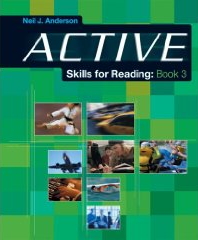 |
|
| Publisher: | Boston: Heinle Cengage | ||
| Pages | ISBN | Price | |
|---|---|---|---|
| Pp. 208 | 978-1-4240-0211-5 (paper) | $39.95 U.S | |
.
Active Skills for Reading, 2nd Edition, authored by Neil J. Anderson (2008), is a five-level reading series based on an interactive reading model that seeks to promote ESL/EFL learner reading comprehension and vocabulary skills. At each level, in addition to the student book, there are supplementary materials, including text/audio CD packages, classroom audio CDs, teacher’s manuals, an assessment CD-Rom with ExamView Pro test-generating software. Also available are supplementary website quizzes and activities. This textbook series is particularly appropriate for reading courses and can also be useful to use alongside core textbooks to develop fluent and effective reading skills.
Active Skills for Reading, 2nd Edition Student Book 3 is designed for use by young adults and adults whose skills range from high-intermediate to low-advanced. The book contains 12 thematic units, each containing two articles that relate to the central theme of the unit. Each unit begins with photographs and a series of questions that activate students’ background knowledge on the topic prior to actually starting the reading. Following the reading texts are reading comprehension questions, vocabulary exercises and post-reading discussion questions. The last section of each unit—“Real Life Skill”— develops the students’ ability to apply what they have learned to the real outside world. These post-reading exercises are presented in a variety of task types to reinforce learner understanding of the words being taught. The “Review Units,” newly added to this second edition, helps students improve their reading rate. The target vocabulary words are presented in subsequent articles as well as in the “Review Units,” a useful technique that allows students to recycle their new words, and in turn reinforces students’ retention of these vocabulary words. In addition to helpful exercises for consolidating vocabulary, the “Vocabulary Index” and “Prefixes and Suffixes” presented at the end of the text make review easy and convenient for students.
The reading texts present a wide range of topics related to real-life issues, such as travel, fashion, health, and education. Such topics encourage understanding and critical thinking about the students’ worldview and also bring more excitement and interest to the learning. Aside from offering high-interest reading passages, the text also has a well-designed cover and visual imagery that is attractive and likely more appealing to students.
The author also includes a wide variety of realistic text genres, such as news stories, interviews, blogs, and travel brochures, to offer a variety of reading experiences and more importantly, promote purposeful reading. With its array of authentic articles, particularly those related to American culture, students are likely to be more motivated to learn and practice English. Most language teachers will agree that culture learning is an integral part of language learning. Indeed, teaching the culture of a target language should not be overlooked; especially in EFL learning environments where everyday input of authentic language use and culture are usually unavailable outside the language classroom.
The intention of this textbook is to cultivate more active readers and encourage learners to engage in both bottom-up and top-down reading processes and help them make full sense of and interact with different reading texts. Another noteworthy feature of this book is that skills for reading and vocabulary learning are fully and clearly incorporated to enable teachers to help their students build reading fluency and broaden their vocabulary levels more precisely and enjoyably
Having using this text (both the 1st and 2nd editions) with Chinese college students in a Reading and Freshman English Course in Taiwan for three years, I find the book extremely useful in developing student reading and vocabulary competence, and in particular, improving their use of vocabulary and reading strategies. I’ve implemented vocabulary learning strategy instruction into a class for a year using this textbook and received positive feedback from my students. The major strength of this text is that it provides concise guides and guided exercises that help learners to develop the important skills they need for effective reading and vocabulary learning.
The first section of the textbook introduces the general concept of reading and vocabulary learning skills and also discusses their usefulness in the classroom. The introductory section can also be used to conduct a one-time strategy training session. A short survey, containing a set of questions asks about students’ reading habits and can be easily utilized to raise learner awareness of reading strategies. Skills for vocabulary learning and reading are presented in another two parts that are separate, namely “Vocabulary Learning Tips” and “Tips for Fluent Reading”. These sections allow students to reflect on their own learning strategies and introduce the students to specific useful skills that are available for them to use.
Subsequently, in each chapter, selected skills are emphasized with detailed explanations and examples. Students can take the opportunity to become familiar with these skills by practicing them using the guided exercises or suggested activities. The vocabulary learning skills highlighted in the book include making inferences by using context clues, grouping words, creating word webs, learning affixes and roots, and creating sentences using new words. These practice examples help learners to associate and recall vocabulary. The reading skills offered in the text, such as predicting, skimming, and scanning, also help learners to improve their reading comprehension.
A number of changes have been made in this expanded and revised version, and they do assist teachers further to help their students develop the skills needed for reading success. Overall, this book is comprehensive. There is one suggestion this reviewer might make. In addition to the general tips for fluent reading presented in “Tips for Fluent Reading,” such as “find time to read every day,” “look for a good place to read,” “and use clues in the text to make prediction,” the author could have added a section that illustrates core reading strategies and skills. It can be useful when learners are given an additional introductory session that shows them how to approach different text genres, such as novels, newspapers, nonfiction, and also how to tackle reading comprehension for these different types of reading comprehension. There could be types of questions that address the main idea, details, inferences, and unknown words in these selections. Many of my students have mentioned that the “Vocabulary Learning Tips” in the introductory section are extremely helpful as a general overview of strategies for vocabulary learning. They used them to systematically record and review vocabulary. Learners would benefit from an extra introductory reading strategies section, similar to how the author already presents the skills for vocabulary learning in the “Vocabulary Learning Tips” section.
I strongly recommend this comprehensive textbook to ESL and EFL teachers who wish to develop their learners’ reading comprehension and lexical competence. Improving learners’ learning strategy use is perceived as a key to enhancing language acquisition. This textbook addresses the current concerns regarding promoting learner autonomy and independence by incorporating essential skills for reading and vocabulary learning. Its notable features also make it an excellent instructional resource for integrating strategy instruction into actual classroom practice.
Ying-Chun Lai
Chung Shan Medical University
yingchun csmu.edu.tw
| © Copyright rests with authors. Please cite TESL-EJ appropriately.
Editor’s Note: The HTML version contains no page numbers. Please use the PDF version of this article for citations. |