

September 2010 – Volume 14, Number 2
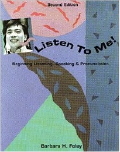
Listen to Me! Beginning Listening, Speaking & Pronunciation |
|||
| Author: | Barbara H. Foley (2010) |
 |
|
| Publisher: | Boston, MA: Heinle, Cengage Learning | ||
| Pages | ISBN | Price | |
|---|---|---|---|
| Pp. vii + 116 | 978-1-4240-0378-5 (paper) | $37.95 U.S. | |
Listening is the most frequently used language skill because people listen twice as much as they speak, over three times more than they read, and over five times more than they write (Morley, 1984). Also, Nation & Newton (2009) asserts that listening is vital in learning a language because “it gives the learner information from which to build up the knowledge necessary for using the language; and when this knowledge is built up, the learner can begin to speak” (p. 38). However, it is a difficult skill because “learners have to recognize the linguistic information from an acoustic signal in real time and make meaning from it” (Chapelle & Jamieson, 2008, p. 125). Therefore, on the way to helping students become good listeners, it is important for teachers to choose an appropriate textbook for particular students in a particular class in a particular program.
Listen to Me! Third Edition is specifically designed for low-intermediate-to intermediate-level English as a Foreign Language (EFL)/ English as a Second Language (ESL) students such as high school students, college-level students, and adult learners. The book is accompanied by four CDs with a variety of voices. Using real-life topics, high-interest narratives, and natural speech, Listen to Me! teaches not only listening skills but also speaking skills relevant to students’ lives. Moreover, the book provides students with specific listening strategies to form hypotheses, predictions or inferences and to determine setting, interpersonal relations, mood, topic, the essence of the meaning of an utterance or the main idea of a passage (Mendelsohn, 1995). The author’s goal is ultimately to familiarize students with such above listening strategies through high interest narratives and informal conversations as well as foster student encouragement and confidence in their ability to understand their new language.
Listen to Me! comprised fifteen units; each unit has five sections with the same format. The first section, “Before You Listen” introduces the topic of the unit with discussion questions that help stimulate students’ interest and ask for students’ experiences and background knowledge.
The second section, Listening 1 includes a one-to-three minute narrative or conversation. Before listening, a series of small pictures is provided to direct students to use visuals to predict, make guesses, get the main idea, or understand the relationship between speakers. After listening, different comprehension activities are provided to encourage students to share information they remember from listening. These activities focus more on comprehension of the story than the structure. The final exercise in this section “What do you think?” aims at encouraging students to express their own opinions about the story or the characters.
The third section is Structure and Pronunciation, which consists of three exercises. In the first exercise, students are given a specific tense and asked to complete sentences from the listening passage with the verb in the target tense. Following is a dictation exercise that asks students to listen and write from five to ten sentences using the target tense from the listening passage. Pronunciation activities follow, including imitation of words, phrases and sentences; rhyming; minimal pairs; and listening discrimination. Such activities provide integrated practice between segmental and suprasegmental features that are very important for developing learners’ speech intelligibility, comprehensibility, and accentedness.
Three to six short conversations or announcements associated with the topic are included in the fourth section Listening 2. These conversations or announcements use authentic language and are much more difficult than the conversations or narratives in the second section. The focused listening strategy is to guess the general meaning of the conversation, helping students become familiar with common conversation techniques such as expressing agreement or disagreement, checking or repeating information.
The final Speaking Section offers freer communicative practice through two or three follow-up speaking activities based on the unit theme. Through debates or sharing personal stories, ideas and opinions, the activities enable students to make connections between the focused practice at the beginning of the lesson and the freer language use at the end.
In terms of linguistic content, Listen to Me! includes a variety of listening comprehension and listening discrimination activities to foster better listening strategies; integrated pronunciation and grammar exercises to improve students’ speaking skills; and short dictation exercises to help students focus on individual sounds, words, and grammar points. In addition, group speaking activities at the end of each unit help personalize the language and allow students to use the skills they have learned.
As for thematic content, Listen to Me! covers real-life topics that are relevant to the backgrounds and interests of pre-intermediate-level students such as school, money, job, family, interests, and daily activities. They are not construed as offensive or culturally inappropriate for ESL/EFL students. The illustrations, design elements, exercises, and examples are appropriate for college-aged students and their educational level. Although, unlike other listening textbooks, this book does not include an index or appendices, it provides an audio-script for additional aids to both teachers and students. One of the outstanding features of Listen to Me! is that it provides the familiarity of consistent lesson patterns. This is important because knowing what to expect in each lesson will help students proceed confidently (Wong, 1985).
Listen to Me! is reader–friendly and easy to use. In other words, since this book is a basic listening textbook, the tasks or exercises followed by detailed explanations and examples are suitable for teachers to use and for students to learn. The book fits nicely into a 15-week listening course for pre-intermediate- level students in ESL/EFL contexts who have never practiced listening and speaking before. With fifteen units presented in an increasing degree of complexity and difficulty, the students will feel challenged but stimulated and have the opportunity to develop some expertise and pride in their increased competency in listening, speaking and pronunciation.
The only reservation I have about the book is that there is no teacher’s manual. Instructions for implementing the parts of a lesson are not provided in a preface entitled “To the Teacher.” Thus it is likely that novice teachers will have some difficulty in using. To compensate for this gap, inexperienced teachers who are going to use this book can seek informal support from experienced teachers by talking with them about how to implement it in their class.
Overall, I highly recommend Listen to Me! because it is more than just a listening textbook. Integration of listening, speaking, and pronunciation makes the book a resource for both teachers and students. I believe that students will benefit greatly from it. Listen to Me! can be used as a core textbook or a supplement for self-study. The answer key and audio-scripts are additional aids to both teachers and students. The units get the goal introduced at the beginning of the book and the tasks reflect what students are likely to experience in their lives in English-speaking countries. I believe that any teacher working with pre-intermediate-level students will find this book most effective.
References
Chapelle, C., & Jamieson, J. (2008). Tips for teaching with CALL: Practical approaches to computer-assisted language learning. White Plains, NY: Pearson Education.
Mendelsohn, D. (1995). Applying learning strategies in the second/foreign language listening comprehension lesson. In D. J. Mendelsohn & J. Rubin (Eds.) A guide for the teaching of second language listening (pp. 132–150). San Diego, CA: Dominie Press.
Morley, J. (1984). Listening and language learning in ESL: Developing self-study activities for listening comprehension. Orlando, FL: Harcourt Brace Jovanovich, Inc.
Nation, I. S. P., & Newton, J. (2009). Teaching ESL/EFL listening and speaking. New York: Routledge.
Wong, F. L. (1985). When does teacher talk count as input? In S. M. Gass & C. G. Madden (Eds.), Input in Second Language Acquisition (pp. 16-50). Rowley, MA: Newbury House.
Reviewed by
SonCa Vo
Northern Arizona University, USA
<stv6 nau.edu>
| © Copyright rests with authors. Please cite TESL-EJ appropriately.
Editor’s Note: The HTML version contains no page numbers. Please use the PDF version of this article for citations. |