

September 2010 – Volume 14, Number 2
Working with Images |
|||
| Author: | Ben Goldstein (2008) | 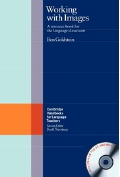 |
|
| Publisher: | Cambridge: Cambridge University Press | ||
| Pages | ISBN | Price | |
|---|---|---|---|
| Pp. x + 242 + CD-ROM | 978-0-521-71057-2 (paper) | $34.00 U.S. | |
That it is a good idea to use images in the language classroom is a notion that is hardly debatable, but which images to choose and for what end, as well as how to use them, is a topic open for discussion. Working with Images is a carefully organized resource book written for ESL/EFL teachers that is filled with practical activities and detailed suggestions for how to make use of myriad image types in the classroom. It could easily be adapted for the teaching of any foreign language.
Author Goldstein promotes the importance of using visual images in the language classroom and aims to enable teachers to use a wide variety of image types. Shifting the image to a more central place allows for greater exploration of the cultural and political impact of images as well as analysis of image construction, while still retaining the traditional vocabulary-building benefit that comes with image use. New as well as experienced language teachers whose students are any age group or proficiency level can benefit from consulting this book and its accompanying CD-ROM.
The book is composed of an Introduction and seven chapters divided into two major sections. Section A, Activity types, includes Chapters 1 through 4 (1-Describing images, 2-Interpreting images, 3-Creating images, and 4-Imaging). Section B: Image types, includes the remaining three chapters (5-Signs, symbols and icons, 6-Advertising images, and 7-Art images).
The final chapter is followed by a short Further reading section. There is no index. The images in the book are black and white, and most are from Google or Flickr. The CD-ROM has about 500 color images in PDF files that are labeled to correspond with sections of the book. Access to the Internet and a projector is for the most part presupposed, although suggestions for how to use the images in a more low-tech manner are also provided.
The Introduction touches on the importance of visual literacy in the classroom, historical aspects of image use in language learning, image composition and its relation to text, the power of images and how to choose them for classroom use, and tips for using Internet resources and the CD-ROM in conjunction with the text. Goldstein promotes the use of “real” images (p. 9) and favors the Internet as a source. He suggests telling students that images “do not have fixed, predetermined meanings” (p. 9) and that they “are socially constructed and culturally dependent” (p. 9). He also advocates choosing images with obvious representational meanings as well as rich associations that can be readily described, interpreted, analyzed and/or created.
Each of the subsequent seven chapters begins with a brief overview that is followed by a set of subsections written in lesson-plan style, a format that allows teachers to easily adapt them to suit the particular needs and interests of their students. Each of the 91 subsections consists of an activity title followed by a shaded box that contains a brief Outline (the activity’s objective), Focus (linguistic practice), Level (usually a range), Time (most are from 20 to 45 minutes) and Materials and preparation. This shaded box is followed by Procedure involving several steps. Where appropriate, answers or sample answers to questions are given. After this there might be a Follow-up activity or one or more Variations and/or Notes.
Section A, Activity types, centers around “what you can do with images (describing, interpreting, creating and visualizing them)” and offers “generic activities that could work with a number of different images and image types” (p. 12). Chapter 1, Describing Images, contains activities for basic image description. Chapter 2, Interpreting Images, moves beyond basic description to image analysis; students interpret images from affective, compositional, and critical perspectives. Chapter 3, Creating Images, gives prominence to student-centered activities. Students create collages, caricatures, photo stories, movie storyboards and more, which can then be used for conversation and comparison. In Chapter 4, Imaging, words or images are used to evoke and develop mental images that are then shared through language.
Section B, Image types, focuses on the types of images that can be used to do the activities delineated in the first section; it “features tasks which are more specifically related to particular images” (p. 12) and includes not only analysis but also many opportunities for image creation. In Chapter 5, Signs, symbols and icons, symbols are asserted as useful because they “can be easily created and are highly resonant” (p. 142). Students analyze these types of images in context and in association to culture, which results in raising intercultural awareness and understanding denotation vs. connotation. Chapter 6, Advertising images, provides activities for students to analyze the strategies and techniques of advertisers and thereby “interact with advertising on an engaging and critical level” (p. 180). Many of the tasks in this chapter explore the relationship between image and text in advertising. Chapter 7, Art images, is the final chapter; it poses questions of artworks just as of more mundane images; images for analysis include not only paintings but also photos and pop culture items such as album covers and cartoons.
Goldstein’s promotion of image use in the language classroom is to be applauded. But even though he states that text and image “should work alongside one another, on an equal footing” (p. 5), teachers will have to look elsewhere for meaty written texts to serve as linguistic input for language learning. And Working with Images is so dense with detail that quickly finding exactly what one wants and needs from it may prove challenging for the busy teacher. An index and/or alternate table of contents that points users to the specific language structures that can be practiced as well as groups the activities according to target age groups and proficiency levels would make this book easier to use.
These minor shortcomings aside, Working with Images is a wonderful resource book that can be opened at any subsection and deployed immediately. In my freshman composition classes designed for international art students, I expect to select activities and image types from it frequently, and I heartily encourage other teachers to do likewise.
Reviewed by
Patricia Kilroe
California College of the Arts, USA
<pkilroe cca.edu>
| © Copyright rests with authors. Please cite TESL-EJ appropriately.
Editor’s Note: The HTML version contains no page numbers. Please use the PDF version of this article for citations. |