

September 2010 – Volume 14, Number 2
What I Believe 2: Listening and Speaking about What Really Matters |
|||
| Author: | Mary E. Ward (2008) | 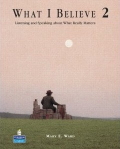 |
|
| Publisher: | White Plains, NY: Pearson Education Inc. | ||
| Pages | ISBN | Price | |
|---|---|---|---|
| Pp. xii + 139 | 978-0-13-159193-6 | $24.00 U.S. | |
Around the world, the need for a working knowledge of English has expanded into virtually every field and occupation. This broad demand for English language instruction has led to explosive growth within the field of ESL/EFL textbook writing. One need only peruse the language learning section of any bookshop to see the vast array of English teaching material available. Although one might find any number of books designed with similar content or a relatively similar format, this abundance of English teaching resources has also fostered many unique approaches. Thus, as material writers attempt to tackle the issue of an ever-broadening learner landscape, various English textbooks that use a distinct and novel approach are beginning to appear. Mary Ward’s What I Believe 2 represents one such effort.
This text is the second of a two-level series focused on exploring and sharing personal beliefs as a method for developing and deepening ones English knowledge. By using the unique perspective of a personal philosophy for living, Ward has crafted a special English textbook. Aimed at high-intermediate English speakers, What I Believe 2 knits together in a cohesive whole, a series of twelve unique narratives. These stories are written by individuals who share a personal essay based on a core value they use as a guiding principle in their daily lives. On the strength of the personal essays the author engages students using various communicative language activities that can be easily enriched with instructor-developed, class-specific, supplemental material. This textbook is written for instructors who have an eye to broaden class discussion based on their students’ own unique life experiences. Using this approach the text acts to personalize the learning environment and reach out to all possible members of a class. What I Believe 2 is accompanied by a class CD highlighted by the fact that each of the 12 essays is read by the original writer, offering learners twelve unique voices and accents. The textbook is further supported by a teacher’s resource book that includes full text versions of the essays as well as a complete answer key for all of the exercises.
Although most instructors seldom consider the size and shape of a textbook, this particular one deserves mention. While What I Believe 2 is colourful with an attractive, easy-to-understand layout, it was its size and shape that garnered the most praise from my students. While using this textbook as a core component of a listening class in an English teacher training program, all of the students surveyed rated the textbook’s light weight and compact size as excellent and very convenient. Regarding the content, the text is broken down into twelve well-structured, accessible chapters which present a wide-range of personal beliefs and guiding principles. These include topics such as tradition, hope, making choices, cooperation, encouragement, creativity, overcoming obstacles, and giving of oneself. Each topic is introduced to the students in an organized and consistent manner whereby learners become neither frustrated nor overwhelmed. The progression through the textbook seemed quick and engaging as each new story was read by its original author in his or her own unique voice. In each unit, by highlighting new characters and their respective personal essays, the material remained fresh, kept learners interested and ultimately found appeal with all participants at some point during the course. As the focus of the book was on presenting individuals and their core values, the order of the chapters and the transition between topics were of less importance than in traditional grammar focused textbooks. In fact, by structuring What I Believe 2 in the manner she does Ward offers a broad and amusing cross section of the rich expanse of personal topics available for discussion in an English class.
In her approach to organizing the units, the author successfully blends traditional language tasks such as “fill in the blank” and “true/false” exercises with more exploratory personal activities that require learners to give personal insights and reflect on their own beliefs relative to the topic of each unit. The tasks within each chapter do however, follow a consistent layout: Raising awareness about the topic through pre-listening, pre-discussion and vocabulary highlights; Listening; Vocabulary; Speaking; and Writing. She provides an initial look at the topic with the presentation of lower-frequency vocabulary in the glossary section. The “listen for main ideas” task then follows and introduces the students to the core belief found within the unit’s essay. At this point, the most unique aspect of the textbook is introduced for the first time. The original writer of the essay also acts as the reader of the essay. In so doing, the reader expresses his or her strong, personal connection to their chosen topic and offers the listener not only authentic pronunciation, emphasis, and intonation but also genuine emotions! This uniquely personal aspect of What I Believe 2 enhances the learning experience for all the class participants. Learners continually commented on the optimistic, touching, and inspiring feel of the stories they were hearing, studying and discussing.
Whilst the main language skills of listening, speaking, writing and reading as well as grammar points offer learners the familiarity of traditional textbook exercises, their presentation built around a spoken essay represents a powerful divergence from the traditional norm that students have come to know and expect when studying a language. The textbook opens with a “Scope and Sequence” overview that not only includes the five goals for each unit but also a photograph of the essayist. Therefore, when the students consider the five goals for each unit, the topic, a language focus, a pronunciation point, a language function, and a speaking task, they do so with a clear image of the essayist in mind. This personal touch helps to draw the learners into the unit beyond a more typical textbook chapter filled with language questions.
Following the listening for main ideas task the remainder of the activities are laid out as follows: Vocabulary for comprehension which focuses on higher-frequency words from the essay, listen for details to challenge the listener’s receptive skills, a discussion task called “reacting to the essay”, a speaking section which offers both a language structure and a pronunciation task, “Get ready to speak” is an opportunity for students to talk about the unit’s principle topic, and finally a writing activity that instructors may use to bring the focus of the unit to a deeper more personal level. Also found in each unit are cultural and background notes that provide the learner with relevant historical and cultural information about both the essayist and their chosen core belief. Each unit opens with a personal introduction to the essayist and ends with the student being asked what they believe relative to that unit’s guiding principle. This tactic functions nicely to tie the students’ learning experience to the personal voices of the writers, the writer’s core value and ultimately the goals of the textbook.
Although the teacher’s resource book doesn’t offer supplemental exercises, all of the essays presented in this text can be found online at the “This I Believe” website – the program that the “What I Believe” textbooks were modelled after (http://www.thisibelieve.org).
The unique approach and personal tone of the textbook encourages and motivates learners. The author has compiled twelve essays that connect English language learners to the stories of real individuals. She has offered excellent activities that not only develop students’ language ability but also reinforce in us all, the fact that language in any of its various forms functions as something both personal and cultural.
As a unique and interesting learning resource Ward succeeds admirably. Her textbook presents an engaging array of tasks and content that can be adapted to suit a variety of listening and speaking needs. With its variety of essays, authentic language, personal content and practical language tasks, What I Believe 2 can be recommended as either the main or supplemental textbook of a high intermediate English listening and speaking course. Moreover, after using this textbook I was left with the impression that not only had my students’ English learning benefited, but that both they and I had grown on a personal level as well. In short, I was impressed with both the educational and emotional considerations that went into producing this book. In this respect, the author’s efforts are well-deserving of the credit and praise they will surely receive.
Reviewed by
C. Dion Clingwall
Fukuoka University, Japan
<dclingwall gmail.com>
| © Copyright rests with authors. Please cite TESL-EJ appropriately.
Editor’s Note: The HTML version contains no page numbers. Please use the PDF version of this article for citations. |