

September 2010 – Volume 14, Number 2
The Cambridge Guide to Second Language Teacher Education |
|||
| Author: | Anne Burns and Jack C. Richards (Editors) (2009) | 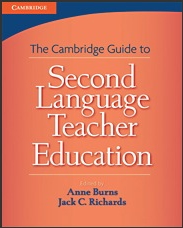 |
|
| Publisher: | Cambridge: Cambridge University Press | ||
| Pages | ISBN | Price | |
|---|---|---|---|
| 325 pages | 9780521756846 | $41.00 U.S. | |
Second language teacher education (SLTE) scored one chapter only in the Carter and Nunan (2001) Cambridge Guide to Teaching English to Speakers of Other Languages. Eight years later the same series gives us a long-awaited complete volume on the topic, adding another layer to the Cambridge reputation for SLTE publications.
A systematic way for readers to track down themes of interest through the thirty chapters would be via the seven section headings: professionalism, pedagogic knowledge, and research and practice being three examples. The introduction to each section is a guidepost. Thus an interest in ways of offering SLTE courses leads to Section Five, Contexts for SLTE. Here the four chapters refer to the course room (Singh and Richards), the school (Legutke and Schoker-v.Ditfurth), distance learning (Hall and Knox) and technology (Reinders). Section Three, on pedagogical knowledge, has chapters by Graves (writing about the curriculum), Bartels (knowledge about language) Ellis (SLA) and Hedgecock (discourse conventions). Following this trail my attention was caught by the details from Hedgecock, who supplements a theoretical discussion with lists of advice for starting practitioners, such as a four-step pair task for analysing a reading selection (p. 148). Following the thread on SLTE though research and practice (Section 7), I found three chapters, each by widely published authors, one of them Burns herself on action research. McKay’s “Second language classroom research” (Chapter 28) would be a starting point for new researchers wanting an overview of the topic before plunging into more detail via the lists of readings at the end of the chapter.
Following up topics in which one is already interested is, however, only one approach to reading the collection. In an edited collection, unlike a single authored volume, it is inevitable (and a strength) that threads recur from chapter to chapter. Therefore a more exploratory way of using the book would be to choose less familiar topics and then follow these through the thirty chapters, using internal references, end-of-chapter reading lists and the index. There are references to teachers’ knowledge in several parts of the book, including Johnson’s “Trends in second language teacher education” (mentioned below) and Graves’ Chapter 11 on the SLTE curriculum. Similarly each of the five chapters in Section 4 “Identity, cognition, and experience in teacher learning”, while complete in their own right, could lead to topics in other parts of the collection.
A third way to approach the volume would be to turn first to favourite contributors. Fittingly, the opening chapter “The scope of second language teacher education” is by Freeman, author of the single chapter mentioned above, and widely quoted by others throughout this volume. He also contributes to Chapter 8 on assessment in SLTE. I was interested to read the chapter on mentoring by Malderez, which was a useful update on her valuable 1999 work. Of course this approach would mean missing potentially interesting contributions from unfamiliar names.
In many chapters there are thoughts worth returning to. One such for me was Johnson’s reference in the second chapter to three areas that are informed by the knowledge base of L2 teacher education. According to her these are: what teachers need to know, how they should teach and how they learn to teach (p. 21). I was also struck by Leung’s characterisation of professionalism as being either sponsored or independent. The former she defines as “promoted by regulatory bodies to introduce reform… “ (p. 49) while the latter is a “more individually oriented notion” (p. 50).
There is so much more here than one review can do justice to: the plea from Franson and Holliday to include social and cultural perspectives in SLTE programmes, the insights from Kamhi-Stein into the role as educators of non-native English speakers, Ellis’s suggestions for incorporating SLA into programmes for teacher education, and Farrell’s report on the novice teacher experience. Wright addresses the need for professional development for language teacher educators.
The contributors to this collection include long-term and newer practitioners, generalists and specialists. For me it would have been interesting to read short bio-data of the writers, but looking at the Carter and Nunan collection already mentioned and at the similar anthology by Richards and Renandya (2002), I realize that this absence is probably a publishing decision.
Several groups of readers come to mind for this extensive and accessible collection apart from its obvious importance as a reference for teacher educators. For instance, I have already started recommending it to people who have taken part in mentoring programs. Individual chapters deserve to be read by students on TESOL courses as an introduction to the specifics of the field. It is also an important resource for researchers. Because so many of the chapters provide both historical reviews and state-of-the-art accounts, the book should continue to be important for many years.
References
Carter, R. & Nunan, D. (Eds) (2001). Cambridge guide to Teaching English to Speakers of Other Languages. Cambridge, UK: Cambridge University Press.
Malderez, A. & Bodoczky, C. (1999). Mentor courses: A resource book for trainer-trainers. Cambridge, UK: Cambridge University Press.
Richards, J.C., & Renandya, W.A. (Eds.) (2002). Methodology in language teaching: An anthology of current practice. Cambridge, UK: Cambridge University Press.
Reviewed by
Marilyn Lewis
The University of Auckland, New Zealand
<mn.lewis auckland.ac.nz>
| © Copyright rests with authors. Please cite TESL-EJ appropriately.
Editor’s Note: The HTML version contains no page numbers. Please use the PDF version of this article for citations. |