

March 2011 – Volume 14, Number 4
EnglishCentral
| Title | EnglishCentral |
| Contact information | http://www.englishcentral.com |
| Type of product | Speaking and listening practice website using authentic video |
| Operating Systems | Windows XP, Vista, 7
MacOS 10.5, 10.6 |
| Browsers | Internet Explorer 7.0 or higher Firefox 3.6.8 or higher Safari 5.0 or higher |
| Supplementary software | Adobe Flash Player 10 or higher |
| Price | Standard Membership: Free Premium Membership: $10/month – $40/6-months |
Introduction
English language learners and teachers in Japan have long valued EnglishCentral as a free source of speaking and listening practice using authentic and interesting videos. In fact, Larry Ferlazzo, author of a popular blog on websites used for language teaching, named EnglishCentral his #1 choice for “The Best Websites For English Language Learner Students” in 2009 (Ferlazzo, 2009). In 2010 he went further calling EnglishCentral “the best site – period – for English language learners” (Ferlazzo, 2010). This year EnglishCentral has unveiled its new site, which will continue to offer free access to areas that users have grown to love while also providing the option of paid access to a plethora of new features. Currently, registered users are being offered a free two-week trial of the Premium Membership site just by logging on.
General Description
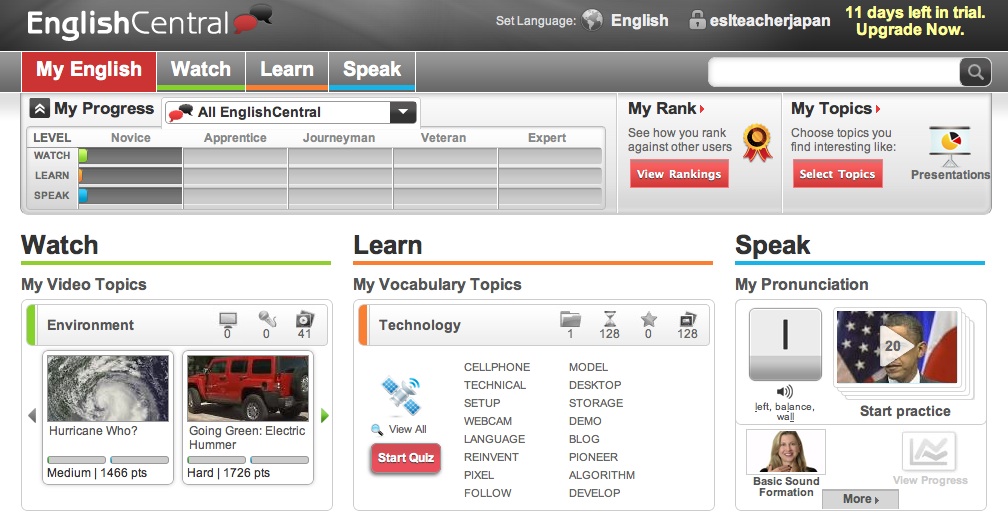 Fig. 1 My English Page
Once logged on, users will see the above My English page which clearly gives an overview of all areas of the site. The My Progress graph on the top left, which can be hidden, gives students a visual way to track their journey through five stages of development: Novice, Apprentice, Journeyman, Veteran and Expert. The My Rank section allows users to rate their progress in comparison to others. These comparisons can be filtered further by native language and goal, allowing users to more accurately gauge how they are doing in comparison to students with similar traits. Finally, by selecting My Topics on the menu, users can organize their video selections by category: business, social, travel and media English and, additionally by sub-categories such as animals, celebrity interviews, meetings and movies. An example of the topic selection process can be seen below.
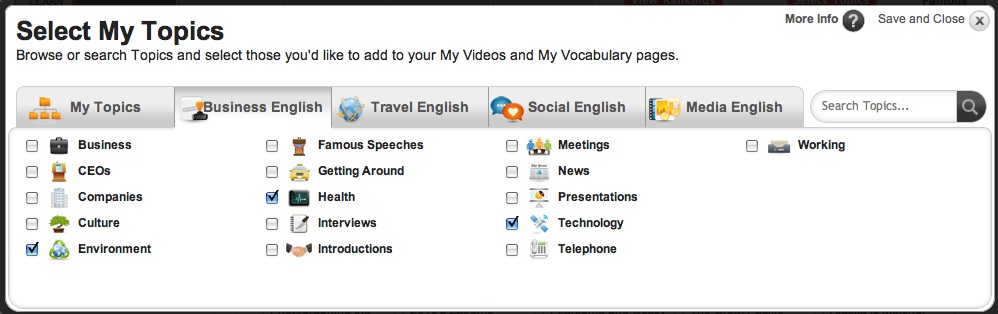
Fig. 2 Topic Selection
After tailoring the site to their preferences through topic selection, a personalized My English page will be displayed that suggests videos based on these preferences under the Watch title on the left-hand side of the page. In Fig. 1 you can see that one of the topics I selected was Environment and that two videos, “Hurricane Who?” and “Going Green: Electric Hummer” have been suggested.
Watch
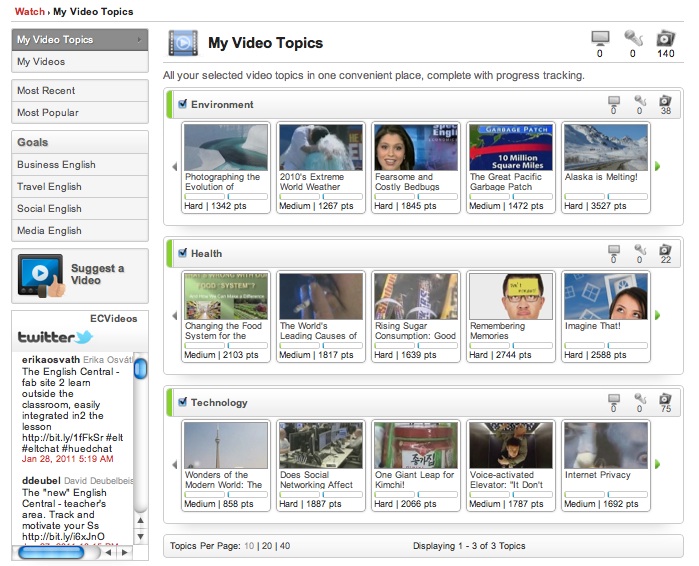 Fig. 3 Watch Page
In the center of the Watch page are suggestions for the user based on their topic selection. The menu on the left can also be used to filter video suggestions by Most Recent or Most Popular or to view videos by goals. Below this menu is a Suggest a Video button, which allows users to customize EnglishCentral even further with the videos that they want to see. Once the video is suggested it takes 1 to 2 weeks for EnglishCentral to review the selection and produce it for the site. The icons above My Video Topics, the computer, microphone and files, indicate number of views, number of times a video is spoken and the total number of videos available in that category respectively.
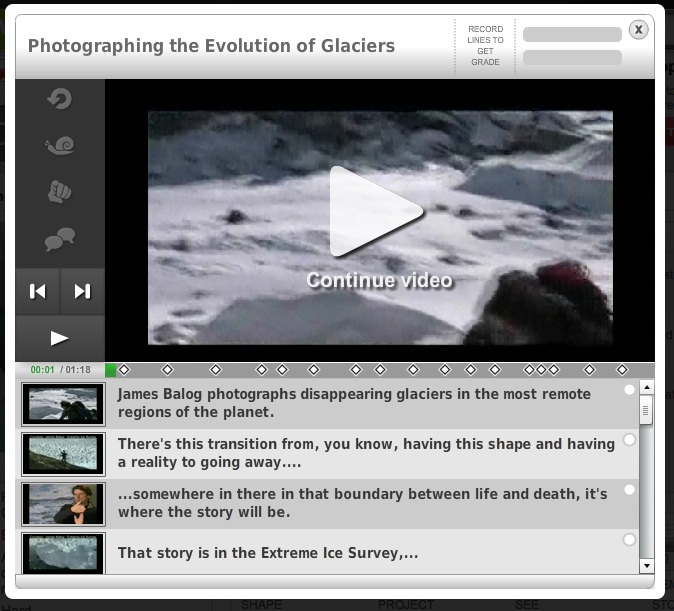
Fig. 4 Watch and Speak
Once a video has been selected, it will open in a new window in the center of the page (as shown in Figure 4 above). Below the video is a transcript in English – a Japanese translation can also be turned on. Controls are to the left of the video. The top icon, a circular arrow, allows the user to replay a line of text that wasn’t heard and the snail slows down the audio to provide scaffolding for lower level listeners. Remarkably, the slowed down version does not sound unnatural.
After listening students can “speak a video”, recording their own voice and getting feedback on their pronunciation. To do this, simply press the microphone icon below the play button (not shown in Fig. 4 since the video has been paused). When the user has finished recording, the program will give a score on your pronunciation and a visual representation of your pronunciation errors on the given line. Words highlighted in green are those where no error has been identified by the system. Words in yellow indicate a possible pronunciation error and red words are those that were not heard by the system. Below is a screen shot of the possible feedback you can receive.

Fig. 5 Speak a Video
Learn
One of the new sections being offered to premium members is the “Learn” area that emphasizes vocabulary development. Users can choose vocabulary to study by Topic, Goal or by the vocabulary that they have already been exposed to in the videos they have watched. Vocabulary can also be filtered by difficulty level by using the “difficulty slider”.

Fig. 6 Difficulty Slider
After reviewing words in context the student can then “Start a Quiz”. This will open a new window in the center of the screen that will preview each word in your chosen list. One of the unique characteristics of this preview system is that the word is paired with a video showing authentic usage in a particular context. The quiz feature is unique in that it doesn’t record a word as “learned” until a student can answer two questions pertaining to the word correctly.
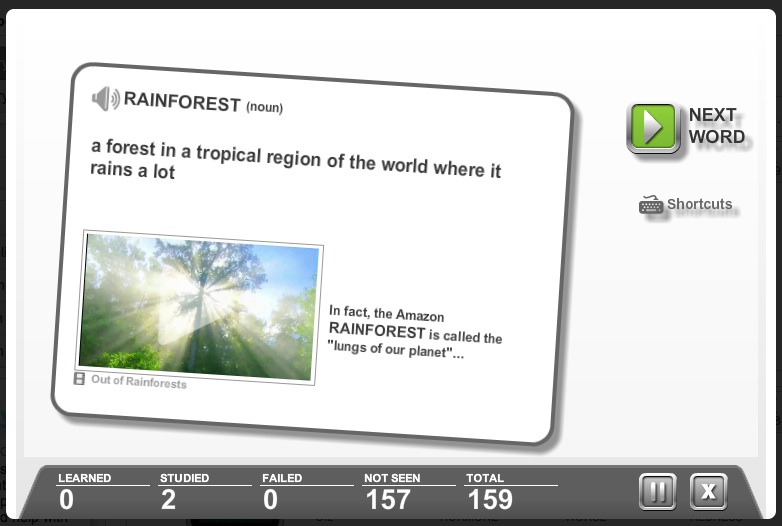
Fig. 7 Vocabulary Quiz Review
Speak
The “Speak” section is another new feature for premium members of the site. While watching and speaking videos on EnglishCentral, a member’s pronunciation “trouble spots” are identified and these weaknesses are pointed out. From there, students can get expert help from a professional pronunciation coach and can then practice those sounds in “Practice Sessions” using authentic videos with a high-frequency of occurrence of the particular phoneme that the student is studying.
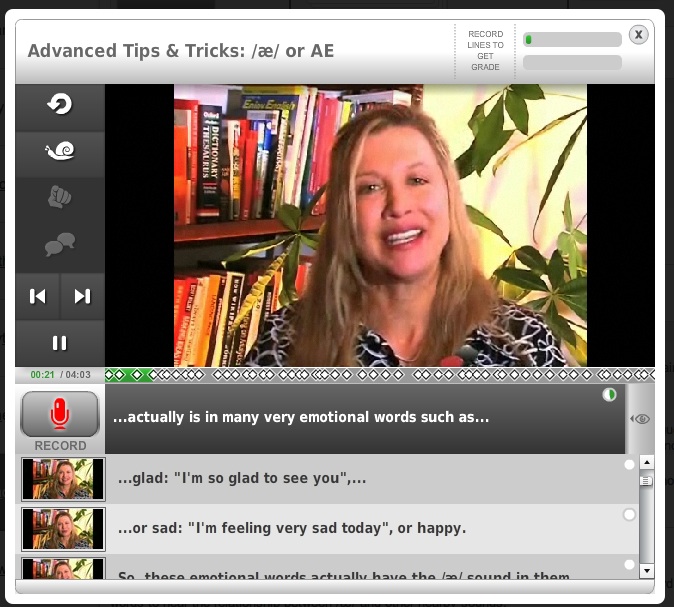
Fig. 8 Professional Pronunciation Help
Teach
The “Teach” section of the site offers instructors a great way to organize usage of the site by particular classes and manage that use over the period of a school term. Once teachers have registered they can pick a unique URL for their class. Then, goals can be set for the class by number of videos, points and difficulty level. In addition, instructors can select topics they would like their students to focus on. One of the advantages of this is that teachers can control the videos students watch, for example, business videos for a business English class but, because of the number of available videos on the site, students still have a measure of freedom in choosing what they want to study. After a class has been set up and basic parameters have been set, the teacher can manage classes easily through the Teacher Dashboard pictured below.
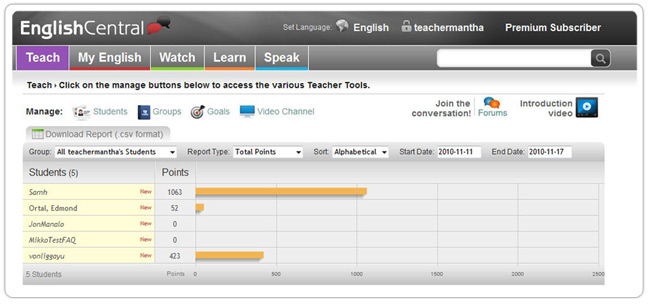
Fig. 9 Teacher’s Dashboard
Advantages
EnglishCentral is an interesting website that can provide learners with hours of listening and speaking practice using materials tailored to their needs and preferences. One of the biggest advantages of EnglishCentral is that the videos used are authentic. Gilmore writes, “Authentic materials, particularly audio-visual ones, offer a much richer source of input for learners and have the potential to be exploited in different ways and on different levels to develop learners’ communicative competence.” (2007, p. 103). When using authentic materials though, it is important that students are provided with a high-level of support, or scaffolding, to keep the input comprehensible (Gilmore, 2007). EnglishCentral does this in a variety of ways. For example, the site provides transcripts in both English and Japanese and the ability to slow down or replay videos line by line.
Another advantage of this site is that it is very student centered, allowing users to make choices about what videos they will watch based on their own interests. Tomlinson has stated that materials should “facilitate learner self-investment” (1998, p. 11). Furthermore, he suggests that this can be accomplished by giving student the ability to choose a focus or activity and to have control of the topic (Tomlinson, 1995). As EnglishCentral gains popularity this feature will become even more pronounced with users suggesting and possibly even producing there own videos to be used on the site.
Disadvantages
Despite the advantages of EnglishCentral there are a few areas where I might suggest improvement. Luckily, communication with the makers of the site has shown them to be very open to taking advice and motivated to make improvements wherever possible. For example, one limiting feature of the “speaking a video” section is that the voice recognition program is set to evaluate a user’s speech using North American English only as a standard. Of course, many of the videos on the site feature accents of other varieties of English. Therefore, there can be a discrepancy between the input that the student hears and the output they are expected to produce. In this same vain, the speech recognition software gives higher points when a user speaks slowly and clearly which might be contrary to the fast, natural speech heard in a video.
An additional concern is a lack of special discounted pricing for schools and teachers. Currently, premium membership to the site is being offered at $10 a month or $40 for six-months but no additional discount is provided to educators at this time.
Finally, one advantage of the site for Japanese users is that translations of videos and the navigation of the site itself can be provided in Japanese. Unfortunately, no other language support is yet available. This is an issue that I believe EnglishCentral will improve upon in the near future as the popularity of the site continues to grow throughout the world.
Conclusions
In sum, EnglishCentral is a huge leap forward in the area of online resources for language learning. The site has been well made, thoroughly researched and most importantly, has continually evolved and improved since its inception. There are some issues that might be improved upon, as noted in the disadvantages section of this review but, there seems to be a real desire by the creators of the site to respond to any criticisms or suggestions that they receive. Therefore, I am confident that EnglishCentral will continue to offer a valuable resource to both learners and students for a long time to come. My only real regret is that they have not yet made a JapaneseCentral to help improve my second-language ability.
References
Gilmore, A. (2007). Authentic materials and authenticity in foreign language learning. Language Teaching, 40: 97-118.
Ferlazzo, L. (2009). The best websites for English language learner students – 2009. Retrieved from http://larryferlazzo.edublogs.org/2009/11/18/the-best-websites-for-english-language-learner-students-2009/ on January 31, 2011.
Ferlazzo, L. (2010). EnglishCentral adds tools. Retrieved from http://larryferlazzo.edublogs.org/2010/04/25/english-central-adds-tools/ on January 31, 2011.
Tomlinson, B. (1998). Materials development in language teaching. Cambridge, UK: Cambridge University Press.
About the Reviewer
Daniel J. Mills holds an M.S.Ed. TESOL and works as a lecturer of English Communication and Writing at Ritsumeikan University in Shiga, Japan.
| © Copyright rests with authors. Please cite TESL-EJ appropriately. |