

March 2011 – Volume 14, Number 4
Teaching Grammar in Second Language Classrooms:
|
|||
| Author: | Hossein Nassaji and Sandra Fotos (2011) | 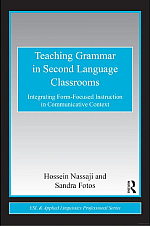 |
|
| Publisher: | New York, NY: Routledge | ||
| Pages | ISBN | Price | |
|---|---|---|---|
| 184 pages | 978-0415802055 | $41.95 U.S. | |
In an attempt to address the seesaw in second language education from the strictly grammatical to the strictly communicative, Nassaji and Fotos present a middle ground for the language teacher. The authors present what appears to be a viable alternative to exclusive second language teaching methodologies by considering the research regarding approaches that emphasize communication and that avoid neglecting the valuable place that grammar has in language studies. Basing their conclusions on their research findings as well as empirical evidence they gained from their personal experiences as language teachers, Nassaji and Fotos deftly construct a bridge between the theoretical and the practical. Teaching Grammar in Second Language Classrooms is a much-needed reminder that the successful language learning process cannot be confined to any one particular methodology or approach.
In contrast to the copious language learning books that solely address strategies without reference to research, Nassaji and Fotos take a relatively academic approach to the subject. Second language teachers are the intended audience, and much is offered to benefit those interested in language acquisition. The first chapter presents an overview of the development of such an approach: Discussing the language teaching methodologies from the Grammar Translation Method to the Audio-Lingual Method and even mentioning others like the Silent Way and the Reading Approach, readers are given a backdrop to the current debate on the inclusion of grammar in the language classroom. Traditionally, grammar-based methodologies often led to the attainment of high levels of accuracy whereas methods concerning communication allowed the learners to achieve fluency. Through their research of approaches that invested in one approach to the exclusion of the other, the authors point out numerous inadequacies of either one individually. They contend that the gaps remaining from approaching the language learning process through one lens may be filled in via the inclusion of the other.
The two-pronged approach is not merely a mishmash of communication and grammar. Throughout the book, the authors, building on Long (1991), refer to a grammatical focus as a focus on form (FonF), which “Long distinguished . . . from a focus on forms (FonFs)” (p. 10). A focus on forms means that linguistic structures are the feature of instruction, whereas a focus on form means that grammatical concepts may be taught, but they exist within a framework of communicative aims. The key, the authors claim, is that meaning and communication are central, while at the same time, grammatical points are highlighted, reviewed, discussed, and elucidated. This approach to FonF is described by the authors as “a series of methodological options that, while adhering to the basic principles of communicative language teaching, attempt to maintain a focus on linguistic forms [i.e., structures] in various ways” (p. 13). Students being taught with a FonF approach are not left with grammatical tidbits stripped of context, nor are they taught to communicate without regard for what is commonly accepted or natural. Instead, students become cognizant of acceptable usage of various aspects of the language and gain a feel for their uses in practical settings.
The authors site a meta-analysis conducted by Norris and Ortega (2001) that “concluded that L2 instruction that focuses on form results in substantial gain in the target structures and that the gains are sustained over time” (p. 9). While the kinds and nature of assessments affect the reliability of results attempting to demonstrate the merit of one approach over another, the authors claim that such research warrants a reevaluation and re-inclusion of grammar in language classrooms – the question, naturally, is thus: How can the typical second language teacher incorporate such an emphasis on grammar without resorting to traditional methods?
One of the great strengths of the book is that the authors cover the bases from the theoretical to the practical regarding grammatical emphases in instruction. Additionally, they juxtapose relevant viewpoints regarding language acquisition. In the field of SLA, in many cases there are either insufficient studies or conflicting results concerning the value of a particular strategy. For instance, the opposing ideas on the value of formal instruction and instructional strategies held by Krashen on the one hand and Smith and Rutherford on the other provide food for debate. Specifically, the authors provide examples of textual enhancement strategies that may be employed by the teacher; however, they are quick to acknowledge the “varying results [of the effectiveness of textual enhancement], from positive and facilitative effects to limited and even no effects” (p. 45). Despite the fact that a few strategies given in the book leave the reader with qualms about their generalizable effectiveness, the reader may be confident that the authors admit the potential limitations of said strategies. Nassaji and Fotos, like any respectable language teachers, are on a mission to find the most effective language teaching techniques, which at times may mean presenting and adding to data for the sake of research, even if it means that some results may ultimately be discarded.
The chapters within the book follow a general pattern: They include an introduction, a background and rationale, detailed descriptions of the instructional strategies, examples of strategies in the form of classroom activities, questions for reflection, and an annotated bibliography for further study. In this way, the book may function as a handy reference for the second language teacher. Those who wish to implement specific teaching strategies may peruse the examples given throughout the book and find those that are most suitable for their classroom needs. Those who want to go deeper into a topic presented in the book will find the annotated bibliographies helpful.
The reflection questions are valuable for language teachers and language students alike. In the chapter entitled “Focus on Grammar through Discourse”, the first question reads, “What is discourse-based instruction? How does it differ from sentence-level instruction and why is it important for L2 acquisition?” (p. 66). The reader is later encouraged to use the material within the chapter to create a lesson plan on reading authentic discourse. Being able to answer the reflection questions ensures that the reader understands first of all the fundamental ideas presented in the chapter; the reader must then understand those ideas in relation to other similar ideas as well as their application and value within the classroom. Teachers in particular should find great usefulness in reflecting by using the prompts from each chapter. Beyond the chapters, the book is divided into input-based options, output-based options, and instructional contexts. Each part of the book allows the reader to approach the focus on grammar from a different angle, resulting in a well-rounded perspective on teaching and learning grammar.
This book may fly under the radar for many in the field, yet it offers great practical value to teachers who wish to see grammar in a new light. The example exercises alone make the book a worthwhile investment as a resource for teachers. Language learning enthusiasts may even want to try something other than flashcards and audio files and deepen their knowledge of language, taking them from topics as varied as dictogloss to corpus studies to current SLA theories. Due to its relevance and expediency, Teaching Grammar in Second Language Classrooms should not be ignored.
Reviewed by
Bryan Bonner
The University of North Carolina at Charlotte
<bbonner1 uncc.edu>
|
© Copyright rests with authors. Please cite TESL-EJ appropriately.
Editor’s Note: The HTML version contains no page numbers. Please use the PDF version of this article for citations. |