

June 2011 – Volume 15, Number 1
Controversy in the Classroom: The Democratic Power of Discussion |
|||
| Author: | Diana E. Hess (2009) | 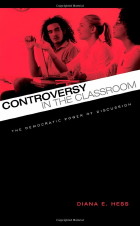 |
|
| Publisher: | New York, USA: Routledge | ||
| Pages | ISBN | Price | |
|---|---|---|---|
| 197 pages | 978-0-415-96229-2 (paper) | $35.69 USD | |
Controversy in the Classroom: The Democratic Power of Discussion seeks to express why schools provide an appropriate forum for future citizens to learn, practice, and value public discourse when grappling with controversial political issues.
Classrooms are microcosms of societies and should be developed as places to practice political behavior critical to active participation in democratic society. The heterogeneous demographic found in many classrooms can promote diverse contributions during discussions modeling citizen’s actual contributions to public policy debates. Hess argues:
[S]chools have not just the right, but also the obligation, to create an atmosphere of intellectual and political freedom that uses genuine public controversies to help students discuss and envision political possibilities. Addressing public controversies in schools not only is more educative than quashing or ignoring differences, it also enhances the quality of decision-making by ensuring that multiple and competing views about controversial political issues are aired, fairly considered, and critically evaluated (p. 6).
Controversy in the Classroom presents empirical support for issues discussion, offers structures for controversial issues discussions, shares insight about students’ experiences with controversial issues discussions and its positive impact on their prospective participation in a democracy, and addresses whether or not a teacher should disclose personal political views.
Most appealing to high school social studies teachers, Controversy in the Classroom also benefits preservice education instructors and students. Hess recognizes the potential audience in family members and the general public, as well as those implementing school policy and curriculum.
Part I of the book, The Case for Controversial Political Issues, establishes essential elements of discussion and a rationale for its use in democracy. While most may not distinguish civic education from democratic education, it is important to understand Hess’s delineation before considering her placement of discussion in democracy. Civic education suggests “fitting in” to society as it currently operates, whereas… “democratic” highlights the dynamic and contested dimensions inherent in a democracy (p. 14). I cannot perceive civic engagement as static, but the functions of dynamics and contest grew ever-important as Hess made a clear case for discussion in democracy.
Providing both US Supreme Court decisions in favor of students’ right to speak about issues in public schools and the U.S. First Amendment’s protection of minority perspectives, as well as political theorist’s and educational researchers’ findings in support of engaging students in controversial issues discussions, Hess substantially arms those wishing to initiate or sustain the use of discussion with advocacy points against barriers to its use. A resonating point is that of enhanced student perceptions of diversity and tolerance; both significant factors policymakers must attend to when ensuring competing views are addressed.
Hess supports teaching with controversial issues discussions by clarifying terminology. After describing controversial public issues, additional distinctions are made. “Too many teachers,” Hess posits (p. 42), “stop at the level of awareness of current events, and thus students are deprived of learning how to deliberate issues.” Comprehending that a current event is what is happening, while grasping that the issue involves what we should do about it, eases this deficit. To understand the roles of public and individual input in the policymaking process, public issues are distinguished from private issues. To illuminate separate roles of the legislature and judiciary, distinctions are made between constitutional and public policy issues. Hess’s defining each term and then supporting it with a teaching scenario aptly secures pedagogical content knowledge.
Part II, Inside Classrooms, Hess provides “observations” of teachers’ professional practice with this very pedagogical content knowledge. Implementation of these models provides students opportunities to cultivate and share their views about public policy issues.
Hess explores how the future citizenry learns from controversial issues discussions both empirically and practically. Discoveries yield multiple perspectives as the key asset to democratic thinking, participation, and governance. Despite available research noting only 23% of Americans participating in “cross-cutting” political talk (p. 78), discourse rendering diverse political points of view, I agree with Hess’s assertion that it is still possible to create classroom environments in which students share varying points of view about decisions surrounding public policy. Indeed, such a statistic warrants the need for such creation even more.
Expecting a definitive answer as to whether or not teachers should disclose their personal political stance, I was both disappointed and surprised not to find one. Hess’s findings that students want to respectfully deliberate their own decisions, their curiosity about adult opinions not withstanding, reminds practitioners of the need to professionally evaluate their rapport with each intended audience of a controversial issues discussion, as well as their school’s climate before determining disclosure as a part of such discussion.
In the final segment, titled after the text, Controversy in the Classroom we are reminded that teaching controversial issues is, by nature, controversial. Teachers are tasked with determining whether issues are open (resolutions remain available), closed (have reached resolve), or tipping (fluctuating between open and closed). Worthy scenarios presented for “teaching the tip” include Japanese internment, same sex marriage, and global warming. Hess posits historical concerns, having reached resolve, are closed issues and claims no need for discussion in such matters. In regards to these discussions being a moot point, I disagree. Properly designed analogies could support student learning and serve to enhance some students’ contributions to the process of democratic education thereby ensuring fundamental aspects of democratic education–multiple and competing viewpoints.
Studies conducted with preservice and practicing educators regarding controversial issues curricular decisions provide a framework to navigate professional discourse while designing discussion lessons. I would have appreciated specification as to the type of effective collegial dialogue that needs to occur to nurture and sustain effective curriculum design, lesson facilitation, and professional reflection.
Lending credence to the important role of teacher decision making in curriculum design, Hess examines the perspectives of both supplemental instructional materials and textbooks in September 11: “The Ultimate Teachable Moment.” Although not a revelation that supplemental resources were more representative of the population than textbooks were, my curiosity was piqued as to the influence of a non-profit publisher’s mission on resources’ content.
Hess’s poignant resounding of the aim of Controversy in the Classroom reinforces schools as suitable locales for all students as emerging citizens, to nurture their democratic skills:
We must concentrate our efforts on ensuring that all students have access to what we know enhances political and civic participation. High-quality education that does not serve the goals of equality is really not high quality at all (p. 172).
Controversy in the Classroom empowers teachers to effectively implement discussions of controversial issues. Elements of the text can be referenced by individual teachers or during collegial discourse to craft controversial issues discussions that will benefit student learning and, if we are fortunate enough, improve democracies.
Reviewed by
Stacy Skinner, University of Central Florida, Orlando, USA
<stacy.skinner knights.ucf.edu>
|
© Copyright rests with authors. Please cite TESL-EJ appropriately.
Editor’s Note: The HTML version contains no page numbers. Please use the PDF version of this article for citations. |