

September 2011 – Volume 15, Number 2
Q: Skills for Success |
|||
| Author: | Jaimie Scanlon (2011) | 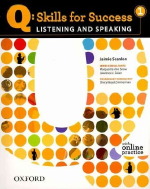 |
|
| Publisher: | Oxford University Press | ||
| Pages | ISBN | Price | |
|---|---|---|---|
| 213 pp | 978-0-19-475610-5 | $39.95 USD | |
The use of appropriate teaching materials in the language classrooms is one of the most powerful factors that determines the overall quality of the instruction. As the need to be able to communicate in English around the world grows, the number of the language teaching materials including textbooks and online resources increases. Attention to aural/oral language skills of listening and speaking and their subset, pronunciation is critical in second language learning and teaching (Flowerdew & Miller, 2009; Murphy, 1991; Folse 2009). The Level 1 book of listening and speaking strand, Q Skills for Success: Listening and Speaking 1 is aimed for use by young adult and adult beginning learners to develop their multifaceted language process of oral communication skills.
Q Skills for Success, offering a fresh and valuable approach to language teaching, is a six-level developmental series of texts with two strands, Reading and Writing and Listening and Speaking, beginners to advanced. The website correlates this book to a TOEFL iBT score of 19-29, a TOEIC score of 250-300, or an IELTS score of 2-2.5. The series was designed based on the suggestions of teachers and students from all around the world who participated in online and editorial reviews. The series is especially designed for promoting the mastery of integrated skills to ESL learners’ of various levels in a way that is learner-centered, meaningful and communicative as well as providing a foundation of balanced instruction through combination of findings of current theory and research. The series features many useful components including A Testing Program CD-ROM, Access code to register for Q Online Practice, Digital Workbook, and Teacher’s handbook.
Listening and speaking activities are divided into the following sections at the start of each unit; listening, vocabulary, grammar, pronunciation, and speaking. Grammar is presented through explicit instruction, and combined with oral or/and written exercises. Listening involves pre-, during, and post listening activities, which are usually integrated with other skills. Vocabulary is introduced in context and it comes from the Academic Word List, and the Oxford 3000™, Oxford’s list of the most useful words. Pronunciation activities focus on the development of both segmental and suprasegmental features. Additionally, learning outcomes, skills objectives, competency self-evaluation checklists and tips for learners offer valuable opportunities for the development of listening and speaking skills.
The book draws mainly on a content-based unit approach exploring a range of topics. The text is comprised of 10 chapters covering topics such as jobs, culture, happy ending, vacation, laughter, music, honesty, change and fear. Each chapter begins with a stimulating question such as What makes a happy ending? and Who makes you laugh?, which encourage learners to become involved in communication activities to discuss the topic, evaluate information from listening texts, and use effective strategies such as scanning a text, listening for the main idea and details, and using a dictionary. Although the activities and the instruction are originally designed for beginners, the text includes multilevel strategies and expansion activities. For example, students can engage in filling in graphic organizers, role-plays and giving their personal opinions on a variety of topics.
One aspect of this book that is particularly useful when trying to create autonomous learners is the built in self-evaluation section for students to complete at the end of each unit. The vocabulary words and phrases are listed, as well as the explicit skills taught in the listening, speaking, vocabulary, grammar, and pronunciation sections. The students are instructed to look at the list and mark what they have learned, and if they need more work on a specific skill, page numbers are listed for them to return and review.
The units in this book are current, for example, one six discusses contemporary actors, while unit seven is based on popular music. Having topics that the students will be able to understand and identify with can result in higher motivation, as the students will be more engaged with the material.
Each unit is structured in a similar way, beginning with a pre-listening activity, then a vocabulary activity, and then a listening comprehension exercise. After each listening, there are post-listening activities, which could be group discussions, completing notes, or creating a response. Then there is a second listening, which follows the same pattern of having pre, during and post activities. Next there is a speaking section that is divided into explicit grammar and pronunciation instruction and practice, followed by a few different speaking exercises. The units then have one final group discussion or presentation.
While each unit follows the same basic format, the specific types of activities for each skill are varied. For example, in Unit 1: Names the pre-listening exercise has students introduce themselves to another classmate and have a conversation, while in Unit 2: Work the students match pictures to descriptions. Having a variety of activities makes the students be more aware of the content and skills that they are learning, rather than using the same unvaried activities every time.
The textbook units have many exercises for students to practice, but what is especially attractive about this book is the online practice provided for students. For each unit the audio tracks are online so that students can listen to the audio tracks on their own. Also, there are a considerable amount of practice activities for each unit online. These activities offer great supplemental material for teachers to assign for homework for the whole class, or for individuals who need extra practice. The online website is simple to navigate and is a great way for teachers to reinforce the skills, structures, and vocabulary that is covered in each unit.
Also, online website offers many resources for teachers to use in the classroom. Each unit has a corresponding PowerPoint presentation with ten slides to use for instruction and class discussion. The website also provides tests that correspond to each unit. Rubrics will soon be placed on the website as well to help assess speaking activities and the students’ mastery of the skills taught in each unit.
One aspect of this book that presents a potential problem is the fact that each unit contains so much information, with many skills, activities and topics covered in each chapter. While the content of this textbook is good, the units are so intensive that they will have to be covered in depth for the students to comprehend the material, particularly since the students’ level is so low. Therefore, the book is not as practical for a one-semester class as it will most likely take more than one semester to cover all of the material with additional scaffolding of content material. Another drawback is that while the book is for listening and speaking, the activities require a lot of reading and writing. Integrating skills in textbooks is a good idea, but since this book is for lower level students, they may struggle with the increased cognitive demand of adding reading and writing to their listening and speaking course. The last drawback to this textbook is that some of the language required to complete the tasks and activities is most likely too difficult for beginning students. While there are grammatical points and speaking gambits provided for students to use productively, the language that they will need in order to read the chapters is most likely beyond their current proficiency level.
As a new source for listening and speaking instruction, Q: Skills for Success does a great job of integrating a variety of tasks and content that will be appropriate and interesting for learners, as well as creating opportunities for authentic language use. With the additional online support, Q: Skills for Success can be recommended as the main textbook for a beginning level English listening and speaking course.
References
Flowerdew, J., & Miller, L. (2005). Second language listening: Theory and practice. New York: Cambridge University Press
Folse, K. S. (2006). The art of teaching speaking: Research and pedagogy for the ESL/EFL classroom. Ann Arbor, MI: University of Michigan Press.
Murphy, J. (1991). Oral communication in TESOL: Integrating speaking, listening, and pronunciation. TESOL Quarterly 25 (1), 51-75.
Reviewed by
Jacqueline Church & Pakize Uldag
Northern Arizona University, Flagstaff, AZ, USA
<jc786 nau.edu>
<pu3nau.edu>
|
© Copyright rests with authors. Please cite TESL-EJ appropriately.
Editor’s Note: The HTML version contains no page numbers. Please use the PDF version of this article for citations. |