

November 2013 – Volume 17, Number 3
Literature for the English Classroom |
|||
| Author: | Anna Birketveit & Gweno Williams (2013) | 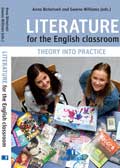 |
|
| Publisher: | Fagbokforlaget Vigmostad & Bjorke AS | ||
| Pages | ISBN | Price | |
|---|---|---|---|
| 260 pages | 978-82-450-1382-5 | 369 Norwegian Krone (approximately $60USD) |
|
Literature for the English Classroom by Birketveit and Williams is a practical, comprehensive, and easy-to-use handbook. This book is designed to support both practicing and aspiring teachers with a rich array of quality literature to engage English learners across age and grade levels. It is crafted in two sections. The longer of the two, Section I, consists of chapters 1-8 with the first chapters geared toward younger readers with discussions and applications of Picture Books; Children’s Poetry; Graded Readers; Fairy Tales; Drama; Graphic Novels; Novels for Adolescents; and, Film. The latter chapters are more appropriate for adolescents and older learners. Specifically, Section II consists of Chapters 9-10 and focuses on Novels; Short Stories; and, the intersection between reading and writing. The book follows a predictable format, which makes it simple to use. Generally, the chapters begin with an introduction and continue with the theoretical base and research that informs the work. The authors also include a definition of each text type under discussion. Moreover, literature examples, analyses, lesson planning activities, conclusions, appendices, references, and suggested readings are provided. The consistent use of illustrations and graphic examples is an additional strength of the text. In particular, the generative nature of lesson-planning strategies across the chapters is a hallmark of this book’s effectiveness. The strategies the authors present are flexible enough to apply to multiple literature and text types. Additionally, the lesson strategies can be readily adapted for age, grade, and developmental levels. In fact, the majority of strategies and lesson planning activities showcased in this book are simultaneously appropriate for young, young adult, and adult learners.
For example, in Chapter 1, the authors focus on strategies for using picture books. While picture books are generally framed as texts for younger children, their potential is commonly overlooked for use with older learners. The authors present picture books as valuable resources for EFL curricula because they allow students of various ages to build vocabulary and comprehension skills. Students learn challenging and abstract concepts such as setting, plot, and characterization; picture books are well supported with visuals, illustrations, repetition, and manageable sentence structures—all of which support vocabulary development and reading comprehension at the earliest stages of reading proficiency. Chapter 1 also includes instructional resources for lesson planning. Teachers will find picture book examples along with recommended language and vocabulary development topics. The chapter is rounded out with suggested teaching topics such as picture-text interaction, theme, story building, simple narrative, and counterpoint. Specific instructional strategies are also presented by the authors. For example, using a chart to match adjectives and corresponding nouns will help beginning speakers of English learn how to organize English for language development in the EFL classroom. Additionally, Chapter 1 focuses on the importance of questioning as an instructional strategy for engaging beginning English speakers with higher levels of thinking and reasoning with comprehensible texts. Teachers will find a list of rigorous question stems to use with a variety of genres. The authors also include activities for student responses to picture books. They outline how to generate an individual or class book that follows the model of the picture book under study. This engages students’ creativity and challenges application of emerging language skills. For the authors, picture books can be leveraged in teaching and learning advanced topics in math, science, and social studies—and this because of their predictable and accessible narrative and syntactical structures and visual scaffolds.
One particularly flexible strategy presented in Chapter 4, “Fairy Tales” is the use of a student’s rucksack as an advanced organizer. The teacher selects objects that relate to the story to put in the rucksack. The teacher frames the activity by posing simple questions about the object(s) respective relationship to the story to predict what might happen. As the teacher reads or tells the story, the object is referenced for vocabulary and concept development. Additionally, the teacher uses the selected vocabulary to create a vocabulary grid to use with students. This develops and reinforces students’ understanding of word classes such as nouns, verbs, and adjectives. Additional vocabulary building activities in Chapter 4 include horizontal, diagonal, and vertical word searches and an English/mother tongue matching exercise. Finally, dialogues are proposed in the format of: “Look what I have found!” “What’ve you found?” The “What have we found” dialogue continues in a predictable sequence with changing objects. This strategy can be adapted so that the dialogue is cut apart and each partner only sees his part. Following this, a true/false activity that corresponds to the dialogue is presented.
While the authors present a variety of text types and related reading strategies in Chapters 1-9, they address the mutually inclusive and beneficial relationship between reading and academic writing in Chapter 10, “Reading and Writing: Intertwined Branches.” Birketveit and Williams capitalize on the natural opportunity that reading provides to teach writing. Chapter 10 consists of the types of writing in English to support teacher training in this area. Initially, the writing process is explained. Teachers will benefit from learning how process-writing supports students’ ability to become proficient writers in the EFL classroom through discussions of prewriting, writing, revision, and editing. Each part of the process is explained carefully so teachers can understand better how the writing process might be broken into steps.
This chapter helps teachers understand how to approach teaching writing. The paragraph is suggested as a “jumping off point” to focus writing efforts on developing one main idea, or topic sentence with two main supporting points. They present the literary essay, which includes any number of paragraphs, as the next logical step. The suggested framework for teaching the literary essay is developing the first main point supported with an example and a quote. The authors recommend that a second main point include a supporting reference and explanation. These suggestions provide teachers with concrete steps they can use in lesson planning. Also, Chapter 10 includes a paragraph exemplar. The topic sentence is written in italics with the supporting details that explain and develop the idea. Birketveit and Williams differentiate essay and paragraph writing with a solid structure to teach essay writing: introduction; body (support paragraph, support paragraph, counter argument with support, refutation with support); conclusion.
The authors extend Chapter 10 by addressing academic integrity to explain how teachers can prepare students to paraphrase a source and how to synthesize a variety of texts. Teachers will also benefit from the information on academic style that is included in this chapter. The authors note that using transitions in English often differ from those more familiar to students. To this end, they provide a table with transitional words and phrases that includes the language function as well as the sentence and clause connectors. Chapter 10 concludes with discussion on writing in the EFL classroom and provides teachers with practices for facilitating writing instruction with students across grade levels.
In sum, Literature for the English Classroom illustrates how teachers can use traditional and contemporary literature types in the EFL classroom to grow English reading skills with students at different proficiencies and ages. It also addresses teachers’ training of building academic skills in English drawing on the natural intersection between reading and writing. Importantly for busy professionals, the book’s organization makes it user-friendly. The chapters are independent of each other and need not be read sequentially. Rather, teachers may select a chapter that is of interest to them and/or their students at a certain point in time. Upon reading the chapter, the EFL teacher is well prepared both with a theoretical framework and practical applications for implementing reading lessons focused on a specific genre. Moreover, the teacher may use the lesson planning strategies and activities in a variety of settings and with any literature as the ideas are reproductive and transformable.
Birketveit and Williams promote literature as a springboard for English language development. The authors counter notions that teachers may have about the appropriateness of using children’s literature with adolescents and adults. They do this with credibility by routinely citing important research in the field to frame their stance. Further, they develop their discussions of specific literature types with related activities that are flexible and generative in nature. Moreover, the authors take on more modern literature types such as graphic novels and the interface between film and literature to advance working with and engaging older learners with a variety of age and interest- appropriate reading material. An underpinning value of the authors’ work is the extensive book lists arranged by text types and developmental levels by age and grade. A concise and cogent presentation of how to engage learners with authentic texts, this book is a well-crafted, informative, and comprehensive guide for better practices.
Reviewed by
Bobbi Siefert Ph.D.
Furman University
<bobbi.siefert furman.edu>
| © Copyright rests with authors. Please cite TESL-EJ appropriately.
Editor’s Note: The HTML version contains no page numbers. Please use the PDF version of this article for citations. |