

* * * On the Internet * * *
February 2014–Volume 17, Number 4
Vance Stevens
HCT / Al Ain Men’s College / CERT / KBZAC
vancestev gmail.com
Nothing focuses like a good deadline. That’s why at a recent Rolling Stones concert I was focusing somewhat guiltily through familiar rhythms on what I would write in this article, whose deadline was imminent. As the Stones went through their set, inspiration came from the Satisfaction of enjoying excellent performers who had been practicing their calling for decades, and who in so doing had touched a huge percentage of the world’s population. I felt privileged to have shared a space with them for a brief span of my lifelong journey.
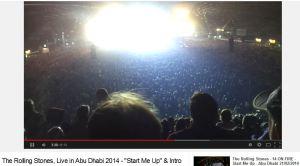
Figure 1. View of concert (http://youtu.be/QIYm9BW9Hhw)
It occurred to me then that the Stones might serve as a parable for star performer teachers. Like both young and aging rock musicians, these star teachers are either up-and-coming in their field–as the Stones once were–or experienced and polished practitioners–as the Stones have become. They are clearly passionate about what they do, and what they do has become second nature. Like musicians around the world, they touch hearts and minds, and enable change in the young and old. These stars, even the most humble among them, are appreciated by those who encounter their work face-to-face, in writing, or online.
We once had to travel to attend conferences in order to have encounters with star performer educators. After talks by such researchers and educators, a lucky few had an opportunity to ask questions in the short time available between one talk and the next. After a popular presentation, a crowd would gather around the podium, with eager participants awaiting their turn (sometimes impatiently, late for the next presentation) for a moment with the celebrity teacher, until the star presenter would beg off on the pretext of another presenter waiting for the room. And, that was it for the attendees. They would have to wait until another conference for a chance to interact with other star performer educators.
Things are different today (I hear every colleague say). Time with star performer educators is abundant, not scarce. There are now exponentially increasing opportunities for teachers all around the world to connect with acknowledged star performers–on an almost daily basis. Perhaps next year, we will be able to say with similar accuracy, that this opportunity occurs on an almost hourly basis.
Interestingly, star performer educators are, in turn, discovered in this ecosystem. Star performer educators were always in the crowd around the podium at the end of the conference presentation by the sage on the stage, when the interaction was predominantly top-down. Online, the stars tend to be more like guides on the side, encouraging voices from throughout the mix of those present. It’s easy for people sharing passions to connect and hear each other, and to continue interacting through their learning networks after an online event. Participants can become known to those with more established credibility, balancing out the appreciation for one another’s work.
Some teacher performers have started encouraging open mic events, where conferences or seminars are announced online, and there is a means for those wishing to present to nominate their own presentations. For example, the annual Global Education Conference (GEC) organized by Steve Hargadon and Lucy Grey has a Ning (http://ning.com); anyone can join and make a proposal in a forum post. If the post is acceptable (most, but not all, are), it’s promoted to the official program. TESOL’s Electronic Village Online holds annual sessions in which anyone wishing to moderate can propose a session (and then go through training designed to help them develop their course with feedback from coordinators). Nellie Deutsch holds numerous conferences (e.g., Moodle MOOC and Connecting Online) in which she outlines a schedule on a Google Doc and then opens it to anyone to add events in the schedule. The conferences are popular among educators, and the results are never disappointing. Webheads in Action hosted three Online Convergences in 2005, 2007, and 2009 (WiAOC). By the last one, we realized we were making work for ourselves by carrying out a vetting process, since no one proposes to speak at such an event without having done significant work or having something interesting to say. As in most social networks, people tend to deliver on their promises, since such networks have become an important part of their identity. In 2010, WiAOC morphed into Learning2gether, which works from a wiki in which again, participants can add their own events. All of these encourage participants to sign up, and give emerging star performers their own podium:
- Global Education Conference: http://www.globaleducationconference.com/
- Electronic Village Online: http://evosessions.pbworks.com
- Connecting Online: http://connecting-online.ning.com/
- Moodle MOOC 3: http://www.wiziq.com/course/36159-moodle-mooc-3
- Webheads in Action Online Convergences 2005-2009: http://vancestevens.com/papers/evonline2002/wiaoc_index.htm
- Learning2gether: http://learning2gether.net/about/
These events are but a part of what is commonly seen as a “fire hose” of information, gushing all around us. The trick to benefiting from this growing plethora of resources is to work out strategies to sip from the hose without being knocked over by the water rushing past. There is so much happening in the fire hose that it’s devilishly difficult to describe what you take from it, let alone describe the composition of the stream as it gushes past. It is like trying to describe what’s on TV at any given time. For example, if you are participating in a MOOC or two, trying to attend occasional online sessions, all while being distracted by work and life in general, your characterization of what is going on online is likely to be different from another person’s. Yet, many are stuck on just that problem: What is going on online? How can we make sense of what is essentially chaotic?
Stephen Downes points out that all around us, everything we see, is chaos (http://youtu.be/wyaeTvGQDsA). This is the conundrum for teachers. How do we prepare students to leave safe learning environments and step into chaos? Dave Snowden’s Cynefin model of addressing problems with varying degrees of complexity explains that when we move from simple problems to chaotic ones, we step off a cliff. This can be seen in the boundary between the two in the diagram below.
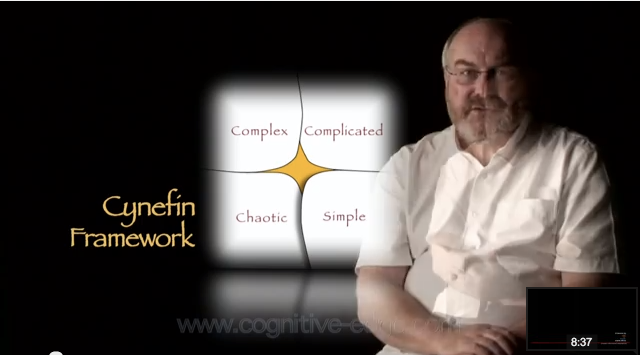
Figure 2. Dave Snowden explains Cynefin (http://youtu.be/N7oz366X0-8)
This seems to be a characteristic of connectivist online experiences (Siemens, 2004), in which participants learn from each other–as opposed to following a program set out by a course designer. When reflecting on one’s experience in MOOC learning, and in connectivist learning online generally, the metaphor of the proverbial blind men each seeking to understand an elephant by touching only one of its parts comes to mind. In connectivist learning, one’s perspective on that experience, and hence on the content of the course, will be unique. In a MOOC with hundreds, thousands, or even tens of thousands of prolific participants, so much happens in the course that it’s impossible to follow it all. Most people dip in where they can; many feel overwhelmed and drop out. Much participation in the course will be in blogging or posting on Google+ Communities or Facebook, and reading other participants’ posts, commenting, and responding to comments. It’s impossible to follow it all for the typical duration of such a course.
Visualize this by zooming out and envisioning the fire hoses arrayed as threads in a distributed network. Then, zoom in to catch snippets of the content in the streaming hoses. The content in the hoses might appear as the blur of an elephant, comprising perhaps a whole, but revealed in only as much as one is able to glimpse before having to move on to something else.
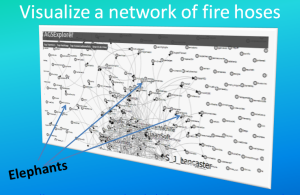
Figure 3. Elephants in the fire hoses (http://www.slideshare.net/vances/the-elephant-in-the-fire-hose)
To some, the situation is chaotic and unfathomable (it is), and thus, discouraging and off-putting. They feel that the best learning happens when teachers are present to call attention to what is important, making the process more efficient by relieving learners from distractions inherent in the fire hose. To others, the situation is chaotic and unfathomable (it is), and thus, exciting and stimulating. They feel that deep learning can only derive from meaningful attempts to resolve the chaos. George Siemens says when teachers do the filtering that learners should do for themselves, it “eviscerates” the learning process (http://www.youtube.com/watch?v=VMfipxhT_Co&feature=related). Where you stand on this idea might depend on what you have to teach or want to learn. Inexperienced learners will likely respond best to the former approach. But the latter approach might be more appropriate for going beyond the basics to exploring a topic in depth in a community of practice.
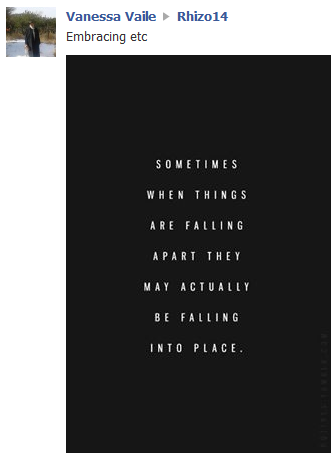
Figure 4. Comment on Rhizo14 Facebook page: (https://www.facebook.com/groups/260654857426965/)
I was recently asked to come online to speak to a group of teachers at a distance who were finishing a set of workshops on meaningful learning. The organizers said I would have limited time; therefore, my presentation had to be concise. As I mulled this over, I felt there was a contradiction in what I thought I was being asked to do–come online and speak from a projected image to an audience of teachers about meaningful learning–so I began to parse my conception of the task. I found the problem was the word ‘to’. I asked if I could instead speak ‘with’ the teachers. I wanted to model a means by which my presentation could become interactive, and thus relate to their workshops. In this way, it could also be personalized (and model what they should be doing with their own students, in which meaningful learning should come from within the learner, not from the teacher). I created slides to give my presentation some cohesion, but at different times, stopped to get input from the audience in the auditorium, whom I could see (and hear) via my camera-audio view.
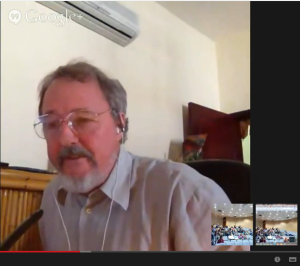
Figure 5. Speaking “with” a distant audience (https://www.youtube.com/watch?v=NdF48wmHydo)
This worked well, as I elicited bullet points from distant participants on characteristics of good teachers (one participant shouted that a teacher should be ‘theatrical’, a word that I had overlooked in my slide on the topic). At the end of our time together, I asked the audience what difference their workshop would make in how they taught their classes. One teacher responded with a long description of changes she had thought through and would implement the coming Monday.
This was verging on meaningful learning. How meaningful would it be it if I told these teachers, striving to do their best with the task and resources at hand, how I thought they should do their job? It was better that they tell me, and in the process, each other. Superstar teachers lead with a good riff but recognize the jazz musician in each student and teaching peer, and invite everyone to join in and to create a learning experience in concert. The best teachers understand that the learning is not about them; it’s about the participants in the experience. The participants (not me) were the superstar teaching performers in their context, and my presentation sought to reinforce this idea.
This is where the elephants in the fire hoses come in. The MOOC experience is geared toward learning from the fire hose by discerning and piecing together, in a personal process, the images of the elephants as they (the elephants) stream past. It is learning in an extreme form of the berry bush metaphor. This metaphor derives from Scollon and Scollon (1982)–the idea that computers encourage random access learning, whereas the model prior to the era of computing was mastery learning, what the Scollons called a conduit approach. The idea is that learning via computers, or networks, is like foraging for berries in a berry patch, or fishing in the ocean. Foragers take what they want and can conveniently reach, or have the time and patience for, and leave the rest.
The berry bush accommodates the role of lurkers in MOOCs and other participatory learning experiences. There are many bushes, as well as many shops and markets; no one shops in all of them. Passersby might window shop, and perhaps learn something about the market by lurking at a window. They may or may not ever stop to shop, but the window can be kept informative, welcome, and open to all when they want to invest more time inside.
In Dave Cormier’s recent Rhizomatic Learning MOOC (Rhizo14, https://p2pu.org/en/courses/882/rhizomatic-learning-the-community-is-the-curriculum/), I was struck by one poster who decried lurkers for absorbing knowledge from the community without paying back through overt participation. However, all of us sometimes lurk at others’ storefronts. And, some of us maintain our own stores, as not everyone has time to spend on frequent essay-length interaction (or the dedication, in the case of another who postpones parental duties so she can interact prolifically). The point is, we are all dedicated to something, and we have limited time for our passions (versus the time we must spend on our obligations). The fact that lurkers, what Lave and Wenger (1991) call more gently, peripheral members, take the time to lurk is, in fact, healthy to a community. These activities connect one community with other communities in which the putative lurker is possibly passionately active, and might even be regarded as a superstar educator.
We return now to the roots of connectivism, or rhizomatic learning, to frame it in the context of Rhizo14, or at least as I see it from my vantage point on the elephant. Connectivism is a learning theory for the digital age, because connectivist learning is particularly capable of addressing the needs of individual learners. The theory suggests that learners forming and learning through networks have available to them knowledge that they can access as needed. It is like having bits of knowledge in drawers all around your house, but better than having to wonder which drawer you left that knowledge in. You have metadata you can use to identify which drawer you should open. The drawers are also in communication with you and each other, reminding you of their contents when you have a moment to listen (or happen to see their tweets). In any event, the drawers with the most important content will make themselves known as they are referenced by other drawers on the network; therefore, the most important knowledge rises to the top, while the most obscure can be still found through its metadata.
Trying to describe what happens in personal connectivist learning spaces is like trying to describe elephants as they pass, barely discernable in the fire hose spray, appearing in glimpses here and there like salmon leaping upstream. Fortunately, participants in MOOCs might manage to catch a few salmon, and those catches are what make the hard work and lack of sleep worthwhile, as the expanding choice of constant learning opportunities competes for available time.
References
Lave, J., & Wenger, E. (1991). Situated learning: Legitimate peripheral participation. Cambridge: Cambridge University Press.
Scollon, S., & Scollon, R. (1982). RUN TRILOGY: Can Tommy Read? Paper presented at the symposium Children’s response to a literate environment: Literacy before schooling, University of Victoria, October 9, 1982.
Siemens, G. (2004). Connectivism: A Learning theory for the digital age. Elearnspace. Available: http://www.elearnspace.org/Articles/connectivism.htm.
|
© Copyright rests with authors. Please cite TESL-EJ appropriately.
Editor’s Note: The HTML version contains no page numbers. Please use the PDF version of this article for citations. |