

August 2014 – Volume 18, Number 2
| Title | Mango Conversations |
| URL | http://www.mangolanguages.com/ |
| Type of product | On-line language learning software |
| Platform | Internet browser-based |
| Minimum System Requirements | For PC) XP SP3, Vista SP2 or Windows 7 Minimum 1 GHz processor with 1G RAM Broadband Internet Connection (For Mac) Snow Leopard (OS X 10.6) or higher |
| Registration | Required |
| Price | Free through local library, or individual lessons can be purchased (prices vary) |
Introduction
Technology has advanced to the point where people have access to tremendous amounts of information at their fingertips regardless of where they are in the world. As a result of this trend, learning, including language learning, can now take place remotely. Mango Conversations (MC) is a popular language-learning program available over the Internet. This article will review MC in order to give language teaching professionals, as well as potential language learners, an idea of how MC works and whether or not it could be a useful tool for them or their students.
An Overview of Mango Conversations
MC is a computer assisted language learning (CALL) software program designed to help language learners develop their speaking skills. It is available for free for patrons of some American public libraries. Alternatively, lessons are available for purchase from http://www.mangolanguages.com/. MC is a program that is accessed over the Internet that does not require any software installation of any kind on a computer. Instead, it operates using Adobe Flash technology already installed on most web browsers such as Internet Explorer or Google Chrome. Figure 1 shows the MC lesson home page in the web browser Google Chrome.

Figure 1. Lesson home page
Currently, MC offers 11 foreign languages and one specialty course available for free through some local libraries (see Figure 2). All of the languages available for free, however, are meant for native English speakers. Non-native speakers of English will not be helped by MC if they are trying to improve their English ability. In addition to these freely available lessons, over 60 foreign and English courses are available for purchase through Mango’s main website (http://www.mangolanguages.com/available-languages/).
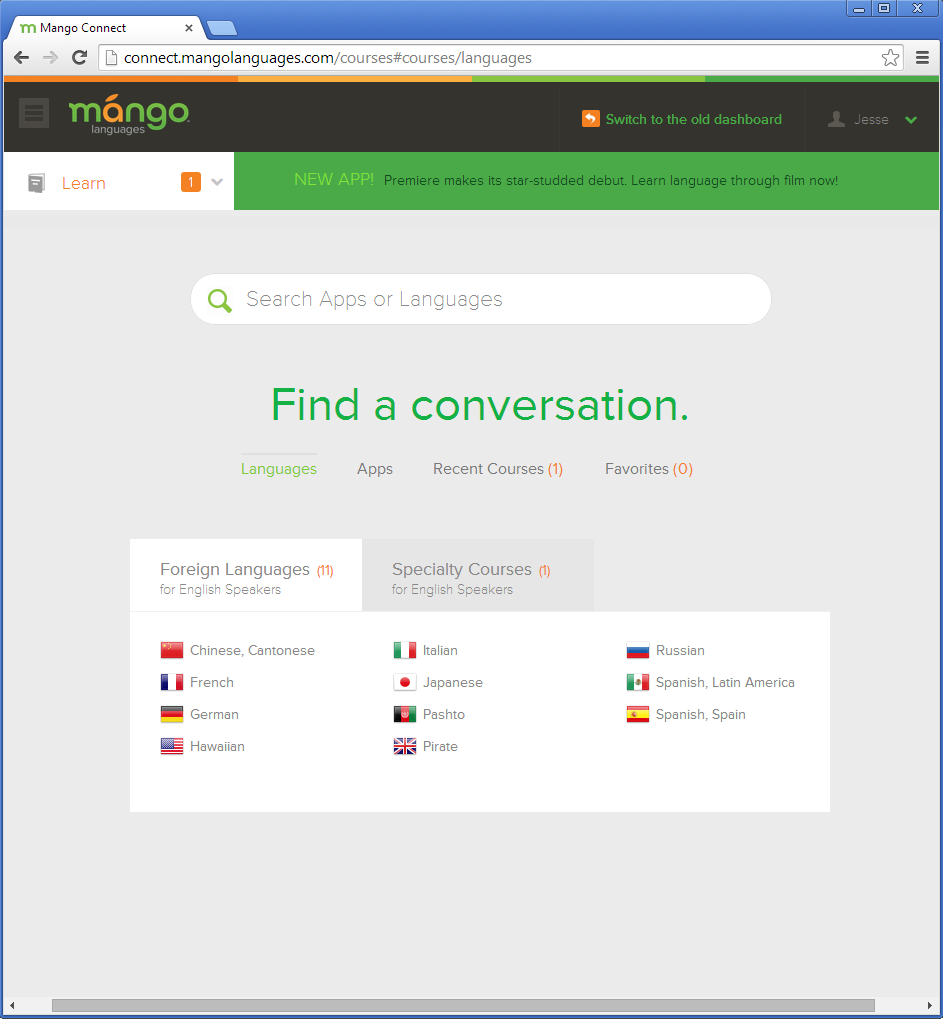
Figure 2. Languages available through local libraries
The main goal of MC is to help users develop practical conversation skills by presenting dialogues and having learners practice shadowing individual parts of the dialogue (Murphey, 2001). In the beginning levels of MC, learners are presented with single words to mimic or recall from memory. Figure 3 shows a dialogue that is introduced at the beginning of a unit. As learners progress through the levels of the program, they are asked to repeat longer phrases until the entire dialogue is spoken, a goal for the completion of the unit. When practicing repeating words or phrases, MC has an option for learners to record their voice and compare it to a visual representation of a native speaker example (see Figure 4). Users can record their dialogue as many times as they like, and can return to previous slides to practice more, if necessary.

Figure 3. Lesson dialogue
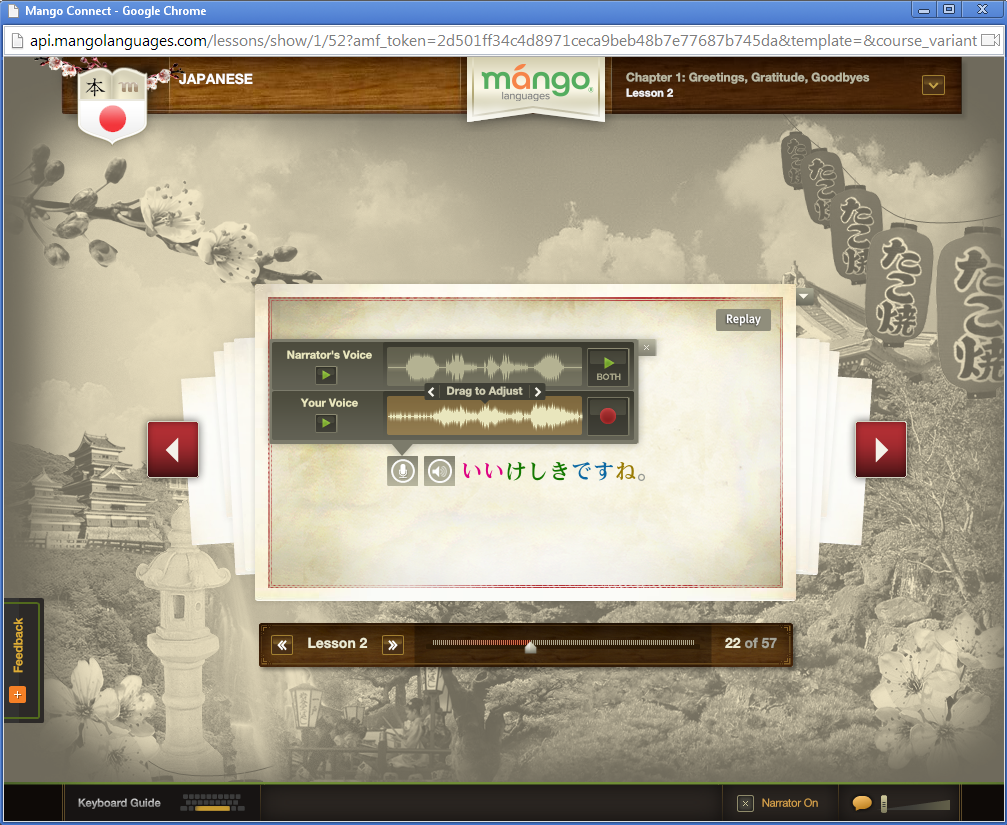
Figure 4. Voice comparison
Although MC does not indicate a specific proficiency level for which it was designed, it is clear from using the program that learners with no prior knowledge of a target language would have no issues starting with the beginning lessons. The higher levels seem to top out at the high-intermediate level. Advanced learners would not benefit much from using MC for anything other than a basic refresher on vocabulary and common grammar usage.
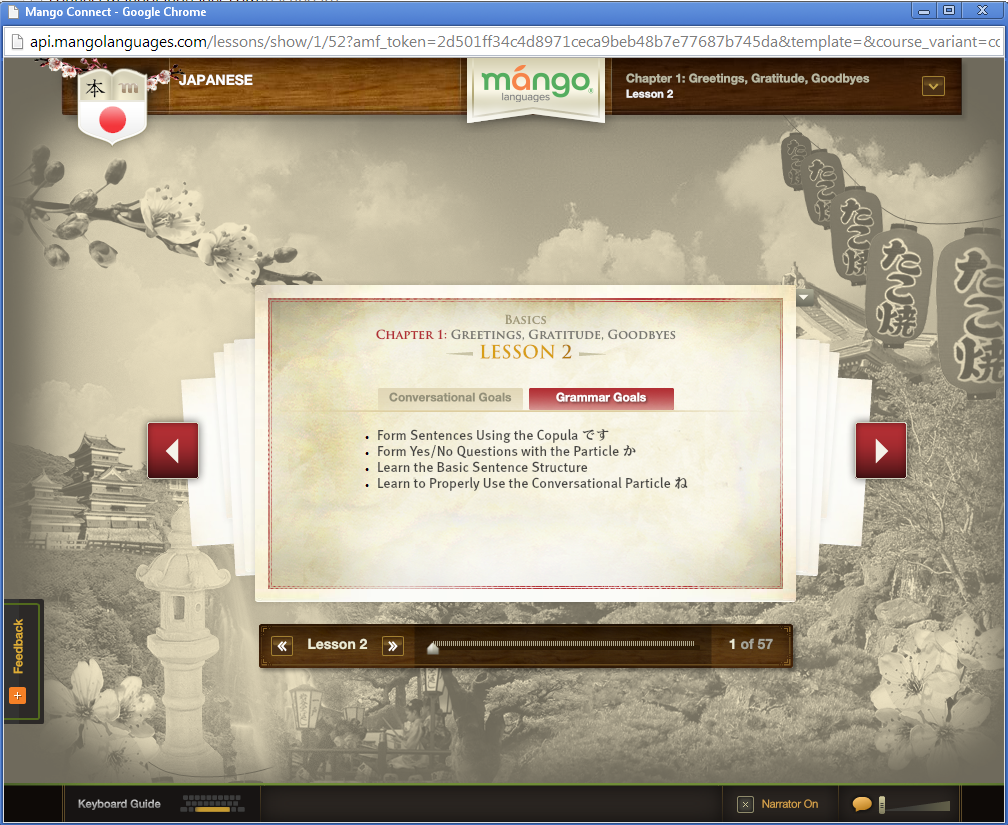
Figure 5. Grammar goals
The main features of MC focus on teaching language through conversations. In addition to that main goal there are several specific aims presented at the start of each chapter, including learning specific vocabulary terms and phrases, grammatical functions, and proper pronunciation of chapter material (see Figure 5). Within each chapter, MC presents learners with some cultural knowledge that is relevant to the language they are learning in order to give context and increase learner interest and motivation (see Figure 6).
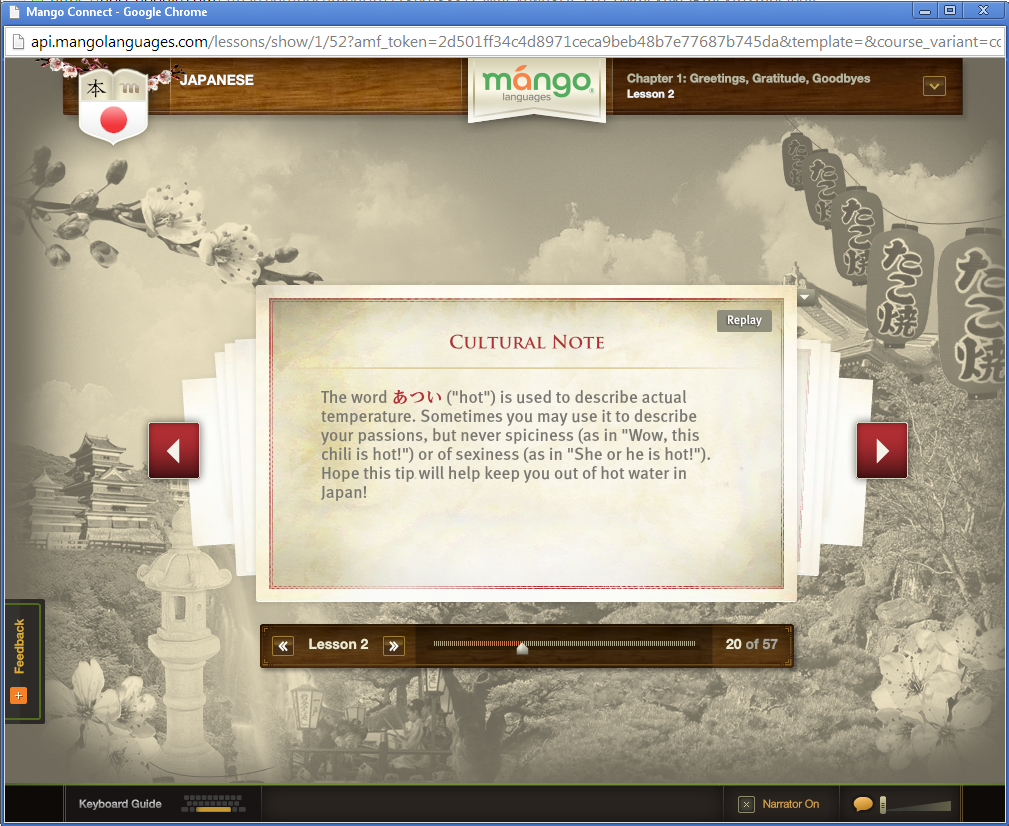
Figure 6. Cultural note
MC’s interface is simple, but attractive in design (see Figure 7). Lessons are generally made up of around 30 to 60 “slides” that present material to learners. Each slide will ask students to either repeat the phrase shown or recall from memory how to pronounce previously learned vocabulary and phrases. The slides display material in the target language as well as in the learner’s first language (L1) (see Figure 7). Each part of speech is also color-coded. For example, in a verb phrase, each word in that phrase will be displayed in the same color in the learner’s L1 as well as the target language. By showing how the grammars of both languages compare, MC attempts to give its learners a better awareness of how the grammar of the target language works while focusing on spoken language skills. MC also offers the understood and literal meaning of phrases being taught.

Figure 7. Mango’s interface
In addition to these features, if users hover the cursor over any of the words, a phonetic equivalent will be shown to assist learners in their pronunciation (see Figure 8). By providing all of this information, MC helps its users not only memorize parts of the target language, but implicitly comprehend how the target language functions in relation to learners’ L1.
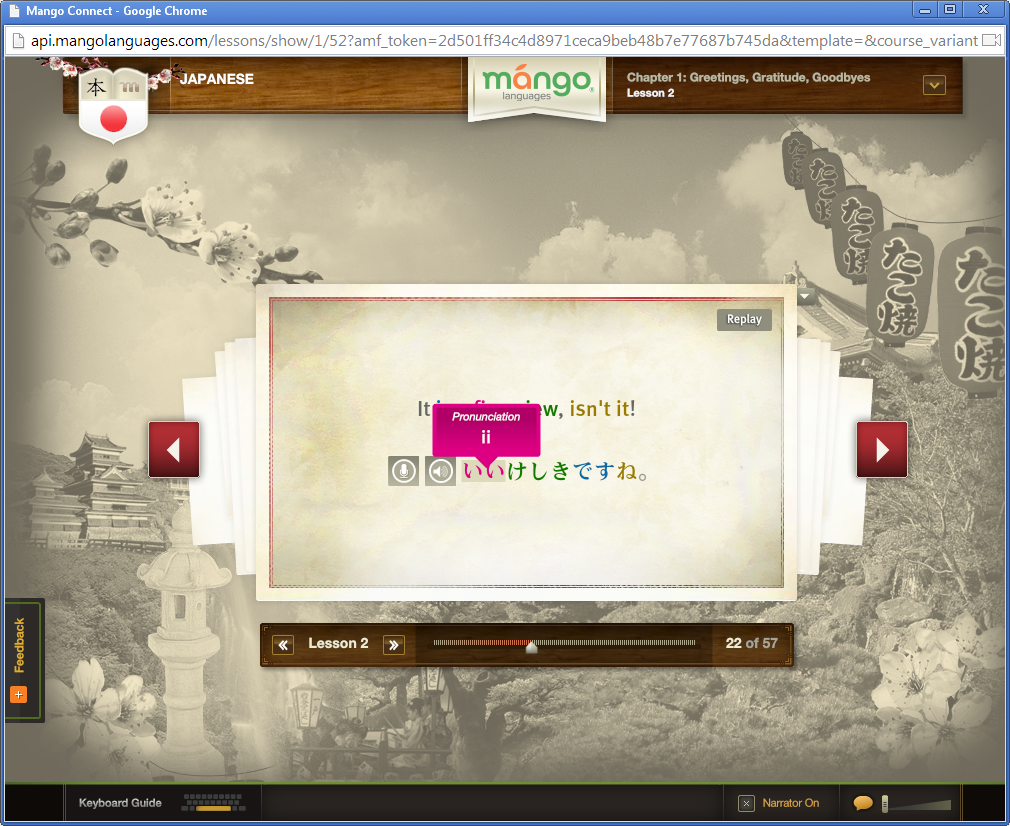
Figure 8. Pronunciation assistance
Evaluation of Mango Conversations
Accessibility and Cost
Once signed up through a participating local library, accessing MC is not difficult; users must simply navigate the local library’s website and sign in through the links provided on the library website. There are few hardware requirements to use MC , and even older computers will have no problems running the program provided there is access to high speed Internet. However, the process is more complicated than it should be. Prior to signing up the user must have a library card and navigate the library website with the users library card number, a library password, and then sign up through MC’s website with an email address and new password for MC. Therefore, any time users attempt to use MC, they must have their library card, library password, MC email address, and MC password in order to gain access to the program. This is a much more complicated process than utilizing many other online resources (i.e., signing in directly to other online language learning sites or networks), and those new to the technology may find it difficult to get past so many barriers.
Another issue in accessing MC concerns the local library offerings. Unfortunately, MC is currently offered by only five libraries in North America (Mango Languages, 2014a), requiring most users to buy individual lessons from the MC website. Also, the number of levels available for each language varies; some languages provide only one level while others offer three. Because each level, or “journey” as MC calls them, costs $79 US, using MC can become quite expensive when compared to other free web based language learning tools (e.g., Livemocha).
Teaching/Learning Value
MC was designed as a tool for language learners’ individual use, without the intervention of instructors. As such, it would be an ineffective use of class time for a teacher to incorporate MC into in-class lessons. However, due to MC’s emphasis on vocabulary acquisition, asking students to use the program outside of class may be a good form of supplementary practice, possibly helping to reinforce vocabulary learned in class. According to Perfetti (2007), vocabulary is best learned by presenting words in multiple contexts and uses, and critical to any successful language education (Byrnes & Wasik, 2009). In other words, used in addition to traditional instruction, MC may help supplement in-class learning.
Learners can also learn grammar using MC. As some researchers have acknowledged, (Ellis, 2006; Leung & Williams, 2011), grammar need not always be learned through explicit instruction. As mentioned earlier, MC provides both the understood and literal word-for-word translations along with color coding of phrases and parts of speech, thereby implicitly teaching the grammar of the target language. By frequently using MC, learners can gain a better understanding of how to use the vocabulary they are learning.
Unfortunately, the language and material learned through MC have some limitations, many shared with audio-lingual method of language instruction (Lightbown & Spada, 2013). Though MC offers several memory building exercises in its learning material (Mango Languages, 2014b), providing learners much practice with vocabulary and dialogues, MC gives no opportunities to use this knowledge in any authentic way. Rarely will any real conversation in a target language progress in the exact way as materials are presented. As a result, MC can be a useful supplementary language learning tool in addition to a more comprehensive primary mode of learning, but should not be the main method of learning a foreign or second language.
As the main goal of MC is to teach conversation skills, reading and writing skills are not covered by MC. Dialogues are presented in the written form of the target language, but the learner is not required to read the text in order to progress. No writing practice is offered either. This does not preclude learners from practicing on their own, but may slow down learners’ progress in MC considerably and prompt learners to seek out better methods for learning to write in a target language.
Conclusion
MC has the potential to be a highly effective supplement to a traditional lower level language class. It is easy to use, attractive, and does a nice job of introducing vocabulary and helping its learners remember it. However, MC should not be the primary mode of instruction for learners who need to achieve higher levels of proficiency in a target language. MC helps build partial knowledge in a foreign language, but does not adequately prepare learners for authentic communication.
References
Byrnes, J.P., & Wasik, B.A. (2009). Language and literacy development: What educators need to know. New York, NY: Guilford.
Ellis, R. (2006). Current issues in the teaching of grammar: An SLA perspective. TESOL Quarterly, 40(1), 83-107.
Leung, J., & Williams, J. (2011). Constraints on implicit learning of grammatical form-meaning connections. Language Learning, 62(2), 634-662.
LightBown, P., & Spada, N. (2013) How Languages are Learned (4th ed.). Oxford: Oxford University Press.
Mango Languages, (2014a). Frequently asked questions. Retrieved from http://www.mangolanguages.com/faqs/library-faqs/
Mango Languages, (2014b). Mango teaching methodology. Retrieved from http://www.mangolanguages.com/mango-conversations/
Murphey, T. (2001). Exploring conversational shadowing. Language Teaching Research, 5(2), 128-155.
Perfetti, C.A. (2007). Reading ability: lexical quality to comprehension. Scientific Studies of Reading, 11(4), 357-383.
About the Reviewer
Jesse Sadoff <Jms936 nau.edu> is an MA TESL student at Northern Arizona University. He also teaches Critical Reading and Writing in the University Community at NAU. His interests include second language vocabulary acquisition, affective factors in second language acquisition, and academic writing.
|
© Copyright rests with authors. Please cite TESL-EJ appropriately.
Editor’s Note: The HTML version contains no page numbers. Please use the PDF version of this article for citations. |