

November 2014 – Volume 18, Number 3
Passages 2 |
|||
| Author: | Jack C. Richards & Chuck Sandy (2008) | 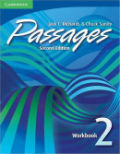 |
|
| Publisher: | New York, NY: Cambridge University Press | ||
| Pages | ISBN | Price | |
|---|---|---|---|
| 160 pages | 978-0521683913 | $43.00 USD | |
Passages 2 is the second and last book in the Passages series. It is aimed at B2-level students and teaches American English. Revised in 2008, the new book offers a wider selection of topics, with a focus on grammar and vocabulary development.
It is divided into twelve units, each divided into two Lessons (A and B). Following its predecessors, the Interchange series and Passages 1, each unit contains one different everyday life theme and two grammar boxes to be explained, as well as vocabulary sections. As mentioned before, each unit of the Passages 2 book is divided into two different lessons: Lesson A and Lesson B. While each lesson explores the theme of the unit from a different aspect of the general topic, it presents a different grammar topic.
Each unit contains between 12 and 13 exercises. These exercises range from a starting point for the topic, listening activities, grammar explanation and solving exercises, vocabulary, discussions, writing, and reading. The authors claim that the book aims to cover the four language skills, and by developing the book with several activities, the goal is achieved.
Vocabulary and grammar are regarded as essential in this book. The approach of the books is to allow students speak more fluently and accurately. To achieve this goal, the book seeks the student to learn more natural forms of communication. Therefore, there is a strong focus on both advanced grammar and vocabulary. For this to happen, the authors have centered on more complex and combinable grammar that students in this level should be familiar with, paying extra attention to phrasal verbs, objects, parts of speech, transformations and inversions, reported speech, passive, comparatives, subjunctive, and subject-verb agreement. While most students know these topics, combining them results problematic in some occasions, as the foundations of the grammar are not entirely solid. Nonetheless, the examples given in the book clarify these knowledge pools and sometimes close them entirely.
The vocabulary complements the grammar topics and seeks to provide students a wider selection of words that fit better a specific situation and to sound more native-like. To achieve this, the authors have focused the vocabulary topics on word construction with prefixes and suffixes, phrasal verbs, collocations, idioms, similes, discourse markers and sentence adverbs, idiomatic expressions, compound adjectives, and prepositions after a specific word and its different meanings. Together, advanced vocabulary and grammar should provide the student a wider selection of possibilities for him/her to communicate better in both oral and written forms.
In spite of the fact that the book focuses on grammar and vocabulary, it does not leave behind other communicative aspects, such as productive skills (e.g., pronunciation exercises and discussions), and receptive skills (i.e., listening comprehension exercises). The four skills of communication are addressed in the whole book and with different topics, allowing the student to contextualize these skills better depending upon theme.
In each unit’s Lesson (A and B), there is an initial “Starting point”, which introduces the general topic of the Lesson. It is suggested that the teacher use no more than 15 minutes in this section, as it is merely a warm-up activity. Here, the students are suggested to discuss the topic and the teacher is suggested to guide the conversation towards the grammar. In personal experience, this activity allows the student both production and reception, and in some cases the discussion leads to talks in which grammar is used by students as the authors want. Sentences from the conversation can be taken as examples to demonstrate the grammar topic.
The listening activities are presented in each unit twice (one for each Lesson). The activities of the audios ask students to obtain specific details of the conversation. While the approach is not bad, more practice on similar audios to the ones presented on certification tests should be included. That is, to make students infer and analyze the information given to provide an answer. Whilst some listening activities suggest further discussion, most of them do not explicitly give instructions on it.
Writing is largely encouraged in Passages 2. Along with Reading, it is presented as the last activity of each Lesson, and specifically for writing activities, at the end of Lesson A. This gives the idea that the authors did not worry about writing as much as with oral skills. However, these activities are well planned and presented. Writing and Reading, as skills, are intertwined. And Passages 2 shows this relation by proving a reading activity before every writing activity. Hence, before students can write about a topic, they must read a text to give their opinion. The activities are in close relationship to the topic of the unit, but the writing skill and topic in each unit is unique. First, the authors provide a title and topic for each activity, followed by a concrete explanation of what that topic means (e.g., Title: Writing about a personal experience, then a explanation on how personal-experience compositions should be written, p. 57). Then, a text is presented, usually showing an example of the skill being practiced. Finally, some follow-up questions or activities are presented to the student, including writing a similar text to the one presented and exchanging ideas with their classmates.
Reading activities are presented as the last activity in the unit and Lesson B. These constitute less challenge for the students as all the information is usually on the page. This issue is balanced with the lexicon presented. The texts provided try to deepen on a specific topic, without being either too technical or too complex to understand; rather, they are everyday life texts. After the activity, students are to answer some questions, fill in blanks, match, or discuss the topic. This is not enough reading practice if we consider the amount of texts and depth of the ones presented in a certification test. More focus on depth should be set in reading texts.
The last part of the book includes a “Grammar plus” section, which focuses entirely on grammar, allowing students to practice the grammar seen in each unit. Here, a grammar box similar to the one used in the unit is presented and more examples and exercises are given. As with the Lessons, two grammar boxes are included in each unit. This section is especially useful when a grammar topic is difficult for students, and not enough time is available for practice on pure grammar.
Overall, Passages 2 is clearly a carefully planned book. The grammar topics presented show a clear connection with vocabulary, reading, writing and listening activities. There are no activities that explicitly require oral production, but it is highly recommended and suggested through group discussions. Being the last book of the Interchange and Passages series, this can be considered as the last instruction for a certification test from the main author, Jack C. Richards. Therefore, teachers might also focus attention on guiding the students to certification-like exercises in which information must be analyzed fast to provide a prompt response—this is the opportunity area of this book.
Reviewed by
César Augusto Borromeo García
Kiosk Escuela de Idiomas, Mexico
<cesar.bogc gmail.com>
| © Copyright rests with authors. Please cite TESL-EJ appropriately.
Editor’s Note: The HTML version contains no page numbers. Please use the PDF version of this article for citations. |