

February 2016 – Volume 19, Number 4
Literacy Teaching and Learning in Rural Communities |
|||
| Author: | Lisa Schade Eckert & Janet Alsup (2015) | 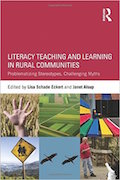 |
|
| Publisher: | New York: Routledge | ||
| Pages | ISBN | Price | |
|---|---|---|---|
| 135 pages | 978-1-138-82234-4 | $49.95 USD | |
As an American Midwesterner by birthright, I was curious (and honestly, slightly skeptical) as to how Lisa Schade Eckert and Janet Alsup would approach literacy teaching and learning to rural students in their new book, Literacy Teaching and Learning in Rural Communities. As I opened the book to the preface and read their opening chapter on ‘problematizing stereotypes and challenging myths’, I exhaled and knew that my regional loyalty would not feel compromised in these authors’ hands.
Schade Eckert and Alsup have crafted an interesting and important read which focuses on the narratives of new and mid-career teachers, many of whom grew up in the Midwest, yet had not had experienced working and teaching in the rural sector. While the US Midwestern states are recognized as the nation’s breadbasket having many outsiders believe all of us live on farms, the reality is that less than 2% of American currently live on working farms and less than 15% live in rural areas. Even within our Midwestern enclaves, suburban areas well outnumber rural ones.
The authors begin the text with an explanation of the dominant narratives that resonate around rural areas. They share a brief overview of the current lens through which rural, suburban and urban research is viewed, and then discuss the crux of the text—the powerful narratives of teachers in rural settings. They finish the introduction in a provocative discussion of teacher identity, especially as this relates to rural teachers. While brief, this introductory chapter is instrumental in setting the tone for the remainder of the book.
The remainder of the text is broken into two sections, Early Career Teacher Narratives and Mid-to-Late Career Teacher Narratives. The choice of separating the teacher narratives into two sections is an excellent strategy as it allows the reader to meld the voices and experiences of five novice teachers and compare those narratives to that of six more experienced teachers. Given the opportunity to compare and contrast the varied experiences of these rural teachers the reader is welcomed into an honest and at times candid discussion of what challenges and triumphs these teachers experienced during their time in rural schools and communities.
The Early Career Teachers’ narratives revolve around three major narratives: identity, disconnect and the realization that there is a culturally relevant pedagogy that relates to rural as well as urban students. Several of the novice teachers discuss at length the disconnect they felt when moving to a rural community. Surprisingly, all of these teachers were born and raised in the same Midwestern state where they eventually worked. What these teachers did not take into account was how the movement from a suburban community to a rural one would bring about such a profound disconnect as to their understanding of themselves and their place in their new community. Several teachers thought that their Midwestern upbringing would insulate them from any sort of separation they might otherwise expect to feel from their rural neighbors. All of the novice teachers discussed their movement from separation, to self-realization, to finally inclusion in their classrooms. They all spoke of the realization that came in embracing that rural students were culturally unique and that such students needed to have their curriculum customized in order to reflect those differences. Once the teachers began to embrace and acknowledge those differences instead of rejecting them, they were able to witness growth, not only in their students but in themselves as well.
The second section of the text, Teaching Through Place: Mid-to-Late Career Teacher Narratives, includes the voices of rural teachers in the western state of Montana alongside teachers in Minnesota and Nebraska. Here the voices of experienced teachers, those who have been able to learn from the early mistakes mirrored in the first half of the text, share how embracing of community (‘place’) helped them deepen and broader their understanding of their students. This understanding not only allowed for greater success in the classroom, but also impacted the development of their own teacher identities as well in generative ways.
Through the five narratives in this section, the authors speak to four major themes. Several of the authors speak to their frustration with standardized assessments, and how authentic student achievement can be undermined if teachers and administration only rely on narrowly constructed, standardized reflections of teaching and learning. The teachers in this section appear to transcend standardized testing; they demonstrate how accessing students’ funds of knowledge can provide rich understandings of ‘knowing.’ As in the first section of the book, the mid-to-late career teachers discuss how they were able to use culturally relevant pedagogy to tap into local culture and celebrate the uniqueness of rural communities through activities done in and out of the classroom. In one memorable chapter, a passionate English teacher from Montana discusses how he was able to connect with his students and the community at large by using ‘cowboy’ poetry as means to share life experiences through the spoken word. All of the authors shared how their early failures built resilience in them. That resilience was instrumental in helping them pursue meaningful connections with their students in and out of school. Finally, the authors shared the importance viewing of ‘place’ as an asset to the classroom was vitally important to their success. It is this take-away, perhaps, that teachers outside of rural communities—including teachers of English as a Second/Foreign Language—will appreciate most from this important teacher resource. While many outsiders may view minoritized communities (including rural communities) as ‘lacking’ in many ways, these teachers were able to leverage what resources existed in order to help their students achieve.
There is much more to be gained from this text in addition to the themes mentioned above. Reading the narratives in their entirety is essential to gaining the full benefit of what this book has to offer. Looking at schooling through the lens of rural educators allows the reader access to a world many have no experience in or exposure to. It is a good reminder that all teachers, urban, suburban, and rural, face similar challenges in meeting the needs of their students. Teachers in rural, urban, and suburban contexts often struggle to relate to our students, to tap into their strengths, to mitigate their struggles, to engage them in a myriad of meaningful activities that will help develop them into successful members of society. We are all in this process of becoming, together, and there is something reassuring about that prospect.
Reviewed by
Jennifer Collins
University of Wisconsin-Platteville
<collinsjen uwplatt.edu>
| © Copyright rests with authors. Please cite TESL-EJ appropriately.
Editor’s Note: The HTML version contains no page numbers. Please use the PDF version of this article for citations. |