

November 2016 – Volume 20, Number 3
Language Teaching Insights from Other Fields:
|
|||
| Author: | Christopher Stillwell (Ed.) (2015) | 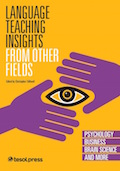 |
|
| Publisher: | Alexandria, Va.: TESOL International Association | ||
| Pages | ISBN-13 | Price | |
|---|---|---|---|
| 177 pages | 978-1-94-222348-1 | $52.95 USD | |
Following the successful publication of Language Teaching Insights from Other Fields: Sports, Arts, Design, and More (Stillwell, 2013), Christopher Stillwell has assembled a second group of professionals engaged in the language teaching field who bring new ways of looking at teaching through the lens of the other disciplines in which they have worked. The reader will find tips for the classroom from a TV commercial producer, a vacuum salesman, a project manager, a positive psychologist, and many more. The book provides much more than a series of chapters with teaching tips; it affords an excellent platform for looking at one’s own teaching through new lenses and for reflecting on what additional areas of knowledge we draw from as we go about the task of teaching and learning.
The book is divided into areas important to all teachers: investing students in their own learning, planning an effective course, expanding one’s toolbox of techniques for teaching, and enhancing teacher effectiveness. Within each area, individual chapters written by different contributors expand on the section theme drawing from each author’s own expertise from outside the usual ESL framework and providing a series of tips on how to apply those insights to classroom practice. Each chapter concludes with resources that provide further exploration on the topic of the chapter, a reference list, and an author biography. One gets the sense that this book is only the tip of the iceberg and much more exploration will come as the ideas presented in each chapter are delved into further.
Every chapter carries with it a deeper understanding of how so many fields of study and aspects of life are a part of the task of teaching. For example, ESL/EFL teachers are always seeking ways to engage their students in their own learning, the theme of the first section, and Wendy Hendrickson’s chapter drawing from the field of marketing and advertising provides some true insights from the field of commercial production that remind teachers to focus on the message. The examples of well-known commercials provide concrete illustrations of tenets from the commercial film business that can assist teachers to create lessons that have a core message and a story that connects emotionally with the students. Reflecting on what the intended core message is in a planned lesson can often lead to the discovery that what we had thought we were teaching was not the message we were actually providing to our learners.
A particularly useful chapter in the section on planning an effective course is Susan Matson’s chapter which draws from her experience as an academic therapist for students with identified learning disabilities. She provides strategies that teachers may find useful in their ESL/EFL classroom by exploring the overlapping areas of difficulty for language learners and students with learning disabilities. This moves us away from the discussion of whether or not a learner is struggling with learning a second language due to a learning disability and into the area of identifying strategies that will work for the learner.
Organizational behavior is certainly a part of effective classroom management, and Emily Austin Thrush’s chapter on using this lens to look at student grouping and motivation serves as a reminder that looking further into ideas from the business world can bring about greater insights into what we can do in our own classrooms. Stillwell provides other business-related chapters drawing from marketing practices to motivate learners, economic principles as they related to decision-making in the classroom, and business school case studies to foster debate in the language and business school classrooms.
While the book presents ideas through a series of tips in each chapter, it is not a how-to book. Rather, Stillwell reminds us that an interdisciplinary approach can expand our depth of knowledge in new ways. It allows us to look beyond our current teaching setting and student population, to look beyond our own past coursework and ESL/EFL teaching knowledge base, and to consider new paths of inquiry that will deepen our effectiveness as teachers.
The final chapter, written by Julian Edge, ties the book together by offering counseling suggestions for teachers to guide their own professional development. Edge approaches the chapter through a counseling lens which he has moved into through his TESOL experience. Just as the book demonstrates how looking at other disciplines can enrich one’s professional practice in ESL/EFL teaching, Edge demonstrates the value and the fluidity that is the essence of the book, that movement among perspectives drawn from other disciplines allows one to see an area of focus in new ways. Teachers or teachers-in-training who read this chapter after reflecting on their own teaching practice as they read the other 14 chapters are now offered insights into non-judgmental ways to listen to and talk with others about their practice. The goal ends up being to foster collegial dialogue around teaching and learning.
The strength of this book lies in what the readers will do after they have finished reading it. The chapters in Stillwell’s book act as a springboard to looking at one’s own experiences, and I can see this volume being used effectively as a professional development tool where both novice and seasoned teachers are encouraged to reflect on their own practice as they read this book or as part of a teacher-training course on reflective practice. Many of the tips mentioned in the book may be ones that some teachers have already attended to and further discussions can occur as they discuss their own experiences and perspectives and listen to others as they share their own personal understanding. For programs that have already established a faculty book club, this book would be a good addition to the reading list. The value will be in the follow-up discussions in which teachers share what they have to offer from their unique perspectives drawn from individual life and work experiences.
In sum, this book will provide useful classroom insights for teachers whether they are just starting out, moving into teaching after a career change, or teaching as a seasoned ESL/EFL teacher. Stillwell characterizes the book as “an invitation to a professional conversation” (p.5), and it is an invitation I urge readers to accept. Each contributing author encourages teachers to consider what can be learned from other disciplines and to explore what their past experiences and knowledge sets may offer in terms of what they bring to the discussion on effective teaching. The book encourages us to share what we can bring to the table.
References
Stillwell, C. (2013). Language teaching insights from other fields: Sports, arts, design, and more. Alexandria, VA: TESOL International Association.
Reviewed by
Jeanne Hind
Director, Spring International Language Center, Denver, Colorado
<jeanne spring.edu>
| © Copyright rests with authors. Please cite TESL-EJ appropriately. Editor’s Note: The HTML version contains no page numbers. Please use the PDF version of this article for citations. |