

November 2016 – Volume 20, Number 3
Pronunciation Myths: Applying Second Language Research
|
|||
| Author: | Linda Grant (Ed.) (2014) | 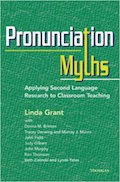 |
|
| Publisher: | Ann Arbor: U. of Michigan Press | ||
| Pages | ISBN-13 | Price | |
|---|---|---|---|
| 251 pages | 978-0-472-03516-8 (paper) | $24.95 USD | |
The field of TESOL is being undermined by the reluctance many teachers currently demonstrate towards pronunciation instruction. Although students of English report having a strong desire to improve their pronunciation, language teachers are not meeting their students’ needs (Baker, 2011). Linda Grant’s Pronunciation Myths tackles the reasons behind this startling reality and breaks down the myths that surround pronunciation teaching.
Pronunciation Myths is a highly accessible book written by pronunciation specialists for second language teachers, teachers-in-training, and program administrators. The text is organized around seven myths about pronunciation instruction. For each chapter, a different expert in the field narrates a personal anecdote, outlines the scholarly research that addresses each particular myth, and then delineates the pedagogical implications of the research. In addition to these seven chapters, there is a Prologue, which provides useful background information on history and basic pronunciation concepts, and an Epiloguem, which succinctly summarizes the main findings.
Grant states in the Prologue that myths abound whenever there is a lack of reliable information. When it comes to pronunciation, misinformation is particularly rampant. Add to this fact that many language teachers spend less than 5% of class time on pronunciation instruction (Foote, Holtby, & Derwing, 2011), and most ESL/EFL programs do not even provide a systematic approach to the teaching of pronunciation. Pronunciation Myths seeks to remedy this situation by first exploring and then dispelling such prevalent myths as “Once you’ve been speaking a second language for years, it’s too late to change your pronunciation,” “Students would make better progress in pronunciation if they just practiced more,” and “Teacher training programs provide adequate preparation in how to teach pronunciation.”
One of the greatest strengths of the text is the clear demonstration of how research and practice are directly linked. For example, Chapter 3 addresses the pervasive myth that “Pronunciation teaching has to establish in the minds of language learners a set of distinct consonant and vowel sounds.” The author of this chapter, John Field, takes the reader on a fascinating exploration of the various theories about phonemes and variability and how our mind decodes acoustic cues in connected speech. Drawing from recent cognitive science research, which suggests that our awareness of phonemes is the result of acquiring literary rather than our listening ability, Field encourages teachers to focus pronunciation practice not only at the phonemic level, but also at the syllable and word level. For example, an activity at the advanced level has the teacher say only the stressed syllable of a word, and then the students are encouraged to guess what the full word is. Field also encourages teachers to expose learners to a variety of contexts, voices, and accents so they are able to store many forms of each phoneme in their minds.
Each chapter includes specific activities and techniques that teachers can use and adapt in their own classrooms. After refuting Myth #2, “Pronunciation instruction is not appropriate for beginning-level learners,” the authors of this chapter (Beth Zielinski and Lynda Yates) provide engaging activities and helpful worksheets for beginning-level students. One worksheet included is a matching exercise where students match basic pronunciation terms and concepts, such as word stress, with the corresponding example, na-tion-AL-i-ty. Additional practical pronunciation activities that incorporate multiple modalities are found in the chapter written by Judy Gilbert, Myth #4, “Intonation is hard to teach.” Gilbert encourages teachers to use kinesthetic aids like stretching rubber bands to practice vowel length, and to hum into kazoos to teach pitch changes and patterns.
Another positive aspect of the text is that it deals with contemporary issues that are both relevant and important for teachers and students. To illustrate, a quick search on the Internet will reveal that Myth #6, “Accent reduction and pronunciation instruction are the same thing,” is particularly common. In this chapter, Ron I. Thomson outlines the intriguing research that studies these two approaches to pronunciation training. He concludes that the majority of accent reduction programs follow a business model that seeks to fuel/perpetuate fear and discrimination, underpinned by the notion that foreign accents are a serious liability and should be eliminated. As he noted, accent reduction programs typically make fantastic claims about pronunciation outcomes that are not supported by research, the program costs for the learner are often exorbitant, and many of the instructors have no background qualifications. On the other hand, pronunciation instruction tends to occur in language programs taught by English language professionals who recognize that the goal of pronunciation instruction is intelligibility, and that individuals with a foreign accent can still be intelligible. Thomson ends the chapter by making an urgent appeal to teachers to provide ethical and systematic pronunciation instruction so that students are not tempted to sign up for dubious accent reduction programs.
Nevertheless, one potential drawback of the text is that although psycho-social factors of the L2 learner are addressed in the research overview, the practical application of how teachers can explore issues of identity and attitude in their pronunciation instruction is largely absent. It is not unusual for historical, cultural, and personal barriers to exist between the learner of English and the language of English (Laroy, 1995). These barriers are often unconscious, but they cannot be ignored since they may negatively affect a learner’s pronunciation progress. Suggestions on how to introduce awareness-raising activities or other types of exercises that acknowledge the differing identities and attitudes towards English in the pronunciation class would be beneficial.
Despite this omission, Pronunciation Myths proves to be both a timely and enlightening read that not only challenges myths through empirical research, but also provides valuable tips and best practices for teachers who are ready to reverse the current state of pronunciation instruction. If you are one such teacher, Pronunciation Myths is well worth the investment.
References
Baker, A. A. (2011). Pronunciation pedagogy: Second language teacher cognition and practice
(Unpublished doctoral dissertation). Georgia State University, Atlanta.
Foote, J. A., Holtby, A. K., & Derwing, T. M. (2011). Survey of the teaching of pronunciation in adult ESL programs in Canada. TESL Canada Journal, 29, 1-14.
Laroy, C. (1995). Pronunciation. Oxford: Oxford University Press.
Reviewed by
Rita M. Van Dyke-Kao
Mt. San Antonio College, California, USA
<rvandykekao mtsac.edu>
| © Copyright rests with authors. Please cite TESL-EJ appropriately. Editor’s Note: The HTML version contains no page numbers. Please use the PDF version of this article for citations. |