

February 2017 – Volume 20, Number 4
Where You May Get it Wrong When Writing English |
|||
| Author: | Leon Barkho (2016) | 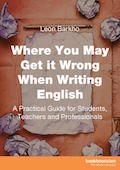 |
|
| Publisher: | Bookboon Publishing, Denmark | ||
| Pages | ISBN-13 | Price | |
|---|---|---|---|
| 219 pages | 978-87-403-1429-8 | $30.90 USD | |
Leon Barkho’s corpus-based book, Where You May Get it Wrong When Writing English, is one of the most insightful books in the field and is written based on the author’s own experience both as an English teacher and an editor. The book is the outcome of collecting his students’ errors then tabulating them in order to make a corpus to be used for teaching. What makes Barkho’s effort significant and unique, lies in the authenticity of his book. The authentic data that he collected resulted in the compilation of the materials over a long period of time in order to address language learners’ common and most frequent mistakes. His book aims to guide English language learners effortlessly through the areas where they may “get it wrong” when writing in English by presenting fifteen organized chapters which target one particular area of error in each.
The first two chapters address quoting and paraphrasing in which hundreds of authentic learners’ errors can be found along with a brief elaboration on each, which are followed by further descriptive examples. Noticeably, the diversity in the numerous examples makes complex writing issues easy to understand. In terms of the structure and sequence of practical guide, his clear and consistent voice throughout the text makes it easy to follow. Broadly speaking on the first three chapters which deal with quoting and paraphrasing, he begins by explicitly stating learning objectives along with a thoughtful discussion which comes at the end of the chapters to summarize what has been argued. Quoting and paraphrasing strategies are the focus of during-writing activities in the first sections and are aimed at providing learners with insight into repeating and quoting in academic writing.
Prompted by his own desire for more meaningful understanding of grammatical patterns in academic writing, Leon allocated Chapters 4 and 5 to the grammatical patterns which are presented through standard definitions followed by examples and common mistakes that had been previously evoked from his own English learners. The focus of these chapters is the English grammar particularly in terms of the subject-verb agreement. Attempting to make the lesson accessible, he provided systematic exercises which invite the readers to practice what they have learned aimed at cautioning against probable mistakes. Interestingly, including authentic content is never neglected. Barkho has cited the sources where these examples have been extracted from publications such as The New York Times and The Guardian. This chapter can help English language learners to more succinctly target aspects of the subject-verb agreements as well as the adjective-noun agreements.
It seems that students’ errors in Leon’s corpus were not limited to grammar and paraphrasing. The inaccurate use of acronyms, abbreviations and even possessive must have appeared frequently in his corpus, which resulted in the composition of chapters 5 to 8. Even though Leon offers a corpus-based list of abbreviations, he added a longer list of the abbreviations which were out of his personally collected corpus in order to make sure the readers have covered a complete list of English abbreviations. This mixture of in-corpus as well as the out of corpus examples can be regarded as the only section in which inauthentic material has been added to the factual material. Similar to previous chapters, a long list of exercises is provided to raise the readers’ awareness of how these acronyms can be used in their writing. In Chapter 8, the principles of punctuation including apostrophes, brackets, colons, commas, dashes, semi-colons, and hyphens are discussed. The author describes each guiding principle by acquainting the readers with them and then move to the exercise in which erroneous samples are analyzed and suggestions provided on how to correct them.
Chapter 9, “currency”, presents the currency names as well as their symbols and abbreviations. Chapter 10, 11, and 12 present the progressive tense, pronouns, and awkward English sentences respectively with insightful examples to clarify the concepts. Chapter 13 presents “coherence” in order to familiarize the reader with the quality of being logical and consistent. Chapter 14 entitled “content words” which discusses the four types of the content words and then compare them with the functional words.
Chapter 15 is entitled “friendly words”. Here another source of trouble in wring in terms of the differences and similarities in meaning, particularly between pairs of words that have common characteristics such as orthography or phonetics or both are presented such as “accept and except”, advice and advise and etc. Leon call these pair of words “friendly words” because they have common characteristics like real friends. Maybe he regards this way of naming the chapter as a technique to make the chapter look more interesting.
I believe the major complaints that can be associated with Leon’s work is his book’s table of content and also the lack of illustrations. For a book as such with numerous sub-headings inside, a more informative table of contents consisting of subheadings within the chapters would have made it less confusing for the readers to find the section they are willing to read. Second, although a large number of examples facilitate the process of learning, some examples are quite similar in terms of their structure, word choice, and teaching goal. Therefore, it could have been more insightful to provide the readers with fewer but more diverse examples. The last limitation is the lack of illustrations. Illustrative information could have visually explained the text and concepts and allowed the readers to gain a better understanding of the topic through the pictures.
In conclusion, Leon Barkho’s book can be regarded as a very fruitful practical grammar guide in which concepts are simplified but not at the expense of accuracy. In my perspective, his effort stands out from previously published grammar books in several aspects. First, despite the importance of language theories, he relied on language usage. Second, in contrast to many other grammar books, all content and examples are based on authentic material that had previously been compiled as a corpus. Last but not least, a large number of situational examples and exercises prevents language learners from making errors in different contexts and also shed some light on these contextualized and situational errors that language learners are likely to make.
Another significant feature is the sources from which these examples and exercises are extracted. The mainstream U.S. and British media outlets such as New York Times (NY Times), The Washington Post, Newsweek, TIME, The Economist, Business Week, The Financial Times (FT) the BBC, The Wall Street Journal (WSJ), and the Christian Science Monitor made the body of the book as rich as possible in terms of realistic drills and authenticity.
Although appropriate for various age groups due to its simplicity and complexity, I highly recommend this book to high school English language learners who wish to improve their writing skill by using an outstanding and easy to follow source. In addition, it can be regarded as a useful practical guide for teacher trainers, as it can help them in new teaching practices mediated by authentic materials.
Reviewed by
Mohammad Sadeghi
University of Pecs, Hungary (doctoral researcher in applied linguistics)
University of San Diego, California (exchange Ph.D. researcher in applied linguistics)
<MSadeghi sdsu.edu>
| © Copyright rests with authors. Please cite TESL-EJ appropriately. Editor’s Note: The HTML version contains no page numbers. Please use the PDF version of this article for citations. |