

August 2017 – Volume 21, Number 2
Classroom Writing Assessment and Feedback in L2 School Contexts |
|||
| Author: | Icy Lee (2017) | 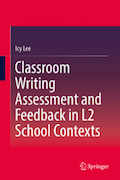 |
|
| Publisher: | Springer Nature Singapore | ||
| Pages | ISBN | Price | |
|---|---|---|---|
| 157 pages | 978-981-10-3922-5 | $69.99 USD | |
In the book Classroom Writing Assessment and Feedback in L2 School Contexts, Icy Lee highlights the need to integrate and bring together classroom assessment and feedback as the two interconnected components of classroom assessment, rather than two separate entities. The book calls for “learning-oriented assessment” (Carless, 2007, p. 57), which underscores “the crucial link between assessment, as carried out in the classroom, and learning and teaching” (Assessment Reform Group, 1999, p. 1). The book also elaborates on a paradigm shift from Assessment of Learning (AoL) to Assessment for Learning (AfL) and Assessment as Learning (AaL). AfL also focuses primarily on classroom feedback and the way it can be utilized to enhance students’ learning. Assessment for Learning (AfL)-oriented classrooms strongly emphasizes quality feedback and active learner involvement (Brookhart, 2011). Capitalizing on the existing second language (L2) writing theories and research, the book is a pioneering work that deals with writing assessment and feedback in L2 primary and secondary classrooms.
After an introductory chapter about classroom writing assessment, the paradigm shift in classroom assessment, and providing teacher feedback, Chapter Two addresses some theoretical and practical issues involved in L2 classroom writing assessment. The AfL/AaL as the basis and foundation of classroom assessment is emphasized, and different functions and purposes of classroom writing assessment are explored. The underlying theoretical underpinnings of classroom assessment are then presented in this chapter, and the chapter ends with a number of guidelines and basic principles that underlie effective writing assessment practices.
Assessment for Learning in the L2 writing classroom is further investigated and fully explained in Chapter Three. Insights from assessment for learning research in writing classrooms and the results of previously conducted research on AfL are also described. The chapter concludes with a discussion of issues related to implementing AfL (i.e., teacher, student, school, and system factors), and its pedagogical principles in L2 writing classes (e.g., pre-writing instructional scaffolding involving students in self/peer assessment and self-reflection, teachers providing descriptive, diagnostic feedback, creating a supportive classroom culture, and disengaging scores from feedback).
Assessment as Learning is mainly discussed in Chapter Four, and the basic theoretical underpinnings and principles of AaL are reviewed in this chapter. AaL has been characterized as a process of “metacognition,” and “it entails the development of learners’ metacognitive capacity” (p. 42). The chapter also outlines how AaL strategies are to be implemented by writing teachers; it ends with several recommendations for future research.
The concept of feedback in writing is introduced in Chapter Five. Theoretical views and perspectives underlying L2 writing are expounded upon, the important role of sociocultural theory in furthering our understanding of “feedback” in writing assessment is stressed, and the way feedback can impact the effective implementation of classroom assessment in general and writing assessment in particular is further discussed in the chapter. Finally, various types of writing classroom feedback (i.e., teacher feedback, peer feedback, and technology-enhanced feedback) are briefly introduced.
Teacher feedback is addressed in Chapter Six. At the beginning of this chapter, the theoretical and practical inconsistencies and variations inherent to teacher feedback are fully compared and contrasted by examining previously-conducted research on providing feedback in L2 writing classes. This research-practice divide in teacher feedback in L2 school contexts, the compatibility and disparity between teachers’ written feedback and the recommended principles, factors accounting for and explaining this gap, and the significance of context for teacher feedback are discussed and elaborated on in this chapter. The chapter ends with a number of guidelines for providing classroom learners with effective teacher feedback.
In Chapter Seven, peer feedback in L2 classroom writing assessment is introduced. First, the theoretical perspectives of peer feedback in L2 writing are discussed. Then, a number of frequently asked questions (FAQs) concerning the application of peer feedback in L2 writing contexts are addressed based on important research findings. The chapter concludes with some tips to help educators plan, organize, and implement peer feedback activities in L2 writing classes.
The role of portfolio assessment in L2 writing classrooms is explained in Chapter Eight. First, portfolio types and the way they are actually put into use in writing classes are discussed. Portfolio assessment is then linked to various assessment purposes (i.e., AoL and AfL/AaL). Second, the dual assessment purposes, which comprise: realizing Assessment for/as Learning and Assessment of Learning in portfolio-based writing classrooms, are described. Third, the link between instruction, learning, and assessment in portfolio-based writing classes is clarified. Finally, the way feedback can be employed during various phases of portfolio process (before, during, and after writing) is discussed. The readers are acquainted and provided with an evaluation of writing portfolios as a pedagogical and assessment tool in L2 writing classes.
The use of technology in classroom assessment and feedback in L2 writing is the main focus of Chapter Nine. At the beginning of this chapter, technology-enhanced tasks in L2 classroom writing assessment (e.g., digital storytelling, blog-based writing, and collaborative writing on wikis) are briefly presented to the readers. Then, the merits and demerits of automated writing evaluation and screencast feedback in teacher evaluation of student writing are fully explained. Next, the use of technology in self-/peer evaluation with reference to Microsoft Word language check functions, concordancing, and screencasting are addressed. Finally, the Writing ePlatform as developed by the Hong Kong Education Bureau for upper primary and lower secondary learners is introduced, and its features and potentials to promote AfL/AaL are discussed. The knowledge base of classroom assessment literacy for L2 writing teachers is examined in the last chapter, and the significance of feedback literacy as a key component of classroom assessment literacy is underscored. The author points to the fact that writing teachers will have to undergo professional development and continuously incorporate assessment innovations in their teaching practices so that they can improve assessment, learning, and the teaching of L2 writing in their classes.
The book is an essential contribution to the ever-growing literature on L2 writing assessment. It may help future researchers become more familiarized with different purposes, functions, and the Theory-Practice divide of L2 writing assessment. It can also provide L2 writing teachers and researchers with new directions and suggestions as how to conduct studies on classroom feedback and writing assessment in similar contexts. Furthermore, the book is an invaluable resource for L2 writing teachers to enhance their classroom assessment literacy, and it provides them with feedback training practices and guidelines and new insights into future research on L2 writing. Finally, the book shows how writing assessment and feedback can be adequately utilized by both learners and teachers (Lee, 2007).
Nevertheless, the distinction made between AoL and AfL/AsL is blurred and not defined in clear operational terms though the author has provided a theoretical definition for each. The paradigm shift the author refers to also needs to be defined in concrete terms and further explained. The claim that only formative assessment contributes to students’ learning and is mostly preferable to the summative one is not well supported and documented by the author as well. Lastly, Lee limits herself to the L2 school context (primary and secondary classrooms), which undermines the generalizability of her arguments.
In sum, the book makes a genuine contribution to the field of language assessment in general and L2 writing assessment in particular. It is a valuable point of reference in the area of teaching, learning, and assessing L2 writing. It is a helpful and practical resource for those interested in implementing principles of L2 writing assessment, enhancing classroom assessment literacy, and effectively utilizing feedback in L2 classrooms.
References
Assessment Reform Group. (1999). Assessment for learning: Beyond the black box. Cambridge: University of Cambridge School of Education.
Brookhart, S. M. (2011). Educational assessment knowledge and skills for teachers. Educational Measurement: Issues and Practices, 30(1), 3–12.
Carless, D. (2007). Learning-oriented assessment: Conceptual bases and practical implications. Innovations in Education and Teaching International, 44(1), 57–66.
Lee, I. (2007). Assessment for learning: Integrating assessment, teaching, and learning in the ESL/EFL writing classroom. The Canadian Modern Language Review, 64(1), 199–213.
Reviewed by
Reza Bagheri Nevisi
University of Qom, Qom, Iran
<re.baghery gmail.com>
Rasoul Mohammad Hosseinpur
University of Qom, Qom, Iran
<rmhosseinpurgmail.com>
| © Copyright rests with authors. Please cite TESL-EJ appropriately. Editor’s Note: The HTML version contains no page numbers. Please use the PDF version of this article for citations. |