

November 2017 – Volume 21, Number 3
Legal English, 4th Edition |
|||
| Author: | Rupert Haigh (2015) | 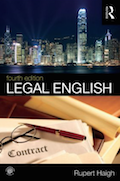 |
|
| Publisher: | Routledge | ||
| Pages | ISBN | Price | |
|---|---|---|---|
| pp. ix + 349 pages | 978-0415712859 | $38.61 USD | |
Legal English 4th Edition is intended for legal professionals, law students, and others who regularly contend with legal documents and communication. The book is available in both paperback and ebook formats. Because of the included grammar and vocabulary sections, this course book is likely intended for intermediate English language learners. It provides a detailed overview of English usage in current international law practices, and it is to be used as a reference for contracts, vocabulary, grammar and drafting documents, as well as a teaching and self-study resource. Included is a self-study section that contains an example of a lawyer’s letter, a contract, legislation, and a case study. The course book aims to explain and clarify complicated areas of English (e.g., law vocabulary), and it is a resource for learners and teachers to use both in and out of the classroom.
The course book contains 23 sections that are divided into two parts: Writing (Part One) and Speaking (Part Two). Part One offers a historical overview of legal English, grammar, vocabulary, writing standards and styles, examples of contract clauses, and correspondence, as well as differences between British and American English. Part Two provides sample sentences of spoken English in the legal context, such as interviewing, meeting and advising clients, court advocacy, negotiation, conventional greetings, and informal talk. In addition, the course book includes tips for professional phone etiquette, such as answering and taking messages, making formal presentations to colleagues or clients, and chairing a formal meeting.
The book has an accompanying website that provides additional exercise questions and videos that students can access, as well as four instructor-led tasks. An exam is provided to teachers who use the book as a required textbook for their course. The tasks include activities such as replying to an email, giving a presentation, conducting a negotiation, and role-playing in a courtroom. Role-plays can be very useful for learners to engage in authentic language because they can create real conversations through real-life topics and themes (Shapiro & Leopold, 2012). The four video examples provide real-life scenarios and examples for the learners to explore.
One of the highlights of Legal English 4th Edition is the use of authentic discourse and real-life samples of legal English texts. Learners are likely to be engaged and motivated by reading authentic discourse (Tomlinson, 2014) and have improved literacy practices (Ahlstrom, 2003). Authentic discourse and real-life exercises are evident in samples of legal documents, lawyer correspondence with letters and emails, problematic scenarios such as dealing with difficult clients, and meetings with clients from different cultures.
One of the selling points of Legal English 4th Edition is that it also includes contemporary themes. Contemporary themes can be defined as themes or units of a course book that are either current or linked to genres of fiction, magazines, newspapers, and journals, as well as trends in spoken and written language (Richards & Schmidt, 2002). Contemporary themes are closely linked to modernism, which is the “rejection of tradition and authority in favour of reason, science, and objectivity,” and are closely linked to Western values, thought, and scientific methods (Richards & Smith, 2002). Contemporary themes have also been linked to learner-centered learning, give learners an active role in learning and are less teacher-centered (Richards & Smith, 2002). Examples of contemporary themes in this course book are court advocacy, negotiation, sexism, and difficult clients. Another benefit of the course book is that it can be used as a reference book and, therefore, will likely be kept by the learner. The units of the course book such as vocabulary and terminology, grammar, punctuation, drafting contracts, and emails are conveniently labeled for the learner to refer to when needed.
While the course book has many strengths, three main drawbacks should be noted. The first is the lack of multimodality and visuals in the course book and accompanying website material. It is important for teachers to incorporate multimodal texts in the classroom, such as online videos, blogs, and websites, among others, because learners encounter these types of texts outside of the classroom in their everyday life (Chun, 2012). Furthermore, technology has enabled the possibility of reading text transcripts and audio versions of books and much more. Multimodal texts can include audio, visual and video or simply be a text together with photos or other visuals (Royce, 2002). The primary use of multimodality in the course book is tables containing vocabulary; there is no use of visuals such as charts, diagrams, pictures, maps, or drawings. The accompanying website does not include any visuals except for the four videos in the video section of the website.
Secondly, the course book lacks an integration of all four skills. Integrating all four skills into instruction can make learning more interesting, rich, and cognitively engaging (Adeyemi, 2010). In order for instruction to be the most authentic, curriculum should simultaneously include as many L2 language skills as possible (Hinkel, 2006). The course book only includes reading and writing texts, and no audio files or video files have been incorporated. Furthermore, there are no pictures or pronunciation symbols, such as fall and rising tone symbols.
Lastly, the book lacks effective exercises and tasks. Questions are only available in Unit 14 and online. They do not adequately cover all the subject knowledge areas included in the book. In addition, there is no opportunity for the instructor to either manipulate or re-arrange the questions online. The online tasks are too lengthy to be used in the classroom. On average, each task can take up to two hours to complete.
Despite its shortcomings, Legal English 4th Edition is a valuable book for those learners who need a legal English reference guide and want to improve their vocabulary knowledge and writing skills. This course book offers learners an opportunity to be prepared to use English language skills in a legal context.
References
Adeyemi, D. (2010). Justification of a multidisciplinary approach to teaching language in Botswana junior secondary schools. Journal of Language, 2(1), 8-20.
Ahlstrom, C. (2003). Collaborating with students to build curriculum that incorporates real-life materials. Focus on Basics, Connecting Research & Practice, 6, 1-7.
Chun, C. (2012). The multimodalities of globalization: Teaching a YouTube video in an EAP classroom. Research in the Teaching of English, 47(2), 145-170.
Hinkel, E. (2006). Current perspectives on teaching the four skills. TESOL Quarterly, 40(1), 109-131.
Richards, J., & Schmidt, R. (2002). Longman dictionary of language teaching & applied linguistics. Essex: Pearson Education.
Royce, T. (2002). Multimodality in the TESOL classroom: Exploring visual-verbal synergy. TESOL Quarterly, 36(2), 191-205.
Shapiro, S., & Leopold, L. (2012). A critical role for role-playing pedagogy. TESL Canada Journal, 29(2), 120-130.
Reviewed by
Ryan Brendzy
Qatar University, Doha, Qatar
<rbrendzy qu.edu.qa>
| © Copyright rests with authors. Please cite TESL-EJ appropriately. Editor’s Note: The HTML version contains no page numbers. Please use the PDF version of this article for citations. |