

February 2021 – Volume 24, Number 4
A Transdisciplinary Approach to International Teaching Assistants:
|
|||
| Author: | Stephen Daniel Looney & Shereen Bhalla (Eds.) (2019) | 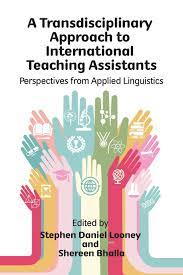 |
|
| Publisher: | Multilingual Matters | ||
| Pages | ISBN | Price | |
|---|---|---|---|
| Pp. x + 188 | 978-1-78892-553-2 (paper) | $35.00 U.S. | |
Stephen Daniel Looney and Shereen Bhalla’s (2019) edited volume, A Transdisciplinary Approach to International Teaching Assistants: Perspectives from Applied Linguistics, is a comprehensive book that positions itself as a key resource in International Teaching Assistant (ITA) research. Arguing against the outdated, deficit-based view of ITAs, this volume sees ITAs as “multilingual, skilled, migrant professionals who participate in and are discursively constructed through various participant frameworks, modalities, and activities” (p. 1). This asset-based stance underlies the entire book.
Using the Douglas Fir Group’s (2016) transdisciplinary framework for second language acquisition as a blueprint, the editors suggest their own framework for ITA research (p. 10). Like the Douglas Fir Group’s framework, the ITA framework is tri-layered, consisting of a micro, meso, and macro layer. The micro level is designated for ITA research on language, social interaction, grammar, lexis, prosody, and undergraduate discourse with ITAs. The meso level includes research on the social identities of ITAs and on communities of practice (CoP). Lastly, the macro level includes ideological values surrounding ITAs (p. 11). In structuring this book, the editors transpose their framework onto each section, demonstrating how their transdisciplinary framework provides a structure for current and future ITA research. Chapter 1 provides an introduction to the framework and tenants of the transdisciplinary work. Chapters 2-4 are situated in the micro level of ITA research, Chapters 5-7 relate to the meso level, and Chapters 8-9 are placed within the macro level. Looney concludes the book in Chapter 10 by stating five imperatives for ITA programs, summarizing the contributions of each level, and providing future suggestions.
The micro level chapters focus on aspects of interactional repertoires, including lexis and grammar, in recurring institutional contexts in which ITAs work, such as in labs or during office hours. Chapter 2, written by Lucy Pickering, describes the history of intonation and prosody in ITA discourse, from the onset of the “Foreign ITA Problem” to the early ITA programs and their approaches to teaching ITAs (pp. 25-26). Pickering then introduces the discourse intonation model and describes how it can be used to improve ITA prosodic features. In Chapter 3, Looney examines sequences of co-operative actions to determine how an ITA and his undergraduate students negotiated misunderstandings and uncertainty in a physics lab. Shiao-Yun Chiang investigates instructional authority in Chapter 4 by examining office hour discourse between an ITA and a native English-speaking student, demonstrating the value of utilizing a social interactional approach for ITA research. Each of the micro chapters point to promising growth in the field, as well as under-addressed areas for future research.
Chapters 5-7 highlight the meso level, addressing ITAs’ social identities and CoP. Okim Kang and Meghan Moran highlight three studies in Chapter 5 that can improve ITA-undergraduate understanding. A one-hour activity, a semester-long partner program, and a class with embedded activities all provide evidence that U.S. undergraduates benefit from well-planned activities with ITAs to address biases against non-native accents and different pedagogies (p. 88). In Chapter 6, Jing Wei examines rater bias in scoring World Englishes (WE) through a transdisciplinary approach, demonstrating that response rating is a “complex linguistic behavior conditioned by social identities” (p. 100). Wei reveals that, while norming raters on unique features of WE may increase awareness of WE linguistic patterns, raters may still not accept these features as grammatically accurate. Finally, Chapter 7 explores South Asian ITA CoPs. Bhalla highlights cultural and linguistic findings from group narratives and interviews, revealing that, while ITAs are highly intelligent individuals, within their CoP, each student will interpret their experiences working as a foreign teacher differently. Overall, each meso chapter demonstrates unique approaches for understanding and improving the ITA experience.
The final section addresses the macro level, which Looney and Bhalla describe as including the “political values, economic values, cultural values, educational values, and linguistic values involved in ITA research” (p. 11). Linda Harklau and James Coda, in Chapter 8, focus on the disconnection between localized (and historically deficit-based) ITA research and U.S. interests. They suggest introducing ITAs to educational policy contexts in which they are situated for self-advocacy purposes, as ITAs are indicators of the “health and status of the US as a world leader in higher education” (pp. 148-149). In Chapter 9, Greta Gorsuch applies course logic from the field of evaluation research to an ITA course. By focusing on instructional planning, Gorsuch encourages teachers to discover how to improve their curricula and learning outcomes. These two macro-level studies demonstrate how viewing ITAs from ideological standpoints creates a strong case for continual improvement.
With the goal of providing a transdisciplinary framework for ITA research, a major strength of this book is its inclusion of professional voices from across the field. Additionally, the effort that the editors undertook in constructing a transdisciplinary framework for ITA research unifies the field by creating a blueprint to utilize. Prior to this, the research field had not been properly conceptualized in that “the idea that language, teaching, and culture, and the intersections between them, comprise the needs of ITAs is one of the few concepts that approach the level of a theoretical model in ITA education” (Gorsuch, 2016, p. 276).
However, there are shortcomings to be noted. First, the ITA framework itself (p. 11) is somewhat dense and could be unwieldy to newcomers to the field. Providing a focus for each framework level (i.e., only including interactional repertoires in the micro level and only including social identities in the macro level) would increase readability and memorability. In addition, it can sometimes be difficult to see how individual chapters connect to the framework and to each other. Since this framework is new, providing a preface to each chapter that demonstrates its positionality might help with navigation.
In creating A Transdisciplinary Approach to International Teaching Assistants, Looney and Bhalla have provided a book of value to ITA researchers, practitioners, and other stakeholders. As stated by the editors, the real challenges of the field are not the ITAs themselves, but that ITA research and practice are not in dialogue with each other, nor is ITA policy informed by research. By addressing these research issues, Looney and Bhalla believe that ITA policy may be improved (p. 10). A decade ago, Ji Zhou, a former ITA herself, petitioned for a “renewed enthusiasm for ITA issues and challenges, and the development of the training curriculum” (2009, p. 23). As this book provides a foundation for ITA research through its transdisciplinary framework, a renewed enthusiasm may very well follow.
To cite this review:
Beck, J. (2021). [Review of the book A transdisciplinary approach to international teaching assistants: Perspectives from applied linguistics by Stephen Daniel Looney & Shereen Bhalla (Eds.)] Teaching English as a Second Language Electronic Journal (TESL-EJ), 24(4). https://tesl-ej.org/pdf/ej96/r1.pdf
References
Douglas Fir Group. (2016). A transdisciplinary framework for SLA in a multilingual world. Modern Language Journal, 100(Supplement 2016), 19-47. DOI: 10.1111/modl.12301
Gorsuch, G. (2016). International teaching assistants at universities: A research agenda. Language Teaching, 49(2), 275-290. doi:10.1017/S0261444815000452
Zhou, J. (2009). What is missing in the international teaching assistants training curriculum? Journal of Faculty Development, 23(2), 19-24.
Reviewed by
Jeanne Beck
Iowa State University
<beckje iastate.edu>
| © Copyright rests with authors. Please cite TESL-EJ appropriately. Editor’s Note: The HTML version contains no page numbers. Please use the PDF version of this article for citations. |