

November 2023 – Volume 27, Number 3
https://doi.org/10.55593/ej.27107m1
| Title | Extempore |
| Developers | Deeloh Technologies |
| Website | https://extemporeapp.com |
| Type of Product | A web-based speaking practice and evaluation tool |
| Operating System | PC or Mac that supports web browsers Chrome and Firefox. Safari is not recommended.
For mobile application Android 5.0 or above, iOS 11.0 or later (iPhone, iPad, and iPod touch). |
| Hardware Requirements | An internet accessible device |
| Documentation | Available from https://extemporeapp.com |
| Price | Free for basic version; purchase required for a full license, $12.99 (one-time fee) for student purchase to enroll each class; $8.99 or less per student for an institution-paid plan; Additional charges for sync group assessments ($2.00/student). |
Spontaneous communication serves as the ultimate goal of language learning (Loewen, 2015). However, language teachers often find it hard to set aside time for abundant oral practice due to limited class time. Extempore would appeal to those teachers who plan to promote their students’ speaking proficiency by providing extra opportunities for speaking practice and a simpler way to evaluate spontaneous speech. Extempore is an online platform designed to help language educators create, assign, and assess oral performance, ensuring spontaneous speech from students (Extempore, 2022). It also offers group speaking assessments in both synchronous and asynchronous modes. Acting as a language lab alternative, it aims to promote the “3Ps” – Proficiency, Progress, and Performance – by providing affordances for all three modes of communication (i.e., text, audio, and video), building proficiency and confidence, and exam preparation. This review focuses on describing how the software works as well as evaluating its potential for achieving its language learning goals.
Description
Extempore is a language learning platform that allows teachers to provide practice and assessment opportunities for students. Teachers can easily create an account on Extempore by entering their email or signing up with their Google, Apple, or LMS accounts. Once they have chosen their role as instructors, they can create classes that students can access through an automatically generated link. Teachers can customize assessments by deciding on the type of response (audio, video, or text), grading options, rubric, and feedback. Extempore also offers an interpersonal speaking mode where teachers can choose between asynchronous and synchronous options. Teachers can access student submissions on the grading page, where they can provide scoring and feedback in text, audio, and video format. Without upgrading to a full license, teachers can have an unlimited number of classes, assessments, and students, all in their single account. The ensuing subsections will elucidate how speaking assessment, interpersonal speaking practice, and feedback are all executed via the Extempore application.
Speaking Assessment
Teachers can create an assessment by customizing built-in parameters (Figure 1). They can decide whether students will respond with audio, video, or text to the prompt of the assessment. Regarding grading options, teachers can decide how long the assessment will be open to students and whether the grades will be visible to students upon submission or hidden by default and manually published to students. Teachers can also set the rubric and whether to provide a numerical score only or with feedback. Finally, teachers can determine whether they will allow students to re-record their responses or use timing parameters to limit the time students can preview and record their responses. After the setup, teachers can begin creating questions for the assessment by adopting different media – image, video, and audio – as prompts (Figure 2). Teachers can assign the assessment to students either to be completed individually or in groups. Within the assessment timeline set up by the teacher, individual students can start responding with audio or video.
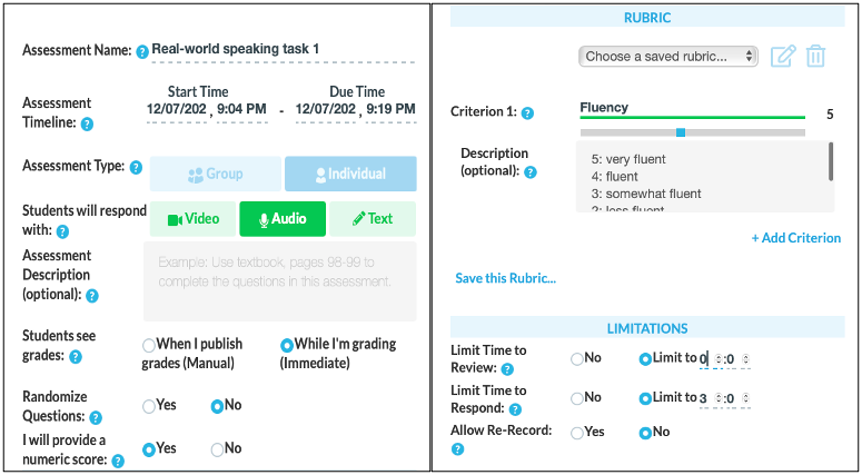
Figure 1. Assessment Parameters.
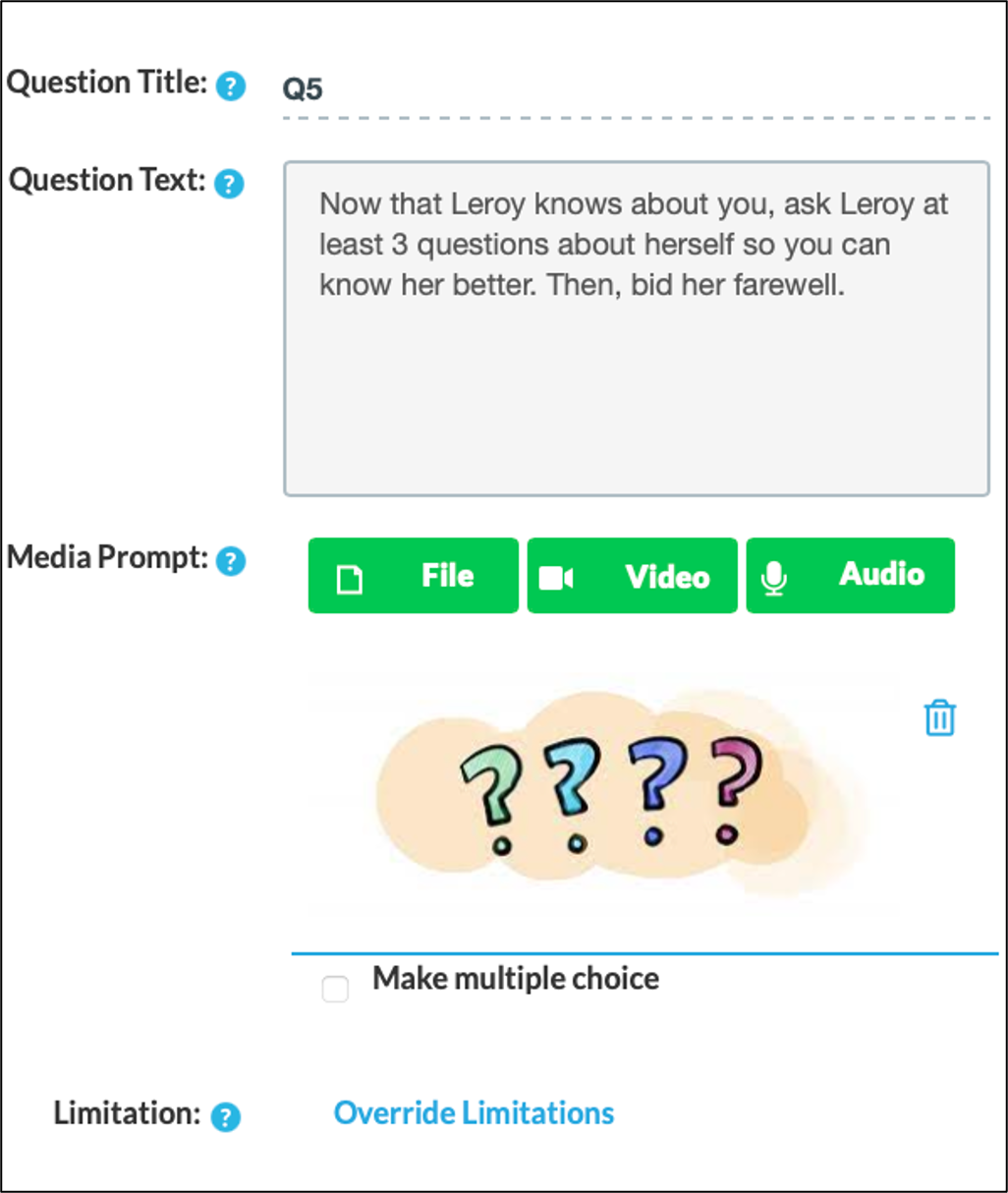
Figure 2. Question Creation.
Interpersonal Speaking Practice
Extempore offers an interpersonal speaking mode where teachers can choose between asynchronous and synchronous options. In an asynchronous mode, up to 15 students can work at their leisure, sharing their audio/video on a discussion board. In a synchronous mode, or Extempore Sync feature, interactive conversations can be scheduled to go live in rooms for up to four students, recorded, and available for teacher review and grading.
When creating a group assessment, students are automatically assigned to one of the rooms, yet teachers can manually move them to another room at their discretion. Students first enter a waiting room area where they can preview the description of the assessment, and when everyone is ready, they can join a room where they can communicate with one another, with the task prompts viewed on the same browser window (Figure 3). The recording begins automatically upon students’ joining the room, and when the allotted time expires, the response is submitted automatically (option 1), or every student in the room clicks the “submit” button when finished (option 2); in either way, students cannot review their submission immediately, nor do they change their response after submission. Students’ collective response is then uploaded to the instructor portal for feedback and scoring.
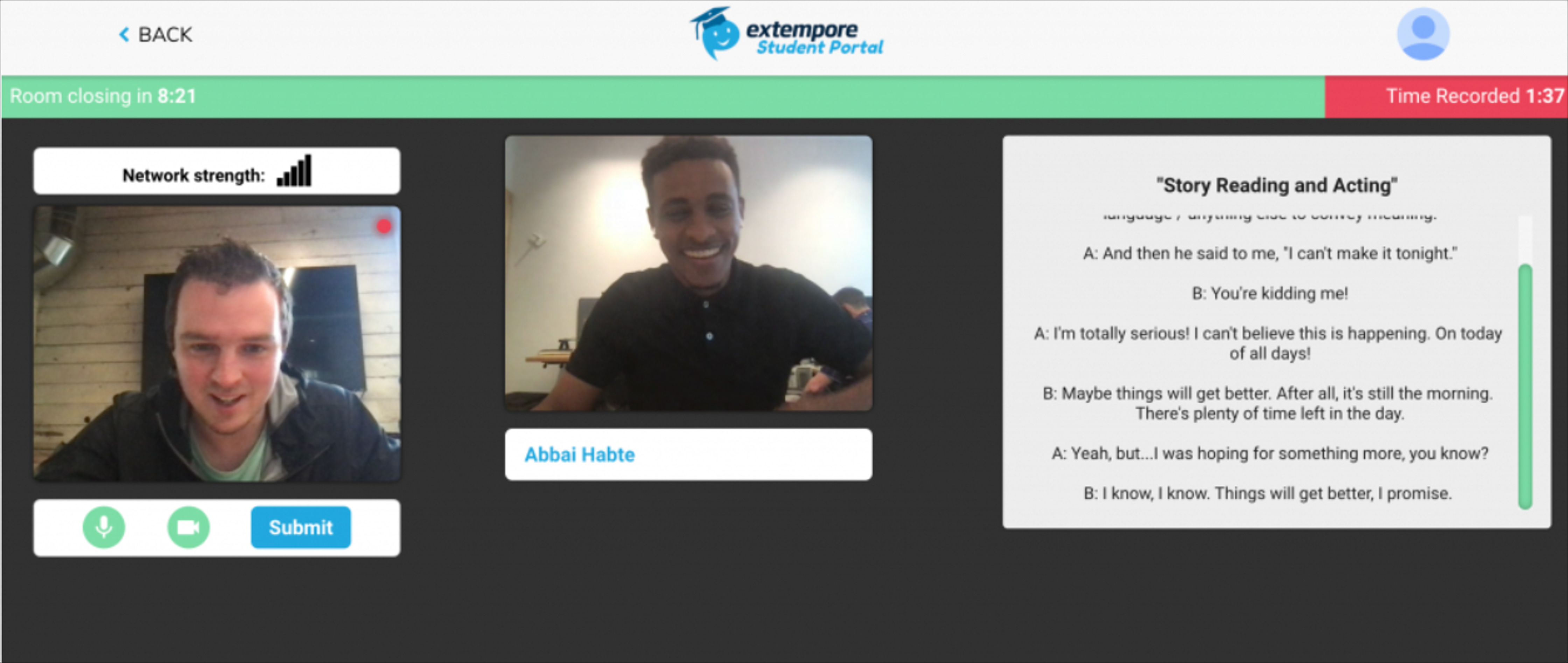
Figure 3. Synchronous Assessment.
Grading and Feedback
On the grading page, teachers can access student submissions and provide scoring and feedback. They can choose to organize either by student or by question; in the latter choice, teachers can go through and grade everyone’s answer to the same question before proceeding to the next question and doing the same. Teachers can leave feedback in the form of text, audio, and video, and they can even interject the student’s recording within their own audio/video feedback directly recorded from the platform (Figure 4). Extempore also offers a Digital Portfolio that shows individual students’ progress by compiling all the grades and feedback from their instructor.
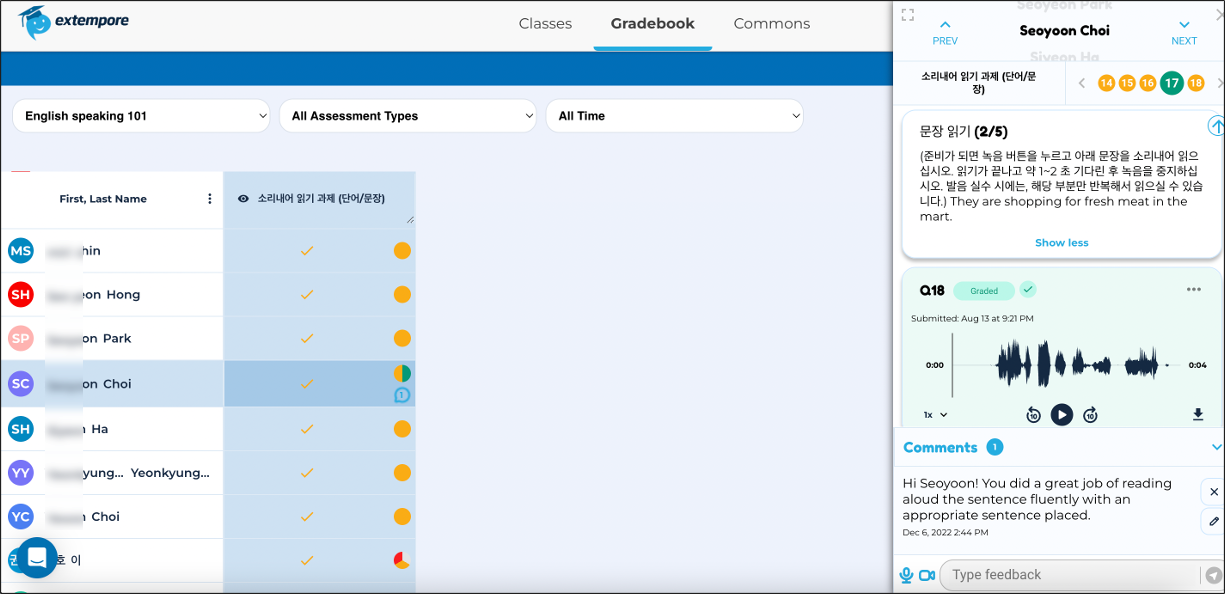
Figure 4. Instructor Feedback Example in Gradebook Feature.
Evaluation
Extempore exhibits both strengths and weaknesses with respect to its technical and pedagogical aspects. For the strengths, first, the overall design of Extempore is fairly intuitive, visually appealing, and easy to navigate. Extempore is outstanding with its built-in cloud-based technology that allows users to access the platform with an internet-connected device. Students can synchronize their phones with other devices so that they can pick up their studies anywhere and anytime at their leisure. The mobile app is only available for students, but instructors can still use a mobile browser to access Extempore, providing them with a flexible means of monitoring and evaluating student progress from a remote location.
The timing feature of Extempore ensures learners practice speaking in real-time rather than producing prepared or read-aloud speech, thereby promoting fluency (Skehan, 2003). The Sync feature promotes authenticity, which is essential for CALL software (Chapelle, 2011). Engaging in interactions with situation prompts, especially those augmented by multimedia, can enable learners to prepare themselves for real-life communication, where creativity and spontaneity in L2 use are necessary (Illés & Akcan, 2017). In interactional conversations, learners can also foster skills such as turn-taking and topic management, which otherwise cannot be developed through monologic tasks (Van Os et al., 2020). Furthermore, such conversations between the learners entail chances for negotiation of meaning and the production of modified output, enhancing learners’ L2 acquisition (Loewen, 2015). Learners working collaboratively are expected to offer each other corrective feedback, especially in moments of communication breakdowns; peer interactions enabled by Extempore’s Sync feature would help to improve students’ speaking accuracy (Khoram et al., 2020; Sato & Lyster, 2012). Another benefit of the software as a speaking assessment tool relates to its incorporation of advanced options for the feedback feature. Teachers can easily provide audio/video feedback recorded directly from the platform. The effectiveness of this feedback can be greatly enhanced by getting students’ attention drawn to the parts – those excerpted and interjected within the feedback – where clarifications or corrections are needed. When teachers point out grammatical inaccuracies in students’ speaking, students would better notice the gap between their non-target outputs and target forms. This heightened awareness contributes to an improvement in their speaking accuracy (Chen & Nassaji, 2018; Gass & Varonis, 1994; Wang, 2014).
Despite notable strengths, critical analysis of Extempore reveals some weaknesses. The Extempore website is poorly supported by Safari, where some web pages switch to a mobile view that does not fit the desktop version. Future updates should consider making the platform compatible across different browsers and operating flawlessly on each. For the time being, the recommended browsers are Chrome and Firefox when accessed via desktop. Furthermore, the learning curve for Extempore can still be a bit steep for instructors who may get confused by the abundance of available functions. The Blog section of Extempore does provide numerous posts regarding the “applications” of the app for different teaching/learning goals, yet it lacks basic tutorials that could onboard the new users successfully. Providing a tutorial that focuses solely on the essential information needed to get started would be helpful.
Regarding the pedagogical aspects, Extempore‘s lack of a lockdown browser may render it inadequate for assessments that require a secure testing environment. The absence of such a feature may compromise the integrity of the assessment, leaving it vulnerable to unauthorized access and potential cheating. For the sync feature, the teacher cannot participate in the synchronous room as an interviewer. Teachers may still be able to join the room in student mode, but this would render them unable to grade students using the rubrics displayed on the screen. These identified weaknesses can limit the scope of Extempore‘s use to learning-oriented purposes or formative assessments rather than more formal language assessments.
Conclusion
To conclude, Extempore is consistent in its claims to facilitate speaking proficiency by providing extra opportunities for speaking practice for students and a simpler way to give feedback on and evaluate spontaneous speech for teachers. However, this review has revealed some issues. Therefore, Extempore may be most effective as a tool for speaking practice and formative assessment rather than the most appropriate platform for conducting formal language assessments.
About the Reviewer
Inyoung Na holds a BA in English Education from Hankuk University of Foreign Studies in Seoul, South Korea, and an M.A. in Second Language Studies from the University of Hawaii at Manoa. She is currently a Ph.D. student in the Applied Linguistics and Technology program at Iowa State University. Her research interests are second language pronunciation and speech intelligibility, language attitudes, World Englishes, psycholinguistics, and language testing and assessment. ORCID ID: 0000-0003-3046-3164 <inyoung@iastate.edu>
To Cite this Review
Na, Inyoung. (2023). [Review of the website Extempore]. Teaching English as a Second Language Electronic Journal (TESL-EJ), 27 (3). https://doi.org/10.55593/ej.27107m1
References
Chen, S., & Nassaji, H. (2018). Focus on form and corrective feedback research at the University of Victoria, Canada. Language Teaching, 51(2), 278-283. https://doi:10.1017/S026144481800006X
Chapelle, C. A. (2001). Computer applications in second language acquisition: Foundations for teaching, testing, and research. Cambridge: Cambridge University Press.
Extempore. (2022). https://extemporeapp.com
Gass, S. M., & Varonis, E. M. (1994). Input, interaction, and second language production. Studies in second language acquisition, 16(3), 283-302.
Illés, É., & Akcan, S. (2017). Bringing real-life language use into EFL classrooms. ELT Journal, 71(1), 3 – 12. https://doi.org/10.1093/elt/ccw049
Khoram, A., Bazvand, A. D., & Sarhad, J. S. (2020). Error feedback in second language speaking: Investigating the impact of modalities of error feedback on intermediate EFL students’ speaking ability. Eurasian Journal of Applied Linguistics, 6(1), 63-80. https://doi.org/10.32601/ejal.710205
Loewen, S. (2015). Introduction to instructed second language acquisition. Routledge. https://doi.org/10.1002/tesq.255
Sato, M., & Lyster, R. (2012). Peer interaction and corrective feedback for accuracy and fluency development: Monitoring, practice, and proceduralization. Studies in Second Language Acquisition, 34(4), 591-626. https://doi.org/10.1017/S0272263112000356
Skehan, P. (2003). Focus on form, tasks, and technology. Computer Assisted Language Learning, 16(5), 391 – 411. https://doi.org/10.1076/call.16.5.391.29489
Van Os, M., De Jong, N. H., & Bosker, H. R. (2020). Fluency in dialogue: Turn‐taking behavior shapes perceived fluency in native and nonnative speech. Language Learning, 70(4), 1183 – 1217. https://doi.org/10.1111/lang.12416
Wang, Z. (2014). Developing Accuracy and Fluency in Spoken English of Chinese EFL Learners. English language teaching, 7(2), 110-118. http://dx.doi.org/10.5539/elt.v7n2p110
| © Copyright rests with authors. Please cite TESL-EJ appropriately. Editor’s Note: The HTML version contains no page numbers. Please use the PDF version of this article for citations. |