

June 2003 — Volume 7, Number 1
Exploring Collins COBUILD ON CD-ROM
| Title: | Collins COBUILD on CD-ROM | ||
| Publisher: | Collins | ||
| Contact Information: | E-mail: dictionaries@eesox.com | ||
| Tel: | +44 (0)1954 208208, +44 (0)1954 200008 | ||
| Fax: | +44 (0)1954 205205 | ||
| URL: | www.cobuild.collins.co.uk/catalogue/cobcd features.html | ||
| Product Description: | Comprehensive English language reference CD-ROM; includes the COBUILD English Dictionary for Advanced Learners (3rd Ed.); English Grammar, English Usage; Thesaurus; 5-million-word Wordbank from the Bank of English |
||
| Minimum Hardware Requirements: |
PC | Mac | |
| OS: | MS Windows 95 or higher | 8.6 or higher | |
| Memory: | Minimum 16Mb RAM | Minimum 32Mb RAM | |
| CPU: | Intel 80486 compatible or higher | Power PC (PPC) | |
| Sound: | Windows compatible sound card Headphones or speakers |
Headphones or speakers | |
| Disk Space: | 110Mb (regular install)/600Mb (full install) | ||
| Price: | ¥4,800 | ||
| ISBN: | 0-00-710884-2 | ||
Background
As many of you may remember, new ground was broken in 1987 with the first edition of the COBUILD (Collins Birmingham University International Language Database) English Dictionary. Its major innovations included being the first dictionary whose content was based on the insights into actual English usage provided by the analysis of a huge corpus of written and spoken English, providing a large number of authentic example sentences taken from the corpus, and defining words not with traditional definitions, but with full-sentence descriptions. [-1-]
After giving the matter considerable thought, I decided back then to require my students to purchase the COBUILD Student’s Dictionary for a number of reasons. I was convinced that many of my Japanese students’ errors were the result of an over-reliance on bilingual dictionaries. In addition, I was well aware of the limitations of traditional, often intuitive dictionary-making methods, and had noticed that, despite their widespread usage, my intermediate students regularly found the language in the definitions of other monolingual learner dictionaries, such as the Oxford Advanced Learner’s Dictionary (OALD5), beyond their level (Although the new 6th edition OALD is much improved in this regard). However, arising from what I felt to be a combination of overly strict adherence to their policy of including only authentic, unaltered example sentences, and possibly from poor example selection, my students continued to encounter occasions where the dictionary did more to confuse them than to aid them, more often than I thought it should, especially given the difficulties I had in getting many of my students to switch to a monolingual dictionary in the first place! In addition, although it was portable (I insist on my students bringing their dictionaries to class), because of its limited size, my students often could not find the words they were looking for (e.g., the word “landmine” listed in the comparison below). I really feel that a good dictionary for learners beyond the beginner level should be comprehensive and yet accessible, and do not know why dictionary publishers seem to feel compelled to offer different editions for different levels of learners. A beginner-level dictionary and a well-constructed one for higher-level learners that they will not outgrow would seem to me to be sufficient.
Luckily, by the mid-90s there were some new corpus-based kids on the block and I ended up switching my allegiance to the newly revised edition of The Longman Dictionary of Contemporary English (LDOCE3) for several reasons. First of all, although COBUILD deserves gratitude for being first and leading the way, I had become aware of flaws in the COBUILD dictionary that resulted from the imperfect construction of the COBUILD corpus. Second, the definitions in the LDOCE3 were written within a simple 2000-word defining vocabulary that was friendly to intermediate students. And finally, despite containing many more words, the LDOCE3 came in a conveniently boxed, portable, Japanese edition.
So when I was asked to evaluate the newest, electronic, edition of the Collins COBUILD English Dictionary for Advanced Learners, 3rd edition, I felt it was a good opportunity to see if things had improved since the second edition which, incidentally, continues to be highly prized by my wife and other high-level learners for whom I purchased it.
Getting going
It was very easy to install on the hard drive of my XP driven PC. Users have the option of only partially installing the program and using it with the CD in the drive. However, fully installing the program allows you to conduct your searches more quickly, and more importantly, frees up your CD drive. However, if you choose to fully install the program, make sure you have 600Mb (!!) of free space available. Also, for some reason, the Collins CD runs much more quietly than my LDOCE disc.
What material does the CD-ROM contain?
Lots. It includes three Collins COBUILD publications (the 3rd edition of the English Dictionary for Advance Learners, the Guide to English Usage, and the English Grammar ) as well as a thesaurus, a 5-million word corpus of authentic written and spoken English, and the sound file (mostly British) pronunciations of tens of thousands of headwords and phrases. For some reason, phonetic transcriptions were left out (see Review of the Collins 2002 for a discussion of this omission). There are apparently 350 American pronunciations in the 3rd edition and COBUILD has since decided to add thousands more to the next edition (R. Krishnamurthy, personal communication, March, 10, 2003). [-2-]
What features does it have?
Searching
The fact that the full contents of the CD-ROM can be searched in one go is no doubt its best feature. This feature not only enables you to quickly look up the descriptions and example sentences for a target word, but to simultaneously find other descriptions and example sentences in the dictionary, the 5 million word corpus, and the grammar and usage guides that contain references to the target word. While finding lots of examples of a word in use is old hat for those of us who use concordancing programs, this CD-ROM is a very learner-friendly package not only because the searches involve nothing but plugging words into the search engine, but also because the examples are always in full-sentence form (as opposed to the default “key word in context”, or KWIC, display used in concordancing programs). The down side is that even when using the Advanced Search feature, more sophisticated searches are not possible because the only Boolean symbols that can be used are “AND”, “OR”, “+” and “-“. It would also be nice if, instead of having to search through the entries, the display would automatically jump to the first example containing the search item. However, other search features include a morphological search which allows members of a word family to be included in a single search, and a phonetic search which allows users to search for homophones. But be forewarned, should you wish to copy any of the information off your display, you unfortunately can only copy entire entries, no matter what their length!!
Display
The interface is very simple, fast and easy to use. A nice feature is the way in which a list of compounds (synonyms, antonyms, phrasal verbs, affixes, etc.) associated with the entry on display is automatically displayed in the small window in the bottom left-hand corner of the screen. However, although these two screens are linked and change simultaneously, the search entry box and the Entry List in the top left-hand corner of the display operate independently of each other and the main display, and this can lead to confusion. For example, as you continue your search, you can end up with the search term (e.g., “rendezvous”), the entry list (e.g., for the word “first”) and the entry display (e.g., for the word “last”) for different entries all being simultaneously displayed. Another feature allows the entries to be viewed in “brief”, which means no examples, sounds icons, or comments. This makes the display more like a dictionary for native speakers, although I am not sure why anyone, even native speakers, would prefer this view.
User Dictionary
Another wonderful learning tool is the “User Dictionary” feature (not available on the Mac version). This allows users to enter any words they wish into their own personal study list, group them, and then test their receptive learning to see if they can recall the definitions of the words in their lists. Although there also appears to be a way to test your knowledge by providing L1 translations, I could find no explanation within the Help files (see below) of how to go about doing so. [-3-]
Help
Although we all know how frustratingly inadequate the content of Help files can be, in this case, the fact that there is one Help file for “Lexicon” (topics related directly to the search engine) and a second one for “COBUILD” (topics related directly to COBUILD publications), makes it all the more so. The other troublesome Help feature is that the Back button was usually greyed-out so I had to repeatedly re-initiate my Help searches. Another feature (again apparently only for PC users) described in the literature for which I could find no information is the option of being able to call up the CD-ROM from within MS Word. Finally, for those not familiar with the COBUILD 5-diamond system for coding word frequency, I was surprised that I was not able to find an explanation, even after I discovered the COBUILD Help file!
How do its features compare?
I happened to have the CD-ROM versions of the LDOCE3 and the Cambridge Dictionary of American English (CDAE) on hand and intended to compare the three dictionaries. However, since the CDAE would not run on Windows XP, I decided to substitute in its place the on-line version of the Cambridge International Dictionary of English (CIDE), which is actually more comparable in terms of size, scope and target audience. However, since I was not able to use the CD-ROM version of the CIDE per se, the features for the CIDE on CD-ROM that I have listed in Table 1 are based on the information on the Cambridge University Press website, and my first-hand comparisons of definitions, example sentences, and usage notes for the CIDE are limited to the content of the online dictionary.
| COBUILD3 | LDOCE3 | CIDE | |
|---|---|---|---|
| Interface (see screen shots below) |
* Search box and two small windows (entry list and compounds) on the left side, entry display on the right. * Buttons allow backward and forward movement through searches as well as dictionary entries. |
* Search box and word list window on the left side, entry display on the right. * Displays a history of past searches. |
Search box and word list window on the left, two small windows on the right. |
| Search Features and Capabilities | * Full text search produces a list of the definitions, examples, and synonyms within each of the five components of the CD. * Can also conduct some basic Boolean searches as well as phonetic and morphological ones. * Derived words and compounds automatically listed in the bottom left window. |
* Search categories include Dictionary, Verbs (conjugations), Pictures, and Tables (abbreviations, codes and lists), as well as Related Words. * There is also a multi-word search capability. |
* Full text search with a highly customizable set of search filters offering six ways to search (e.g., part of speech, category, etc.) each with further sub-categories. * Can search pictures and conduct meaning-based searches. * A single word search automatically produces a list of searchable chunks and collocations. |
| Pronunciation | Recordings, usually of more than one form of the word, in British English. | * Recording of one form of the word automatically plays upon display. * British and American phonetic transcriptions (although some symbols do not copy into MS Word). |
British and American recordings and phonetic transcriptions (although some symbols do not copy into MS Word). |
| Other Features | * Definitions for noun and verb forms listed together. * Full sentence definitions (which often incorporate collocations). * Only full-sentence examples. * Customizable user dictionary. * Word frequency indicators (1-5 diamonds) for the most common English words (but the diamonds do not copy into MS Word along with the text). |
* Definitions for noun and verb forms listed separately. * Highlighted “signposts” in longer entries to help you find the appropriate sense. * Highlighted collocations (although bolding does not copy to MS Word. * Verb transitivity listed. * Limited 2,000-word defining vocabulary. * Written (W) and spoken (S) frequency indicators for the 3,000 (1/2/3) most common words of each. |
* Definitions for noun and verb forms listed separately.
* Limited use of “signposts” (“Guide Words”). |
Table 1. Basic features of the three CD-ROM-based dictionaries
[-4-]
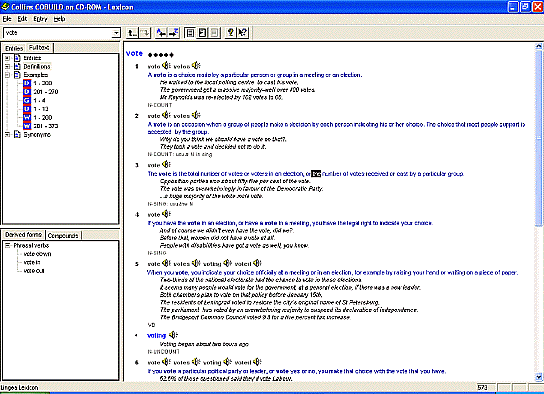
Click on figure for larger view
Figure 1. The COBUILD3 interface (full-text search/examples listed).
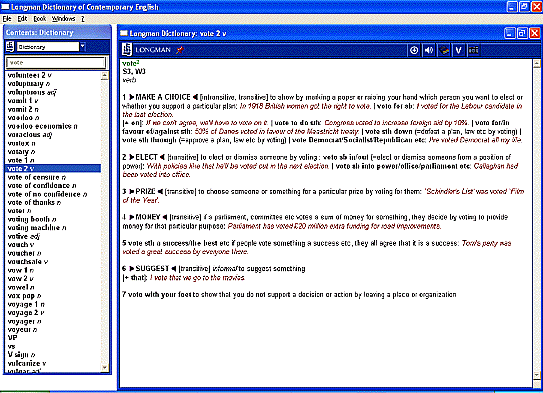
Figure 2. The LDOCE3 interface (dictionary search)
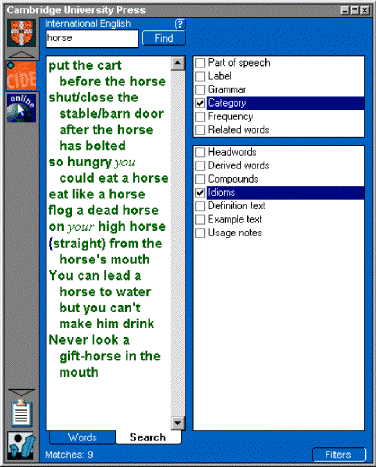
Figure 3. CIDE interface (customized search)
[-5-]
How do the dictionary entries compare?
Assuming that the dictionary is COBUILD’s best known product and the most likely reason someone would buy this CD-ROM, a comparison of the actual dictionary entries seemed in order. After considering other options, as a test sample, I decided to select the first five words listed in one of my intermediate students’ vocabulary notebooks. While such a small sample could never give a complete picture of the strengths and weaknesses of these three dictionaries, and there can be no substitute for actually trying them out first hand, my hope is that for those unsure about which electronic dictionary might be most helpful for their students (or themselves), the table below will provide a rough guide.
| Word | (for the semantically appropriate entry) | COBUILD (3rd Ed.) | LDOCE (3rd Ed.) | CIDE |
| 1) Endanger (v) | # of definitions | 1 | 1 | 1 |
| the accessibility of the relevant entry | #1 | #1 | #1 | |
| Original Context: ‘A group that works to protect the environment and endangered animals.’ (But she chose to look up the word ‘endanger’ instead.) |
the appropriate definition | Endanger endanger endangers endangering endangered To endanger something or someone means to put them in a situation where they might be harmed or destroyed completely. VB |
endanger /verb [transitive] to put someone or something in a dangerous situation where they can be hurt, damaged, or destroyed |
Endanger verb [T] to put (someone or something) at risk or in danger of being harmed, damaged or destroyed |
| # of example phrases/sentences | 2 | 2 | 4 | |
| The example sentences/phrases | The debate could endanger the proposed Mideast peace talks.
…endangered species such as lynx, wolf and several species of vulture. |
Smoking during pregnancy can endanger your baby’s health. If unemployment continues to rise, social stability may be endangered. |
The police must deal with criminals without endangering the lives of passers-by. [T] There can be no doubt whatsoever that smoking endangers your health. We must be careful not to do anything that might endanger the economic recovery. Endangered species are animals that are in danger of dying out completely, often because of exploitation by humans. | |
| Additional Information | 4 recorded forms available. 5 additional example sentences in the corpus. |
(Separate/adjacent entry) endangered species /.”.. ‘../ noun [countable] a type of animal or plant that may soon no longer exist The whale is an endangered species. |
1 highlighted collocation | |
| 2) Fight (v) | # of definitions | 18 (COBUILD has one entry for verbs and nouns combined) | 8 (for nouns) | 7 |
| the accessibility of the relevant entry | #1 | #4 in the list of definitions for the noun (not listed among the 18 definitions for the verb form) 6 signposts listed |
#2 | |
| Original Context: ‘To fight pollution of all kinds.’ | the appropriate definition | Fight 1 fight fights fighting fought If you fight something unpleasant, you try in a determined way to prevent it or stop it happening. VB |
fight2
S2, W3 |
Fight
verb |
| # of example phrases/sentences | 3 | 4 | 7 | |
| The example sentences/phrases | Mother Teresa is an elderly nun who has devoted her life to fighting poverty. More units to fight forest fires are planned. I’ve spent a lifetime fighting against racism and prejudice. |
[+ against]: the fight against crime [+ for]: We will not give up the fight for better conditions. have a fight on your hands (=have to oppose someone to achieve something). He’ll have a fight on his hands to get Malone acquitted. |
The firefighters spent three days fighting the warehouse fire. [T]
He fought the disease bravely for three years. [T] I managed to fight off (=quickly get rid of) the sore throat/feeling of depression. [M] |
|
| Additional Information | 396 additional example sentences in the corpus. Noun form, example sentence and collocation/pattern listed. 4 phrasal verbs listed. 1 usage note under ‘quarrel’. |
3 highlighted collocations listed. 1 bracketed explanation. Phonetic transcription only listed for the (separate) entry for the verb form. |
7 highlighted collocations.
3 bracketed explanations. |
|
| 3) Landmine (n) | # of definitions | 1 | 1 | 1 |
| the accessibility of the relevant entry | #1 | #1 | #1 | |
| Original Context: ‘To support the use of landmines.’ |
the appropriate definition | landmine
landmine landmines |
landmine /’ noun [countable]
a kind of bomb hidden in the ground that explodes when someone walks or drives over it |
landmine, mine
noun [C] |
| # of example phrases/sentences | None | None | 1 | |
| The example sentences/phrases | None | None | Two UN peacekeepers were killed when a massive landmine exploded yesterday. | |
| Additional Information | 2 recorded forms available. 1 alternative spelling listed. 1 synonym listed. 327 examples in the corpus. 3 word parts listed. |
1 synonym listed. | ||
| 4) Assist (v) | # of definitions | 3 | 2 | 1 |
| the accessibility of the relevant entry | #1 | #2 | #1 | |
| Original Context: ‘To assist the victims of landmines.’ |
the appropriate definition | assist 1 assist assists assisting assisted If you assist someone, you help them to do a job or task by doing part of the work for them. VB |
assist1 S3, W3 verb 2 [transitive] to make it easier for someone to do something: –see help1 |
Assist verb FORMAL to help |
| # of example phrases/sentences | 3 | 1 | 2 | |
| The example sentences/phrases | Julia was assisting him to prepare his speech.
The family decided to assist me with my chores. |
They had no maps to assist them. | We assisted the firefighters in extinguishing the blaze. [T] You will be expected to assist (the editor) with the selection of illustrations for the dictionary. [I] |
|
| Additional Information | 4 recorded forms available.
1 synonym listed. |
1 synonym listed. | Word register listed. 1 usage note listed. 2 highlighted collocations. |
|
| 5) Vote (v) | # of definitions | 11 | 7 | 5 |
| the accessibility of the relevant entry | #5 | #1 6 signposts listed |
#1 | |
| Original Context: ‘Present your plans to the class and to vote on the best proposal.’ |
the appropriate definition | 5 vote votes voting voted When you vote, you indicate your choice officially at a meeting or in an election, for example by raising your hand or writing on a piece of paper. VB |
vote2 S3, W3 verb 1 MAKE A CHOICE [intransitive, transitive] to show by marking a paper or raising your hand which person you want to elect or whether you support a particular plan |
Vote
verb |
| # of example phrases/sentences | 6 | 8 | 11 | |
| The example sentences/phrases | Two-thirds of the national electorate had the chance to vote in these elections. It seems many people would vote for the government, at a general election, if there was a new leader. Both chambers plan to vote on that policy before January 15th. The residents of Leningrad voted to restore the city’s original name of St Petersburg. |
In 1918 British women got the right to vote. vote for sb: I voted for the Labour candidate in the last election. [+ on]: If we can’t agree, we’ll have to vote on it. vote to do sth: Congress voted to increase foreign aid by 10%. vote for/in favour of/against sth: 53% of Danes voted in favour of the Maastricht treaty. vote sth down (=defeat a plan, law etc by voting) |
In a democracy, all adult citizens have the right to vote–the people choose the government. [I] She was too young to vote in the national election. [I] The committee voted on the proposal, and accepted it unanimously. [I] Over 55% voted Liberal. [I] The evening was voted a tremendous success (=This was most people’s opinion). [T + obj + n] |
|
| Additional Information | Gerund listed with example sentence.
4 recorded forms available. |
9 highlighted collocations listed. 2 bracketed explanations. |
8 highlighted collocations. 3 bracketed explanations. 3 grammatical patterns listed. |
Table 2. Entries in three CD-ROM-based ESL dictionaries
Conclusion
As can be seen from the information in the table above, all three dictionaries provide lots of very helpful information and choosing among them is often simply a matter of personal preference. A quick search of the reviews on Amazon.com will reveal an enthusiastic following for each of these dictionaries. However, a few general comments are in order. In terms of differences among the features of these three CD-based dictionaries, while the interface of the LDOCE3 is as straight-forward to use as anyone could want, the search engine is no doubt less versatile than the customizable, full-text searches available on both the COBUILD3 and CIDE (based on the information and screen shots I found on their website). Although the COBUILD3 and CIDE search features are both quite versatile, let us not forget that the COBUILD on CD-ROM contains two more reference books (the CIDE also includes a thesaurus), and possibly more importantly, especially for high-level learners thirsty for examples of language in use, a searchable 5-million word corpus (for a short discussion of the usefulness of example sentences see Example sentences , 2001). While I feel that the Collins COBUILD ON CD-ROM no doubt has the potential to become a language learner’s nirvana, I also feel three important caveats are in order. The first addresses what I feel is a serious oversight in the design, and the other two involve not so much the quality of the COBUILD3 dictionary/CD-ROM as the question of whether it could not be better designed to meet the needs of a wider range of learners.
The first is the issue of why COBUILD has chosen not to highlight the collocations which occur within their definitions and example sentences (as is done in the “Extra Column” in the print version). As pointed out by Komuro (n.d.), fixed phrases and collocations are only listed and highlighted at the end of an entry. As a result, in the COBUILD entry listed for “fight” in Table 2, at no point is it made clear to the learner that “fight for” (highlighted in both the LDOCE and the CIDE) and “fight against” (highlighted in the LDOCE) are commonly occurring collocations. Since knowledge of collocations is one of the most crucial, possibly the most crucial, elements of fluency in any language, and what my students need so badly, why, unlike the other two dictionaries described in this review, they made this decision is beyond me. (See Appendix 1 for the response of a COBUILD lexicographer to this criticism.)
The second has to do with its usefulness to intermediate level learners. The bottom line for me (and I would imagine many other teachers as well) is: Should I be recommending this dictionary to my intermediate learners who are looking for a good, comprehensive dictionary that they will not have to worry about outgrowing as their proficiency grows? As I mentioned above, it was this concern that caused me to stop recommending the COBUILD2 to my intermediate level students in the first place, and it seems that in the third edition, nothing has really changed. When it comes to COBUILD dictionaries, my intermediate level students are still forced to make a choice between comprehensiveness and comprehensibility. I discussed this issue with a COBUILD lexicographer following his presentation on COBUILD dictionaries at JALT 2002, and the question remains: When a learner encounters the relatively infrequent words “nun”, “devoted”, “racism” and “prejudice” in example sentences for the word “fight” (see Table 1), should these words be seen as “necessary words of appropriate register and context” (R. Krishnamurthy, personal communication, February 4, 2003), or should they be seen as evidence of poorly chosen examples that inhibit comprehensibility and make the learner’s task more difficult. Without wanting to deny the learning opportunities introduced by the inclusion of these words, considering that dictionaries are primarily used for self-study, one has to wonder if example sentences are the best place for learners to be encountering such words. As a further example, the words “national electorate”, “chamber”, “overwhelming majority”, “suspend” and “declaration” can be found in the example sentences for the word “vote” (see Table 1). While such lower-frequency words crop up in all three of the dictionaries in this comparison, they do so with much greater frequency in the COBUILD3. Again, please see Appendix 1 for the response of a COBUILD lexicographer to some of these criticisms. [-7-]
Finally, again related to the question of how carefully Collins has considered the needs of its target audience, is the issue of the CD-ROM format. Of course, many of us can enjoy using the various resources on this CD-ROM, and certainly non-native speakers of English who need ready access to the information on this CD and who work at computers or carry laptops will find it useful. However, given that not all my students have PCs, and more importantly, that small, portable electronic dictionaries are the most popular format for the majority of my students, until the contents of this CD-ROM become available in a more portable format, I am not sure many of them would show much interest. This is really unfortunate because I think my higher level students would love it and learn much from it.
In sum, while this CD-ROM which combines so many different resources is no doubt a wonderful resource for high-level learners, my feeling is that with a more careful and flexible approach to the selection of the content, the COBUILD3 dictionary could become the ESL dictionary, and one that I could recommend to a much broader range of my students. In the meantime, for my intermediate Japanese learners who can’t afford the pocket electronic version (a COBUILD3 version of which was recently released by Seiko), to ensure higher levels of comprehension, I will continue to recommend the compact print versions of the LDOCE3 and the OALD6.
References
Cambridge international dictionary of English on CD-ROM. (2000). Cambridge: Cambridge University Press.
Example sentences in dictionaries: More important than definitions. (2001). Retrieved February 17, 2003, from http://www.antimoon.com/how/examplesent.htm
Komuro, Yuri. (n.d.). A comparison of the treatment of collocations. Retrieved February 17, 2003, from http://www.longman-elt.com/dictionaries/llreview/r3komuro.html
Longman dictionary of contemporary English (3rd ed.) on CD-ROM. (1995). Essex: Pearson Education Limited.
Oxford advanced learner’s dictionary (5th ed.). (1995). Oxford: Oxford University Press.
Oxford advanced learner’s dictionary (6th ed.). (2000). Oxford: Oxford University Press.
Review of the Collins COBUILD on CD-ROM. (2002). Retrieved February 17, 2003, from http://www.antimoon.com/how/cobcd-review.htm
Acknowldgements
I would like to thank Michelle Devereux of Collins COBUILD Publishers for providing a copy of the Collins COBUILD on CD-ROM, and to Ramesh Krishnamurthy for his thorough and insightful comments on this review.
Rory Rosszell
Sophia University, Tokyo, Japan
<h-rossze@sophia.ac.jp>
Appendix 1
In his response to my criticisms of the inclusion of low frequency words in example sentences for the word “fight” in the Table 2. above, R. Krishnamurthy (personal communication, March 10, 2003) offered the following counter argument: “‘nun’ and ‘devoted’: Mother Teresa (629 examples* ), winner of the Nobel Prize, is one of the most famous people in the world, so students probably know from L1 culture that she is a ‘nun’, and that she has been fighting poverty. Fighting for causes often entails being ‘devoted’–note that several definitions contain similar words like ‘determined’. ‘Racism’ (23 examples* * ) and ‘poverty’ (12 examples* * ) are common collocates of ‘fight’; and ‘prejudice'(6 examples* * ) happens to be a very strong collocate of ‘racism'(80 examples* )!”
I responded, “This a quite a persuasive argument, but the question is to how broad a range of learners would it apply. Also, I don’t know what market segment the full COBUILD is aimed at (‘advanced’ is a very general term), but if it is trying to compete with the OALD and LDOCE (and now possibly Macmillan), I think it might lose out in many cases for the very reasons I have outlined. If COBUILD is content to market it only to the high end, their sales figures may never get to be what they could be with greater attention to those who are ‘less advanced.'”
In further defence of the COBUILD approach, Mr. Krishnamurthy subsequently responded, “I do appreciate your point about the lack of ‘downward mobility’ of the biggest COBUILD dictionary to some extent. I still feel that the rest of the COBUILD apparatus –full inflected forms, full sentence definitions, incorporation of main collocates or super ordinates (where there are no prominent collocates within a semantic range), typical contexts (who does what to whom), pragmatics (when and why do speakers select this particular word, what attitude or other pragmatic aim is being fulfilled), grammar patterns, etc are where the ‘downward mobility’ exists–the examples are not the place. Words like ‘racism’ and ‘prejudice’ are exponents of the class ‘something unpleasant’ which has already been signalled in the definition, and ‘devoted’ is echoing ‘in a determined way’ in the definition.”
* –Indicates the number of examples found in the entire Bank of English (450 million words).
* * –Indicates the number of examples found within a 10% portion of the collocations for ‘fight/fights/fighting/fought’ from the entire Bank of English (450 million words).
|
© Copyright rests with authors. Please cite TESL-EJ appropriately. Editor’s Note: Dashed numbers in square brackets indicate the end of each page for purposes of citation.. |
[-8-]