

June 2003 — Volume 7, Number 1
Collins COBUILD English Collocations
| Title: | Collins COBUILD English Collocations, v1.2 |
| Publisher: | Harper Collins |
| Contact information: | Collins Electronic Dictionaries |
| Email: | sales@ref.collins.co.uk (An e-mail was returned indicating the address is not valid. A second e-mail address, direct@cobuild.collins.co.uk, yielded no response.) |
| Type of product: | Concordancer CD-ROM |
| Platform: | Microsoft Windows 3.1 (or higher) |
| Minimum hardware requirements: |
PC with 80386 (or faster) processor; 2 Mb RAM (4Mb recommended); 512Kb free disk space; CD-ROM drive (150Kbps transfer rate or better); a Microsoft compatible mouse |
| Price: | $65.00 (through Amazon.com) |
| ISBN: | 000-371081-5 |
Introduction
Several years ago, a student asked me the meaning of the word “clock.” I explained the word and then showed the student a clock on the wall in the room next door. My student looked at me quizzically and asked why someone might put a clock on someone else’s head. With further discussion, it became clear that the student had heard the colloquial expression “to clock someone.” Without the context, my explanation and example were irrelevant. This highlights the importance of teaching and learning lexis in context and suggests a good reason to incorporate concordancer software, such as Collins COBUILD English Collocations, into ESL/EFL teaching and learning. [-1-]
Software Description
A concordancer is a computer programme that shows examples of words in context drawn from a corpus of spoken and/or written texts. These examples allow one to see collocations –words that tend to co-occur in a language–in grammatical patterns, compounds or fixed phrases. The Collins COBUILD programme contains some 10,000 node words (a keyword that is the object of investigation); 140,000 node/collocate pairs; and approximately 2.6 million different examples. These examples are drawn from the Bank of English –a corpus of 200 million words from a variety of written and spoken sources (such as fiction, non-fiction, newspapers, magazines, transcriptions of radio broadcasts, everyday conversations and interviews) amassed by the University of Birmingham. The majority of the texts originated after 1990 and are primarily British; approximately 25% are American English and 5% come from other native English varieties. A free online sampler of the concordancer software is available at: http://titania.cobuild.collins.co.uk/form.html. For a more detailed description of the Bank of English, go to: http://www.cobuild.collins.co.uk/boe_info.html. For online access to the Bank, the User’s Guide says to contact: direct@cobuild.collins.co.uk. While I received no response to the e-mail I sent, I was able to find information at this site: http://www.cobuild.collins.co.uk/wbinfo.asp. There is a subscription fee for online access.
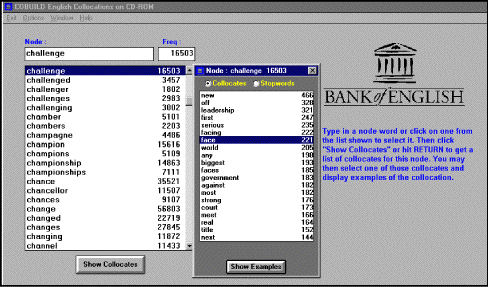
The software is easy to use and has a Help feature that clearly explains the terminology used in the programme. From the main window, enter a node word. A window then displays the frequency of the word in the Bank. Click on Show Collocates to view a list of collocates for the node word (Figure 1). In this programme, words are considered collocates if they occur within a span of four words before or after the node word.
Click on figure for larger view
Figure 1: Collocates for the node word challenge
From the list, highlight the target collocate and then click on Show Examples to explore a sample of 20 concordances. The examples can be aligned by node word (Figure 2) or by collocate (Figure 3); they can be sorted left or right depending on the item under investigation. There is an additional category of Stopwords –just over one hundred largely function words that occur with particular frequency. In light of their frequency, these words are omitted from the main list of 10,000 nodes and the database does not store them as collocates. However, Stopwords which are significant collocates (based on frequency) are displayed separately from other collocates.
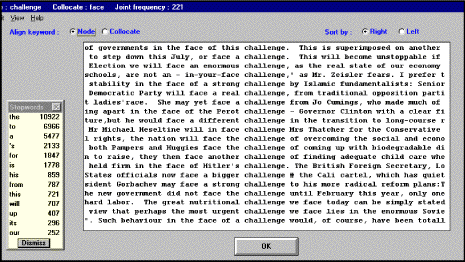
Figure 2: Node word challenge, aligned by node word challenge
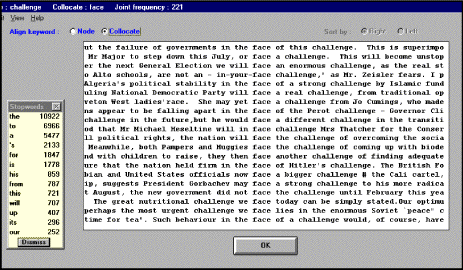
Figure 3: Node word challenge, aligned by collocate face
From the 20 examples that are displayed, one may opt to view Expanded Examples. These show the node word and the collocate in their larger context, along with their source (Figure 4). [-3-]
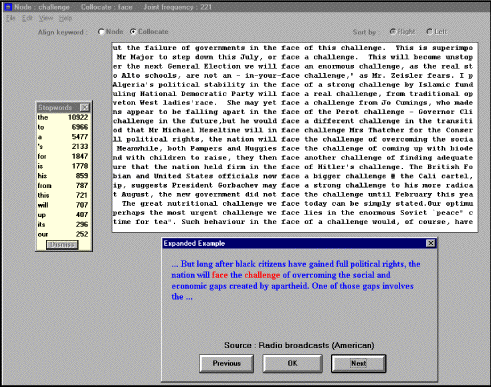
Figure 4: Expanded Example
Relevance to ESL/EFL
Although Collins COBUILDEnglish Collocations is not targeted at specific users, it is evident that there is value for second language materials writers, teachers and learners in having ready access to a variety of authentic and illustrative samples of English language patterns or lexical chunks. One of the key benefits is that analyzing and exploiting authentic language models in context can help second-language learners develop an awareness of patterns. This “noticing” (Schmidt and Frota, 1986) is a significant factor in language learning. On their own, though, students are not likely to know how to look for patterns in a concordance. For this reason, structured, companion exercises, such as the academic writing materials designed by Thurston and Candlin (1998), are beneficial. Of note for those interested in using the Collins programme for academic purposes, many words from The Academic Word List (Coxhead, n.d.) are in the Collins bank. As an example, all 60 words in Sublist 1 of the Most Frequent Words of the Academic Word List could be found in the corpus.
Willis and Willis (1996) have proposed a taxonomy of consciousness-raising tasks related to language learning that correspond well with data provided by a concordancer. These tasks include, for example, identifying a pattern or use along with the forms associated with it; classifying words according to similarities and differences. Another type of task is to have students guess the original sentence in which the collocation was found and then fill in their suggestions at either end of the language sample (Stevens, 1995). With Collins COBUILDEnglish Collocations, students can compare guesses with the Extended Examples. Users need to be aware, though, that the span in this programme of four words before and four words after the node word can be confusing for learners because several different patterns (e.g. node word + preposition or fixed phrase) are likely to be revealed. Unless learners are at an advanced level, it will not be useful for them to study many patterns at one time (Lewis, 2000). For this reason, instructors may, at least initially, want to edit concordances or draw students’ attention only to certain examples.[-4-]
Once students have learned to notice patterns through guided practice, they should be ready to analyze a concordance on their own. Some of my undergraduate ESL students, (high-intermediate), who have been taught to look for collocation patterns in their readings have experimented with concordancers. As an example, in preparation for a vocabulary quiz, students wanted to know if the preposition of or about should follow the word skeptical. They had the example skeptical of in their text but a dictionary gave examples with both of and about. With the concordancer, the students could see that with the node word skeptical + the collocate remain, for example, the two prepositions occurred with almost the same frequency (of –451 instances and about –441 instances). Examining the patterns with of and about helped my students to determine appropriate usage in the context of their task. The Collins concordancer is not ideal for this sort of investigation, though, because the words of and about are Stopwords. As such, they are only displayed once a collocate has been selected. This renders looking for preposition patterns cumbersome. Another point worth noting is that the word skeptical appears solely under the British spelling sceptical. Users must therefore keep the British weight of the corpus in mind when entering a node word.
Feedback from my students was largely positive. Solving language problems independent of the teacher was satisfying. Thus, such software has the potential to foster autonomous learning and to stimulate students’ problem-solving skills: “[Concordancers] bring cognitive and analytic skills in students to bear on the manipulation of comprehensive databases for the purpose of solving real-language problems” (Stevens, 1995, p. 2). At the same time, the students appreciated working with authentic language samples that were not necessarily related to their academic assignment. Stevens (1991) explains why this appeals to students:
Whether or not the corpus is drawn from familiar texts, the students appreciate the fact that they are dealing with authentic language and all its unpredictable insights. Furthermore, because they have more contexts to work with, hence double checks on their work, students succeed more often¹ and this bolsters confidence and feelings of accomplishment (p. 40).
Though evidence from my students of the value of working with a concordancer is anecdotal, it is a compelling prompt to continue exploring what this resource can bring to the language learning environment.
Conclusion
Collins COBUILD English Collocations is a user-friendly concordancer with an extensive corpus of spoken and written English. The software has merit for second language learners who can benefit from studying grammatical and lexical patterns of language in context. Ultimately, the ability to use a concordancer may encourage learners to be more independent in their learning.
References
Coxhead, A. (n.d.). The Academic Word List. Retrieved April 22, 2003, from http://www.vuw.ac.nz/lals/div1/awl/
Lewis, M. (2000). Materials and resources for teaching collocation. In M. Lewis (Ed.), Teaching Collocation: Further developments in the lexical approach (pp. 186-204). Hove, England: LTP.
Schmidt, R. and Frota, S. (1986). Developing basic conversational ability in a foreign language: A case study of an adult learner of Portuguese. In R. Day (Ed.), Talking to Learn (pp. 237-326). Rowley, MA: Newbury House.
Stevens, V. (1991). Classroom concordancing: vocabulary materials derived from relevant authentic text. English for Specific Purposes,10, 35-46.
Stevens, V. (1995). Concordancing with Language Learners: Why? When? What? CAELL Journal,6 (2), 2-10.
Thurstun, J. & Candlin, C.N. (1998). Exploring Academic English: A workbook for student essay writing. Sydney, Australia: NCELTR.
Willis, D. & Willis, J. (Eds.). (1996). Challenge and Change in Language Teaching. Oxford: Macmillan Heinemann.
Carolyn Samuel
McGill University, Faculty of Arts, English and French Language Center
<carolyn.samuel@mcgill.ca>
|
© Copyright rests with authors. Please cite TESL-EJ appropriately. Editor’s Note: Dashed numbers in square brackets indicate the end of each page for purposes of citation.. |
[-5-]