

Vol. 8. No. 3 — December 2004
| Title | English Language Listening Lab Online |  |
| Author | Todd Beuckens | |
| URL | http://www.elllo.org | |
| Type of product | An interactive self-study website providing audio interviews and supplementary materials. | |
| Platform | Mac, Windows, Linux, cross-platform | |
| Minimum hardware requirements | English Language Listening Lab Online (ELLLO) uses MP3 audio files and recommends RealOne Player software. Requirements for RealOne Player* | |
| PC | 120 MHz Intel Pentium processor or better, 16 MB RAM or more, 16-bit sound card or better, 65,000-color video display card , 28.8Kbps modem , Windows 95, Windows 98, Windows 2000, or Windows NT Service Pack 4, speakers or headphones |
|
| Macintosh | Mac OS 8.1 or later, 32 MB RAM, 64 MB virtual memory, PowerPC 604 processor (200 MHz or faster), 65,000-color or better video display card, 28.8Kbps modem, speakers or headphones |
|
| Reviewer used a 733 Mhz 256 MB RAM Pentium III with Windows 2000, IE 5.5 and an ADSL internet connection. | ||
| Minimum software requirements` | RealOne Player or any player that handles MP3 files (QuickTime, Windows Media Player, etc.). | |
| Browser support | Internet Explorer (IE) 4.01 or later, Netscape 4.05 or later. | |
| Price | Free | |
* Requirements supplied by Real Networks.
Introduction
Imagine overhearing a conversation with a vivid description about cobras or a discussion about what it’s like to experience a hurricane. Would you be curious? These and other topics can be found among the interviews accessible at a new listening site that aims to motivate listeners with authentic language content. English Language Listening Lab Online (ELLLO) is an interactive self-study website providing audio interviews and supplementary materials for the improvement of ESL/EFL listening skills. The listening material consists primarily of authentic dialogues with English speakers and different interviews are available for each day of the year.
English Language Listening Lab Online presents interviews on a variety of topics with English speakers from a wide range of nationalities. The website was created in February 2003, as a project for Temple University’s “Technology in Teaching” course. Initially, interviews were conducted by the website’s author, Todd Beuckens, a male native speaker of American English. However, recent interviewers also include native speakers from Great Britain, Canada, Australia, and New Zealand.
The majority of each listening segment consists of comments by the interviewee. Early interviews (January – March 2004) run approximately 1 minute in length but, in response to listener feedback, more recent interviews have been extended to 2-3 minutes. All audio files are in MP3 format and can be played with RealOne Player or any player that handles MP3 files, such as QuickTime and Windows Media Player. [-1-]
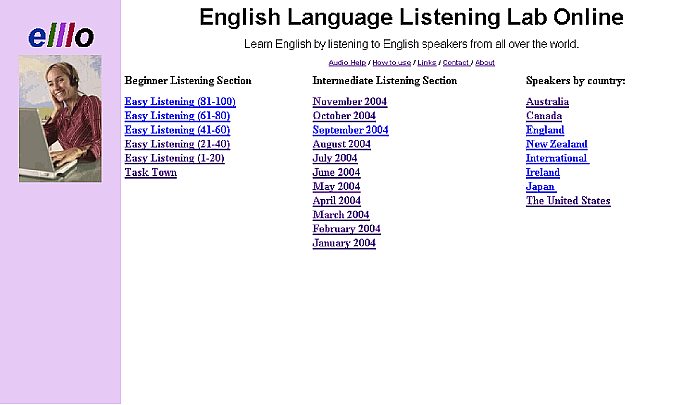
Screenshot 1: ELLLO‘s entry page
Pre- and post-listening comprehension activities provide learners with an interactive, user-controlled listening lab environment. Pictures of the interview subjects and key vocabulary create a visually appealing and motivating screen display. Beuckens places great emphasis on reaching out to new learners of English and has targeted this audience by categorizing some interviews as “easy”. However, due to the authentic conversational speech rate and occasional indistinct utterances, the majority of the listening material is most suitable for intermediate to advanced students. The website is free; users are allowed to download the interviews for personal and educational purposes.
Beuckens is based in Tokyo, Japan and has selected mostly younger interview subjects from the wide range of foreigners temporarily living in the area. Interview subjects represent a wide variety of accents and cultures–including American, Canadian, British, Australian, New Zealand, South African, Japanese, Swiss, Kenyan, and Norwegian–providing learners with a rich and realistic listening experience. Interviews are conducted without scripts and thus encourage authentic discussions on a variety of topics.
Program Objectives
The ELLLO website has clear pedagogical goals: (1) to offer students ample exposure to comprehensible input while engaged in authentic listening (Krashen and Terrell, 1983) and (2) to enhance concentration and interest by providing visual support with photos of the primary speakers and key vocabulary items. Learners focus on listening tasks as they try to understand the input. The tasks support comprehension using pictures and vocabulary to contextualize the topic and interactive feedback to guide user responses. The website is specifically meant for students and teachers around the world who do not have access to authentic, graded listening material. At the time of this writing, the website offers one interview per calendar day from January to November 2004. In the author’s words, “It is hoped that by having one clip a day, students will be motivated to practice listening [daily], or . . . frequently” (Beuckens, 2003). [-2-]
Authentic listening
Authentic listening is challenging but more relevant to real life situations than non-authentic material. The conversations on the ELLLO web site are spontaneous and personal. Chappelle (1999) points out that authenticity can be judged by how personal and specific the information is. Learners recognize the authenticity of the English Language Listening Lab Online interviews because the interlocutors delve into personal details, and are thus motivated to learn about the topic under discussion. Furthermore, the interviewer offers additional support by rephrasing responses using redundancy and elaboration. Chappelle (1999, p. 113), in examining Computer-Assisted Language Learning (CALL) tasks, describes “added redundancy” as one method of modifying input to make it comprehensible.
Site Design
The site loads very quickly and presents an index of interviews, classified according to level, month, or nationality, with most interviews available in the month section (Screenshot 1). Users select a month (e.g. June) and view an easy to use display of the month’s interviews; these are listed chronologically by date and include both a photo of the interviewee and a brief description of the topic discussed (Screenshot 2). Each interviewee’s photo is marked with a flag representing his/her nationality. Users read the description to choose a topic that interests them, enhancing motivation due to the recall of background knowledge schemata (Nishida, 1999). Site support is available on the “Audio Help” and “How to Use” pages, while the “About” page offers background information on the website’s development process. In addition, there is a useful “Links” page with links to other listening websites.
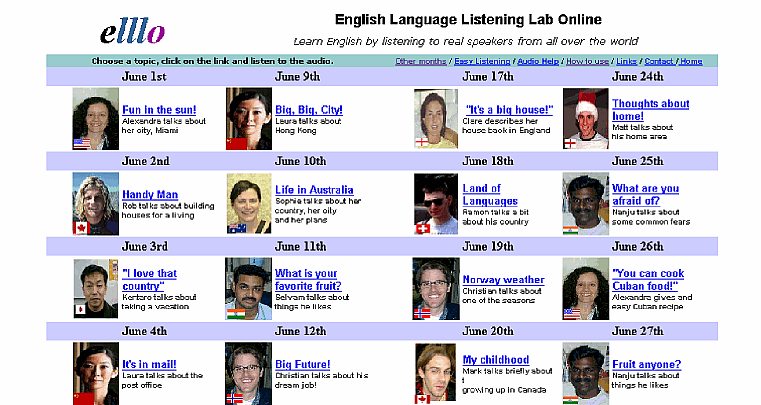
Screenshot 2: Index of interviews for one month
Once an interview is selected, the user is directed to an activities page. At the top of the page is a heading, which indicates different sections (i.e., Parts 1 – 4). In Part 1 (Screenshot 3) the user sees a photo of the speaker as well as “clue” pictures related to the vocabulary used in the interview. A focus question helps activate schemata and thus aids prediction; the question is usually quite easy in order to enhance motivation (Beuckens, 2003).
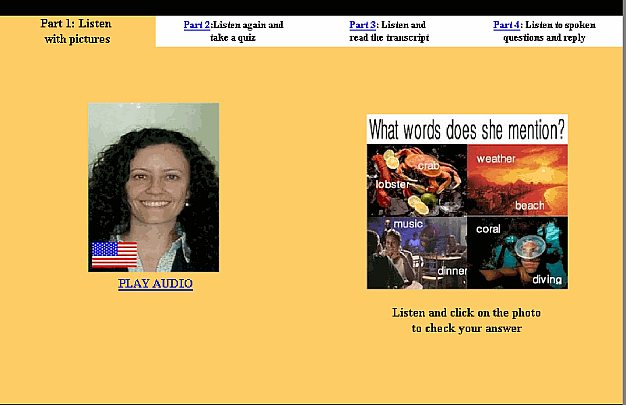
Screenshot 3: Interview, Part 1
[-3-]
Users reveal the answer to the focus question by sliding the cursor over the “clue” picture. The focus question provides immediate feedback and scaffolding for the rest of the activities; by directing the user’s attention to the information in the focus question the author creates both a purposeful and helpful listening context.
In Part 2 (Screenshot 4), users can listen a second time and check their comprehension by taking an interactive quiz with multiple-choice questions. The comprehension questions provide contextual clues for key elements in the interview, allowing the listener to focus on specific audio phrases.
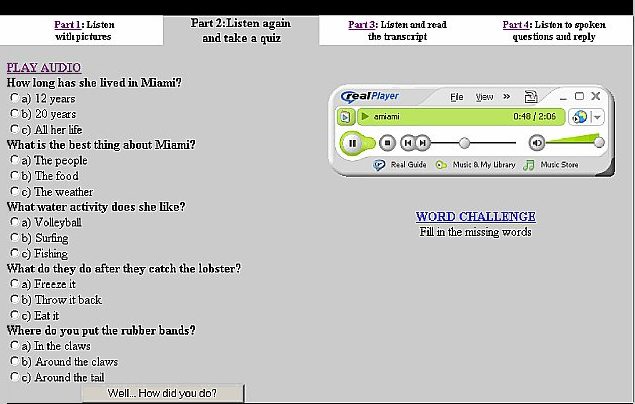
Screenshot 4: Interview, Part 2
Learners can see their score at any time and confirm their correct answers by clicking the “Well . . . How did you do?” button at the bottom of the screen. Interviews from April 2004 forward also include an information-gap activity. Selecting the highlighted link “Word Challenge” opens this page (Screenshot 5) which includes an audio excerpt from the interview; learners fill in the missing words while listening to the audio.
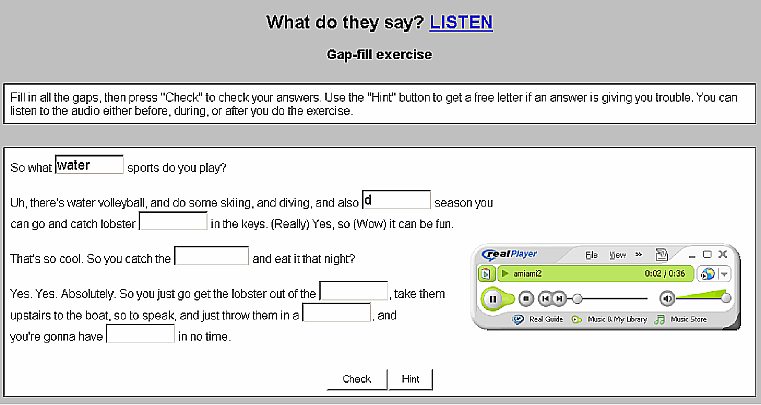
Screenshot 5: Gap-fill exercise
[-4-]
The “Check” and “Hint” buttons at the bottom of the page provide immediate feedback, offering confirmation of answers and letter clues respectively. This exercise reinforces listening for information and focuses users’ attention on particularly salient lexical items which help develop their listening awareness.
Part 3 (Screenshot 6) offers a transcript of the text. The interviewer’s dialogue is rendered in “plain” text, the interviewee’s dialogue is in “bold”. Users have the option of reading the transcript while listening to the audio.
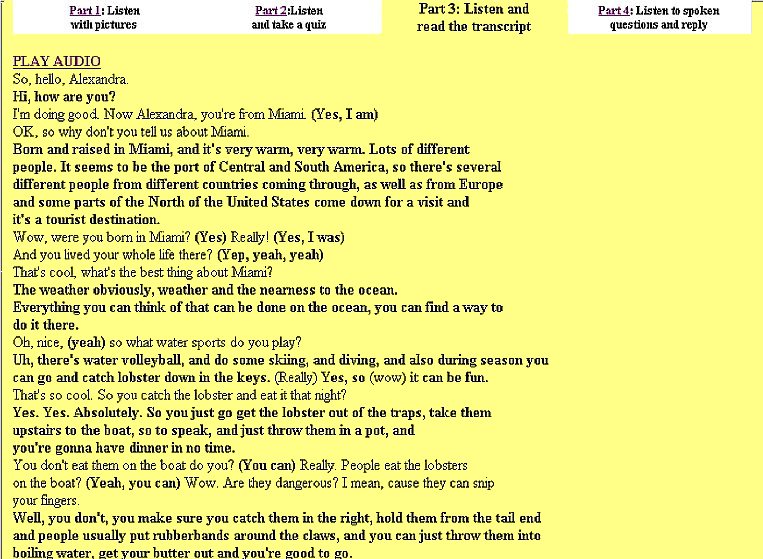
Screenshot 6: Interview, Part 3
Part 4 (Screenshot 7) offers three to five questions that are usually spoken by the interviewee. The listener has the option of clicking the button “See Question” to read the spoken question. Users can also click the button “You can say!” to see a suggestion for a suitable answer. This activity encourages users to respond appropriately and provides interactivity. Additionally, by encouraging exploration of appropriate responses, the author helps students “put their schemata into contact with others” (Widdowson, 1983, p. 47) and thus develop pragmatic skills for interlocution.
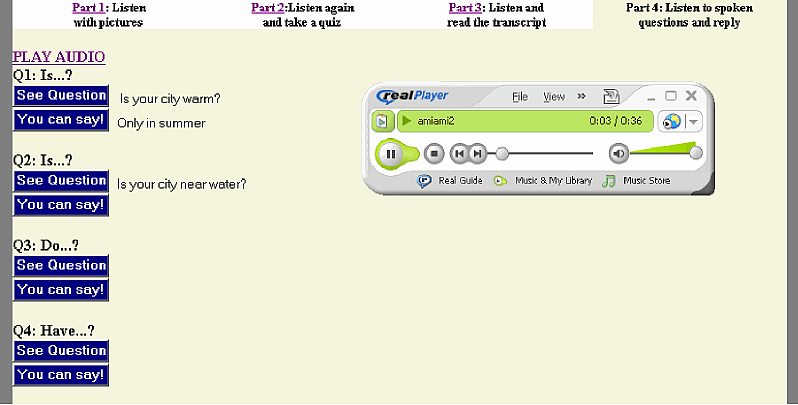
Screenshot 7: Interview, Part 4
For all the activities, students can use the RealOne Player console to control the audio as they wish. The listener can pause, move forward or back, and replay the audio with ease. [-5-]
Site Evaluation
The main strength of the website lies in its authentic interviews with its diverse group of (mostly) native English speakers. The dialogues provide an insight into the lives of ‘real people’ which stimulates the learner’s curiosity. The topics (animals, travel, love, sports, family, politics, etc.) are quite interesting and encourage persistence and repetition. The personal nature of some of the stories may even encourage identification with interview subjects as potential role-models. This effect is further enhanced by the preponderance of young interview subjects, since the target audience is of a similar or younger age (high school and college students). The photographs of the interviewees add a significant dimension to this connection process. One way to improve this aspect of the website’s intrinsic appeal would be to include several additional photos of each person, perhaps taken candidly during the interview.
Unfortunately, some interviews are difficult to follow, especially when the interview subject does not formulate a clear rhetorical argument. For example, in discussing space travel (May 1, 2004) Ebony says, “I think, eventually, it’s a great thing, and it does help, and I think it’s a wonderful thing to be paying attention to, but I don’t know whether it’s the right moment for it. But either way, they’re doing it, so I think it would be really neat. I mean I’ve always wanted to say to . . . my kids, ‘Ok, let’s go vacation on the moon… I feel like going out to the suite hotel. You know, let’s go look at the stars’. You know, a few meteors passing by, wouldn’t that be neat…to say that and really be able to do that someday?” This tangential way of speaking, though realistic, can be confusing for learners.
The authentic nature of the conversations makes it unlikely that beginners will be able to benefit from the listening tasks. Even intermediate learners may be frustrated trying to follow the quickly spoken dialogues with their idiosyncratic pronunciation, liaisons, and grammar. Another important consideration is the categorization of the material by level of difficulty. Several interviews, classified as ‘Easy’ were, in fact, rather challenging. Therefore, it may be necessary to extract shorter audio segments from some of the material in order to provide simplified content for beginners, and to re-examine current material for level of difficulty and reclassification.
The national flags (affixed to each speaker’s photograph) help learners associate accents with nationalities and the recently added index, listing interviews by nationality, is useful for this purpose. Moreover, the array of accents, although a challenging hurdle, may help learners develop their ability to distinguish between varieties of spoken English. Still, it would also be useful to provide additional indexes sorted alphabetically by topic and by interviewee’s name (with photo).
The “clue” pictures of selected vocabulary items (Part 1) help activate learner background schemata. However, the layout is somewhat crowded and it’s easy to get the answers prior to listening. One solution would be to remove all the pictures, leaving only each vocabulary item with a link to its corresponding picture; answers could be provided in a separate link. Additionally, although the pre-listening question and selected vocabulary items are useful, more direct questions pertaining to the dialogue’s content would help users derive more meaning from this task.
Most of the listening tasks are located on the same page, which makes for efficient loading. However, navigation is at first confusing because the task headings (i.e., Parts 1-4), though useful as hyperlink anchors, are a bit clunky and could be visually enhanced. A simple solution would be to eliminate the headings and use a more distinct border to separate the tasks visually (see the Civilisation Française[1] website for an example). Furthermore, tasks could be linked using “Back” and “Next” arrows, with a “Return” button providing quick access to the homepage.
Additionally, it would be useful to elaborate on the content of the dialogues by providing off-site links to cultural references for student follow-up, as is done on the “Civilisation Française” website. Another option would be to further develop the cultural themes as a separate listening area; for example, focussing on interviews which compare Japan to other countries or discuss foreign travel experiences. Organizing interviews according to cultural themes would encourage teachers to use the site for group activities based on cultural topics. Also language tools, such as a glossary for each interview, would help learners grasp contextual vocabulary while completing the tasks.
The website is entirely free and grants liberal access rights to the audio material as long as it is for non-commercial purposes. Thus audio files can be downloaded to a hard drive, audiocassette, or other reproducible media for playback flexibility. This offers teachers and students the option of using the interviews in various settings without computer or internet access. Teachers could off-load interviews for use in a language lab and/or produce copies of the material for students to take home. The material is designed for independent learning. However, teachers could also use the website’s material to expand classroom activities. [-6-]
A minor disadvantage with ELLLO is that the site is currently in the midst of construction as the author strives to improve the current format. The author expects this process to be completed by the end of 2004. However, this does raise the issue of consistency since even minor changes require considerable time and effort and should be applied site-wide to all previously created material. Thus, while some interviews display the newer format others display the old until the process is completed. This problem can be avoided by making major changes public only after all interviews have been processed, and indeed, Beuckens has recently chosen this approach.
To his credit, the author places great emphasis on user comments and has made significant improvements since the website first appeared. However there are still noteworthy problems, such as feedback elements in the quiz sections that don’t function properly and the lack of “intelligent feedback”. Intelligent feedback means that advice is tailored to the needs of the individual student. Considering the effort required, this may not be practical in most cases (Bradin, 1999). However, at the minimum, interactive material should include semi-intelligent feedback, providing learners with additional information to explain incorrect responses (Nelson, 1997). The English Language Listening Lab Online offers only unintelligent feedback (i.e., it only indicates whether the student’s response is correct or incorrect).
Perception and social learning theories suggest that negative feedback has a detrimental effect on the self-concept of learners by inducing a sense of “learned helplessness” (Robinson, 1991). Comprehension is facilitated by learners making inferences about the input they receive. Thus indirect feedback, providing only correct responses, offers more opportunities for student discovery and analysis of their own errors than offering full disclosure of the information.
One final point is that individual listeners who use the site for self-study have no source for follow-up communicative activities. Adding a bulletin board, like the one on ‘Dave’s ESL Café'[2], would substantially improve the site’s interactivity by (a) motivating students to ask meaningful questions, (b) providing a mechanism for learner feedback, and (c) receiving helpful responses from teachers or other students (Nelson, 1997). This would make the listening tasks more significant for users, allowing them to discuss the interviews with other learners and extend their comprehension beyond the original content.
Conclusion
English Language Listening Lab Online is a very good choice for EFL learners who want to improve their listening skills but have limited access to authentic listening material by native speakers. Since the interviewer (in most cases) is American and many of the interview subjects are Americans or Canadians, teachers may find the website’s material is also useful for ESL learners. Although there are many free listening sites available, English Language Listening Lab Online provides students with an abundant supply of audio material, mostly in dialogue form, which can be downloaded and freely used. Students can develop their understanding of foreign culture through the personal views expressed by the international interview subjects.
Notes
[1] Civilisation Française. http://www.cortland.edu/flteach/civ/cuisin/cuisin.htm
Scroll down the page to the “Pour en savoir plus” section to see a selection of off-site links related to cuisine.
[2] Dave’s ESL Café. http://www.eslcafe.com/help/index.cgi
References
Beukens, T. (2003). Authentic Listening Material at Todd’s English Language Lab (TELL). Unpublished manuscript, Temple University, Tokyo, Japan.
Bradin, C. (1997). CALL issues: Instructional aspects of software evaluation. In J. Egbert & E. Hanson-Smith (Eds.), CALL Environments: Research, Practice, and Critical Issues (pp. 159-175). Alexandria, VA: TESOL Publications.
Chappelle, C. A. (1999). Theory and research: Investigation of “authentic” language learning tasks. In J. Egbert & E. Hanson-Smith (Eds.), CALL Environments: Research, Practice, and Critical Issues (pp. 101-115). Alexandria, VA: TESOL Publications.
Krashen, S.D. & Terrell, T.D. (1983). The natural approach: Language acquisition in the classroom. London: Prentice Hall Europe.
Nelson, J. T. (1997). A system for the evaluation of ESL web sites. Retrieved October 27, 2004 from http://www.itp.innoved.org/~jtnelson/thesis/complete.
Nishida, H. (1999). A cognitive approach to intercultural communication based on schema theory. International Journal of Intercultural Relations, 23(5), 753-777.
Robinson, G. L. (1991). Effective feedback strategies in CALL: Learning theory and empirical research. In P. Dunkel (Ed.), Computer-assisted language learning and testing: Research issues and practice (pp. 155-167). New York: Newbury House/Harper Collins.
Widdowson, H. G. (1983). Learning purpose and language use. Oxford: Oxford University Press.
All images reprinted with permission by English Language Listening Lab Online.
About the Reviewer
Leon Piasetski teaches EFL at Kyoto Sangyo University in Kyoto, Japan. Originally from Canada, Mr. Piasetski has taught EFL in Japan for over 10 years.
Leon Piasetski
Kyoto, Japan
<leonpiasetski yahoo.com>
|
© Copyright rests with authors. Please cite TESL-EJ appropriately. Editor’s Note: Dashed numbers in square brackets indicate the end of each page for purposes of citation.. |