

December 2005 – Volume 9, Number 3
Oxford Handbook of Commercial Correspondence (New Edition)
|
||||
| Author: | A. Ashley (2003) | 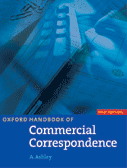 |
||
| Publisher: | Oxford: Oxford University Press | |||
| Pages | ISBN | Price | ||
|---|---|---|---|---|
| Textbook | Pp 304 | 0-19-457213-7 | £16.95 | |
| Workbook | Pp 112 | 0-19-457214-5 | £8.55 | |
The new edition of The Oxford Handbook of Commercial Correspondence is a welcome revised and updated version of this reference guide to writing effective business correspondence. The main strengths of the revisions lie in the addition of a necessary section on the use of email, an essential mode of correspondence in today’s business world, in addition to the more traditional memos, letters, and faxes, as well as the inclusion of a new glossary of helpful business vocabulary and an answer key to the comprehension exercises. The index at the end of the book has also been revised and extended.
The handbook aims at providing a comprehensive guide and reference to the essential writing skills needed in the business world. It offers practical help in improving written style by explaining the language of business correspondence of all types, such as letters, faxes, emails, application letters, and cvs. It also presents effective ways of handling enquiries, payments, banking, insurance, and social correspondence. It is composed of 15 units, each containing an introduction to the topics covered and an explanation of key terms; an analysis of the objectives to aim for when writing, with lists of alternative phrases, sentences, or paragraphs that can be substituted in different situations; various example correspondence and transactions, in addition to comprehension questions focusing on content, vocabulary, and style; and finally, a summary of key information that provides an opportunity for the reader to review the material covered in each unit.
The content of the handbook is as follows: Unit 1 introduces letters, faxes, and emails, including a detailed presentation of the characteristic features of each and a discussion of the advantages, disadvantages, recommended writing style, and appropriate uses of emails in business correspondence. Unit 2 deals with content and style in business writing, including length, order and sequence, organization, courtesy, idioms, clarity, and accuracy in writing. Units 3-8 present the six following types of transactions: enquiries, replies and quotations, orders, payment, complaints and adjustments, and credit. Units 9-12 cover the four following types of commercial organizations: banking, agents and agencies, transportation and shipping, and insurance. Unit 13 deals with miscellaneous correspondence such as travel reservations, appointments, invitations, and letters used in special occasions; unit 14 presents memos and reports; and finally, unit 15 handles personal appointments, including letters of application and cvs.
Each of the units is fully illustrated with various examples, provided from the main types of commercial organizations such as banks, agencies, and insurance companies. Many of the examples used are linked to one another throughout the handbook. For instance, in unit 4 (“Replies and quotations”), a “reply” letter is linked to the original “enquiry” letter in unit 3 (“Enquiries”), and in unit 11 (“Transportation and shipping”), “a request for a quotation for delivery by air” is linked to previous correspondence in unit 10 (“Agents and agencies”): “offer for an agency”, “agent’s reply, asking for more details”, and “manufacturer’s reply, giving more details.” This technique of providing continuation and links among the examples used across the units is a very effective one that enables the reader to place the transactions in a real-world setting.
Although claiming to be useful to anyone who routinely needs to write commercial correspondence in English, the handbook seems to be primarily targeted at the UK context. For instance, the sample correspondence and documents used mainly reflect authentic transactions and supply information about commercial practice in the UK. In addition, business writing style in the UK is emphasized throughout the handbook; for example, in unit 1 (“Letters, faxes, and emails”), the handbook informs readers that in the UK, unlike in some other countries, it is acceptable to write the sender’s name before the address in business letters. Nevertheless, the handbook makes a few observations regarding differences between American and British business writing style, such as noting in unit 1 that while it is unusual in the UK to close a formal business letter with “Yours truly,” this practice is accepted in the USA. Another example is mentioning in unit 1 the differences between British and American designations for the different members of the Board of Directors.
Thus, the handbook is primarily useful for students and teachers of business and commerce in the UK; however, ESL learners may not particularly benefit from some of the sections in the handbook. Indeed, some guidelines seem to be written with only the native speaker of English in mind; for instance, in unit 2 (“Content and style”), when discussing idioms and colloquial language, the handbook warns readers that using colloquial language or slang in business writing is not recommended because correspondents may misunderstand if their first language in not English. In addition, also in unit 2, in presenting “prepositions”, the handbook indicates that there are huge differences between “The price has been increased to”, “increased by”, and “increased from”; however, an ESL writer, even one with “intermediate to advanced” proficiency in English (the English level targeted by the handbook) may need an additional explanation as to how these prepositions alter the meaning of the sentence. Therefore, ESL writers who need grammar practice should use, alongside this handbook, a book such as Duckworth’s (2003) Business Grammar and Practice that provides exercises aimed at improving the intermediate and high intermediate business student’s language skills.
Finally, the handbook does not offer an adequate discussion on cultural sensitivity in business writing. Guidelines for writing openings and closings of letters and faxes, style and courtesy in business writing, and even length should be accompanied by a discussion of how correspondents from various countries or cultural backgrounds may react differently to the same piece of writing. One instance where the handbook does mention cultural differences is in unit 13 (“Miscellaneous correspondence”); in the guidelines for seasonal greetings, the reader is warned that people in different countries or from different religious or cultural backgrounds may not share the reader’s holidays. Interested readers should refer to a book such as Gibson’s (2002) Intercultural Business Communication, for a discussion of cultural diversity in the business world. Although Gibson’s book does not discuss the issue particularly in relation to business writing, it will nevertheless help readers to consider the importance of communicating effectively in intercultural and international settings.
In spite of the few criticisms mentioned above, The Oxford Handbook of Commercial Correspondence is an excellent guide to writing effective business correspondence, richly illustrated with numerous sample correspondence models for writing emails, faxes, memos, reports, and cvs. An accompanying workbook is available for further practice, offering additional training in writing different kinds of commercial correspondence, in addition to some exercises on grammar and vocabulary. The units in the workbook conform to those in the handbook. Finally, for the business studies teacher, online materials accompanying the handbook are available to help in lesson planning and in providing additional resources and samples for students to use.
References
Duckworth, M. (2003). Business Grammar and Practice. Oxford: Oxford University Press.
Gibson, R. (2002). Intercultural Business Communication. Oxford: Oxford University Press.
Rula L. Diab
American University of Beirut
<rd10 aub.edu.lb>
|
© Copyright rests with authors. Please cite TESL-EJ appropriately. Editor’s Note: The HTML version contains no page numbers. Please use the PDF version of this article for citations. |