

December 2005 – Volume 9, Number 3
Language Minority Students in American Schools |
|||
| Author: | Adamson, H.D. (2005) | 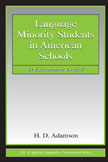 |
|
| Publisher: | Mahwah, Lawrence Erlbaum Associates Inc. | ||
| Pages | ISBN | Price | |
|---|---|---|---|
| Pp. xviii + 249 | 0-8058-4497-X (paper) | £22.95 | |
Language Minority Students in American Schools has been written primarily for trainee teachers of English as a Second Language (ESL) in the USA., and as such, it offers a highly accessible and comprehensive overview of the issues that are prevalent in ESL in the USA today. Given its clear and informative discourse as well as its breadth and scope, this book should definitely be included on any ESL student’s essential reading list.
Chapter One is a personal introduction to the author and his varied experience teaching ESL in different parts of the globe. It also includes a brief synopsis of the following chapters of the book and has a short, but interesting discussion on what the focus of an ESL program should be, which the author concludes by making various observations from his own teaching experience such as: (1) that a school’s culture and curriculum has to be relevant to its student’s lives outside of school hours, (2) that a school has to be able to deal with and overcome problems of discipline, and (3) that minority students’ languages need to have a respected place in their school.
Chapter Two offers a solid introduction to first and second language acquisition theory. It also takes a look at language acquisition from the perspectives of Cognitive Psychology and Pidgin and Creole studies, and includes a discussion on Social/Cultural Approaches to Language Acquisition and surrounding issues such as communicative competence in FLA and sociolinguistic competence in SLA. What is interesting about the literature overview in this chapter is that it is set in a philosophical context as well as a historical one, which allows readers to see how modern language learning theories can be related to the writings of philosophers like Locke and Descartes.
Chapter Three, Language Teaching, makes the natural transition from language acquisition and learning to language instruction. The first part of the chapter gives an easy to digest overview of the main approaches to language instruction in the 20th century, essential knowledge for any ESL teacher, and concludes with an interesting discussion of meaning-based instruction versus form-based instruction set in the backdrop of research conducted by Swain and Lapkin (1989) and Doughty (1991). The literature review is again made more interesting by being set within a broader context, this time that of nationwide instructional approaches and instructional approaches used in teaching content subjects such as L1 reading and mathematics.
Chapter Four, Standard and Vernacular English, can be divided into two main topics of discussion; (1) the ongoing polemic of standard language versus the vernacular, and (2) the role of non standard varieties in the classroom. The debate is this time not only described in terms of its historical evolution but also in terms of its socio-linguistic one and the discussion sheds some interesting light onto the confusion that surrounded the famous Oakland School Board Resolution in 1996 on Ebonics. The usage of non standard varieties in the classroom is still a hot topic in ESL where decisions have to be made as to whether or not non standard language varieties should be allowed in classrooms, and if they are allowed, to what extent and in what contexts should they be allowed? The author takes the stance: “Standard English is a language variety like any other, just a more prestigious one,” (p. 101), and “Black English, and all vernacular varieties, should be studied and cultivated in the schools where they are spoken,” (p.130).
Chapter Five, Learning in a Second Language, takes a look at the issues involved in teaching academic content in a second language. Two useful topics covered in this chapter are: (1) Vgyotsky and Vygotskian frameworks for teaching, and (2) Cummins’ (1990) BICS (Basic Interpersonal Skills) and CALP (Cognitive Academic Language Proficiency) distinction. Very often ESL resource books make direct or indirect references to Vygotsky without really explaining much about him or his theories and how they relate to ESL learning and acquisition, so it is a real bonus to have his theories defined within an ESL context in this chapter. The BICS/CALPS distinction is also useful for student teachers as it helps to make the differentiation between teaching academic discourse and teaching general discourse. The author concludes the chapter with various suggestions for helping to teach ELL (English Language Learners) difficult academic content materials, one being to offer sheltered or adjunct courses for students, that is ESL courses that run in tandem with mainstream content courses but which are designed to help students cope with the materials they encounter in the mainstream courses.
Chapter Six, School and family, which reports the findings of a one year case study of three ESL students at Cholla Middle School, is one of the strengths of the book as it allows educators to get a glimpse of what happens inside different classrooms and to see how different approaches to teaching and learning can have different effects on student output, motivation and learning outcomes. It also highlights the importance of the role of family in language education and shows how different individual students can be in the way they acquire language even when they study in similar learning situations. This obviously has important ramifications for course designers and organisers and shows how complex and difficult it is for schools to design and create suitable ESL programs that will meet the needs of all of their students.
Chapter Seven, Bilingual Education, concludes the book with an insightful discussion of the main issues fuelling the BE (Bilingual Education) debate in the USA. The chapter predominantly discusses BE within the American context but also describes and refers to programs in Canada, Sweden and The Netherlands. The chapter consists of: a historical introduction to BE; a synopsis of some of the different types of bilingual education programs currently being implemented in the US as well as some of their successes and failures; a fascinating overview of the legislative and legal history of BE in the USA, and a resume of the main arguments for and against Bilingual Education. The chapter concludes with the general observation that research has shown that well-run BE programs are effective and therefore Bilingual Education programs should be chosen as the preferred option over ESL-only programs wherever possible.
Overall, the value of the book lies in the research findings reported in chapter six and in the way in which the book brings together vast amounts of information from different fields, such as applied linguistics, sociolinguistics, psycholinguistics, and educational research, and links it all together into a comprehensive and intelligent package. The scope and breadth of the book makes it a valuable research and reference tool, allowing ESL teachers and educators to explore and discover the various topics covered in the book from different angles of approach set within a variety of contextual backgrounds. Highly recommended for student ESL teachers as well as for already qualified and experienced ESL practitioners and educators who want to solidify, deepen and refresh their existing knowledge.
Fiona Cromarty-Lawtie
ULB, Brussels, Belgium
<Fiona.Cromarty ulb.ac.be>
| © Copyright rests with authors. Please cite TESL-EJ appropriately.
Editor’s Note: The HTML version contains no page numbers. Please use the PDF version of this article for citations. |