

March 2006 — Volume 9, Number 4
Teaching the General Paper: Strategies that Work
|
|||
| Author: | Caroline Ho, Peter Teo & Tay May Yin, Eds. (2006) | 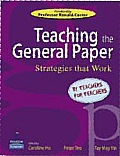 |
|
| Publisher: | Singapore: Prentice Hall | ||
| Pages | ISBN | Price | |
|---|---|---|---|
| Pp. xxiv + 357 | 981-244-961-2 (paper) | $26.90 U.S. | |
When I was in teacher education, I was always alarmed by the horror stories my beginning teachers told me. Many groused about the paucity of teaching resources in the schools they were attached to for teaching practicum while others lamented that their new (and often older) colleagues expressed reservations about sharing teaching materials with them. Thrown into the deep end of the teaching pool, some of these beginning teachers often had to grapple on a daily basis with the need to find resources while others were amazed at how dated materials used by older colleagues had become. In light of this still existing practical need to create a repository of up-to-date resources, the collection of twenth-six essays in Teaching the General Paper: Strategies that Work should be warmly welcomed by those who teach the General Paper, since this text is a resource book written by teachers for teachers. Sixteen of the essays are individual contributions while the remaining essays are collaborations between two or more teachers.
Some skeptics may be quick to argue that this book has limited use, as it caters to the Singapore academic hinterland. After all, the General Paper is a pre-university subject studied by no more than 20,000 students in Singapore each year. Others may be quick to point out the subject’s colonial roots: students sit for an examination designed by the University of Cambridge Local Examinations Syndicate in order to gain entry to the local Singapore universities. However, anyone who has seen a General Paper examination paper and taught the subject would realize the striking similarity it bears to diagnostic examinations conducted by ESL programs in most universities. Like them it tests the key skills of critical reading, academic writing and creative thinking. In that respect, this book’s applicability extends beyond Singapore’s shores.
The book comprises twenty-six chapters contained within three main sections: (1) Strategies that Work for General Paper Teaching and Learning; (2) Strategies that Work – Paper 1 (Essay); and (3) Strategies that Work – Paper 2 (Comprehension). While the first section offers general insights on how to plan a General Paper program, infuse critical and creative thinking into General Paper lessons, and use the media, literature, drama, and debating techniques to improve classroom instruction, the latter two sections offer more specific strategies for teaching essay writing and reading comprehension skills. The reader will, nevertheless, realize that a number of the strategies do cross over from the general section (Section 1) to the more specific sections (Sections 2 and 3). For instance, Chapters 13 and 14 in the first section demonstrate how a general resource like the newspaper can be used specifically to improve both the essay and the summary-writing skills covered in Section 2.
Just as the strategies are interwoven between the first section and the latter sections, we see a mixture of old and new teaching techniques being employed by the various contributors. For example, How, the author of Chapter 5, illustrates how currently fashionable approaches by creative thinking advocates like Andrei Aleinkov and Tony Buzan can be harnessed for use in the General Paper classroom while Liaw and Ng, in Chapter 7, embrace key tenets of problem-based learning like collaborative learning, teachers as facilitators, and using real life situations. Discussion boards also make their way into the General Paper classroom in Rappa and Chan’s Chapter 20, thereby bringing General Paper instruction into the twenty-first century.
As innovative and cutting edge as some of these approaches are, it is perhaps the re-working of some tried and tested techniques that stands out in this volume. Ho (Chapter 18) who offers a practical, systematic approach to guide students in generating questions to broaden perspectives and extend discussion, credits her tutors from the 1980s for teaching the “Hand” approach to her. It is gems like these that become enduring legacies to future generations of teachers. In a similar vein, close reading techniques that have for a long time been used in English Literature practical criticism classes are brought into the General Paper classroom fold through Evans’s (Chapter 10) and Heng’s (Chapter 11) practice of using George Orwell’s or Wilfred Owen’s writings as a platform to discuss politics and war.
This dynamic hybrid of old and new techniques pervading the book is made possible through the careful selection of both new and experienced teachers as contributors. We know this because the backgrounds of the respective contributors and their years of teaching experience are shared with us at the start of the book. Such an interface between these two generations of teachers is all the more constructive, as most chapters end with each teacher disclosing their practices’ limitations. In other words, as readers, we are privy to the blind spots that accompany these practices and can therefore benefit from the contributors’ hindsight.
Equally commendable and useful are the chapters that attempt to engage the teaching of more subtle aspects of critical reading. Readers will find Chapter 26 a valuable resource as the authors of that chapter share with us how to teach challenging topics like identifying an author’s viewpoint, attitude and tone in a comprehension passage. This chapter, like many others, comes with tasks that enable teacher practitioners to try out activities in their classrooms. In addition, many chapters include worksheet appendices to aid teachers. These worksheets are not meant to be templates to slavishly follow but instead to provide an opportunity for readers, as Ong (Chapter 8) observes, to think about practices for their own classrooms.
In keeping with its eclectic tenor, the book ends with a vision that the General Paper will be defined by multiliteracy, multimodality and the use of IT. As a result of this multidimensional element, the co-editors foresee that a combination of teaching approaches will be needed. Fortunately, the breadth of approaches contained within the chapters of the book position its readers to take on current and future challenges in teaching the subject. Given the treasure trove of resources found within this book, it is hoped that Teaching the General Paper: Strategies that Work will help allay anxiety among new teachers and encourage more seasoned teachers to come forward to share their wealth of experience. Only then can we move toward creating a genuine community of learning within the ESL teaching profession.
Peter I. De Costa
University of Wisconsin-Madison
<decosta wisc.edu>
|
© Copyright rests with authors. Please cite TESL-EJ appropriately. Editor’s Note: The HTML version contains no page numbers. Please use the PDF version of this article for citations. |