

June 2011 – Volume 15, Number 1
Listening Myths: Applying Second Language Research to Classroom Teaching |
|||
| Author: | Steven Brown (2011) | 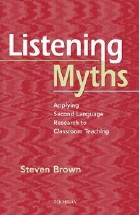 |
|
| Publisher: | Ann Arbor: U. of Michigan Press | ||
| Pages | ISBN | Price | |
|---|---|---|---|
| 195 pages | 978-0-472-03459-8 | $23.00 USD | |
Listening Myths is part of a Myth series of the University of Michigan Press. All of the titles in this series purport to nominate and discuss a topic of teacher interest—two examples are vocabulary and writing—and to connect second language research on that topic to classroom teaching. The purpose of this book on listening is to allow the author to have an informed but informal conversation with a reader, who is assumed to be a ESL or EFL classroom teacher who would like to know more about listening, who might be interested in applying some of the research in a classroom situation, and perhaps might even be interested in engaging in listening research. I judge Brown to be successful.
The author makes several working assumptions about who might be reading this book and why. One set of assumptions is that we are teachers not researchers, but we might be interested in knowing the background research that is available, and we might even be intrigued enough to engage in some research ourselves. But the main assumption is that we are primarily interested in a listening activity for a class. This last assumption informs the structure of the book.
Listening Myths is divided into eight chapters or myths, each myth introduces an issue to be discussed, confirmed, and/or disconfirmed: myth one is that listening is the same as reading, myth two is that listening is passive, myth three is listening equals comprehension, myth four is that listening ability is effortlessly acquired, myth five is listening means listening to conversation, myth six is listening takes place inside a person’s head, myth seven is students should listen only to authentic materials, and myth eight is that listening can’t be taught.
Each chapter begins with a section titled, In the real world where the author contextualizes the relationship of the theme of the chapter using common life experiences. Next comes a section titled, What the research says. This is the heart of each chapter. Here Brown is able to review, synthesize, and make sense of a great deal of the relevant listening research relevant to the theme of the chapter, a topic not all of us may be immediately familiar with. Finally, each chapter ends with a section titled, What we can do. This is where Brown makes practical classroom suggestions that teachers can use. However, this is not a listening textbook, and while Brown connects his teaching suggestions to the research, he does not give us lesson plans; rather, he encourages us to do that ourselves.
I was particularly drawn to Myth five about listening to conversation because I did not read this listening book entirely for the love of learning; in fact, I had a problem. My students are international teaching assistant (ITA) candidates and listening is necessary for them if they are to successfully interact with their future students. For that reason, although I mainly teach speaking fluency, I wanted to include a listening lesson in some of my classes. I especially wanted an easy lesson that would not require a lot of high technology or resources on my part. Part of the discussion of myth five was discussion of dictation including a technique called Dictogloss.
I was impressed by the research coverage on Dictogloss. In about five pages, Brown reviews a dozen or so research studies including those from well-known second language acquisition researchers such as Richard Schmidt on the topic of Attention and Bill VanPatten on Processing Instruction as well as some researchers whom I had not read. This is not only informative, but were I so moved, there is clearly the basis for a literature review here.
A Dictogloss is a form of dictation in which as Brown states, “students listen to a passage read at normal speed, take notes, and use those notes to work with a partner to reconstruct the passage as well as they can” (p. 92). I wondered if the directions and background provided in Listening Myths would be enough for me to construct a listening activity that met my specific needs. As my Dictogloss topic I chose Places I’d like to see, assuming that my international students would like to take trips around the country especially during breaks. Brown recommends a pre-teaching task (Myth two), so I included in my listening plan drawing a simple map of the U.S. on the board and asking students what cities they knew, and then to write them on the map in their approximate locations. I wrote five things to dictate and decided which vocabulary to Preteach (Myth two). For the first reading, I read my five utterances at a normal but steady pace asking students to listen only; for the second reading students listened and took notes. The listening task was to grasp the main idea (Myth four, p. 77) I had representatives from the groups write the reconstructed dictation on the board. I have a large board in my room, so I left room on the left for me to write my original dictation of five utterances. Student representatives from groups wrote what they reconstructed parallel to my space. After that I wrote my script. That allowed us all to see and discuss differences. For example, my first dictation was “Many ITAs in America want to travel during break” but some wrote “Many ITAs in America want travel during break.” That provided an opportunity to talk about reductions. The whole exercise took about 15 or 20 minutes, and was easy for me to do. I was motivated to find Wajnryb’s 1990 book Grammar Dictation for her many examples of Dictogloss.
The title is appropriate in that Listening Myths applies second language research on listening to the classroom. There are close to 300 references. In that sense, this text can be valuable to academic writers and classroom teachers alike. Do I have any criticism of this text? Brown does not discuss testing extensively. In fact, he only mentions testing twice, but the second mention (p. 50) caught my attention: “Testing tries to weed people out, and at its worst, can be tricky.” As a testing person I agree that testing can be off-putting and tricky, but when I engage in test construction and validation, I am trying to identify students who need help, not trying to weed them out. In fact, I suspect that testing can be a form of teaching. If I ever write a book on Testing Myths, I will certainly include this as one of my myths.
Reviewed by
Dale Griffee, Texas Tech University
<dale.griffee att.net>
|
© Copyright rests with authors. Please cite TESL-EJ appropriately.
Editor’s Note: The HTML version contains no page numbers. Please use the PDF version of this article for citations. |