

June 2006 — Volume 10, Number 1
Voices of Diversity: Stories, Activities, and Resourcesfor the Multicultural Classroom |
|||
| Author: | Lori Langer de Ramirez (2006) | 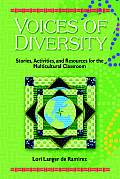 |
|
| Publisher: | Upper Saddle River, NJ: Pearson Prentice Hall | ||
| Pages | ISBN | Price | |
|---|---|---|---|
| Pp. xix + 204 | 0-131178-86-5 (paper) | $20.00 U.S. | |
Multiculturalism is a very broad topic. An Amazon.com book search brings up over 592 hits. Multicultural education can be a type of Rorschach test for authors who bring their own framework to the field. That framework for multiculturalism can range from a relatively trivial Contributions Approach (e.g., focusing on Heroes and Holidays) to a Social Actions Approach where students become societal change agents. Multicultural education is a teaching/learning philosophy that believes that all children can learn. It is a philosophy built upon various documents from the U.S. Declaration of Independence, the U.S. Constitution, and the U.N. Declaration of Human Rights. It is a philosophy that believes in freedom, education, equality, equity, justice, and human dignity.
One of the problems teachers have with multiculturalism courses or approaches is that ordinary textbooks may not be terribly effective in changing student attitudes: that is, all too often students may learn how to “talk the talk, but not walk the walk.”
Langer de Ramirez’s text is a relatively short one, running around 200 pages, including full-page cartoons and poetry. The book is designed for inservice teacher training or as a supplemental text in a multicultural-education course. It also could serve as a resource for the increasing number of language teachers whose classrooms are multiracial and multiethnic.
The author takes her theoretical framework from the work of Brazilian theorist Paulo Freire (famous for his work Pedagogy of the Oppressed). A Freirian believes that people learn best in small groups, reflecting on practices that can lead to transformation. An approach based on Freire is particularly appropriate here because Freire emphasized informal learning, critical pedagogy, and dialogue. Langer de Ramirez intends her book to form a triangle of theory, dialogue, and activity.
The text has 11 chapters:
- Introduction to the Diverse Classroom
- What is Multicultural Education?
- Race and Ethnicity
- Learning Styles
- Socioeconomic Status
- Sexual Orientation
- Religious Beliefs
- Linguistic Diversity
- Gender and Gender Roles
- Learning (Dis)abilities and Special Needs
- Physical Abilities
Numerous activities are offered. Each chapter opens with a witty cartoon (My favorite cartoon begins the chapter on Religious Beliefs: A teacher is reciting the Pledge of Allegiance to several students: “One Nation, under our God, who is Christian and White and Male with a long beard and hates unpatriotic liberals and foreigners, indivisible….” The cartoon’s caption reads: “What some folks really want.”.) Each chapter also includes well-written first-person narratives. For example, in the Religious Beliefs chapter, the narratives include a story of a Jewish soccer player who chooses to miss a game scheduled on Yom Kippur. Her coach then tells her that she must explain her religious conflict and her decision to miss the game to her soccer team. A narrative from the Physical Disabilities chapter tells of a severe, life-threatening allergy to peanuts and the resulting exclusion the narrator often felt. Although some students may minimize or even ridicule a classroom ban on peanuts—such insensitive reactions can provide a forum for dialogue and an opportunity to consider other views.
Discussion questions following each narrative can supplement such spontaneous dialogue. Projects and extension activities complete the activity part of the author’s instruction process. For example, in the Race and Ethnicity chapter, students are asked to bring in magazines aimed at different ethnic groups and compare their advertisements. Lastly, additional reading resources and Internet resources are given at the end of chapters. These reading selections are sorted into three sections: for adults, young adults, and children.
One reason I chose this text to use in teaching a university course, Multiculturalism in Special Education, is for the book’s chapters on Linguistic Diversity, Learning (Dis)abilities and Special Needs, and Physical Abilities. The current textbook I use, The Special Education Bilingual Interface, by Baca and Cervantes, mainly covers bilingual students and their needs in a Special Education environment. Langer de Ramirez’s text is an excellent companion volume to Baca and Cervantes’ more formal textbook, both because it is less formal and because it presents a wider array of diversity to be aware of in any of today’s classrooms—in my case, a Special Ed classroom.
The Linguistic Diversity chapter is an important one. Although most preservice teachers know not to judge students on their ethnicity or race, those same preservice teachers may still judge students on their dialects. And even ESOL teachers may judge unfavorably the United States Spanglish their students might speak as being “ni chichi ni lemonada.”
In the 15-odd pages devoted to linguistic diversity, the author presents a mini-lesson on dialects and nonstandard dialects. She includes code-switching and Cummin’s BICS v. CALP (or put more simply, the difference between a student’s conversational English level and academic English level). Langer de Ramirez disputes Lisa Delpit’s claim that black teachers are more effective than Anglo teachers because they are more explicit and direct in guiding and reprimanding their students (Delpit, 1995). Langer de Ramirez offers a Freirian take on the power status involved and questions as being “oversimplified at best and stereotypical at worst” (p. 125) Delpit’s characterizations of black and white teachers’ communication styles. This is good analysis. Both narratives in the Linguistic Diversity chapter deal with nonstandard dialect perceptions, cultural code-switching, and ESOL students. Each narrative ends with several “Questions to Consider,” which make the narratives in the book ready to go as mini case studies.
Langer de Ramirez’s suggested cultural exploration activities in the Linguistic Diversity chapter include visiting a neighborhood where one linguistic group predominates, if possible with a guide from the area who speaks the prevalent dialect. Since this task may be difficult for teachers in rural areas, another more do-able task involves students interviewing a person who speaks a language other than English and writing a linguistic biography of the person. Samples of books recommended in this section include classics such as How the Garcia Girls Lost Their Accents, When I Was Puerto Rican, and Native Speaker.
Voices of Diversity adds much to a multicultural-education course, some of it not always included in a longer multicultural textbook. Its activities and narratives might also lend weight to an otherwise lightweight multicultural component in an ESOL or any language course.
Reference
Delpit, L. (1995). Other people’s children. New York: The New Press.
Wolf Kozel
Fort Hays State University, Kansas
<wolfk2 yahoo.com>
|
© Copyright rests with authors. Please cite TESL-EJ appropriately. Editor’s Note: The HTML version contains no page numbers. Please use the PDF version of this article for citations. |