

September 2006 — Volume 10, Number 2
Essential Academic Vocabulary:Mastering the Complete Academic Word List |
|||
| Author: | Helen Huntley (2006) | 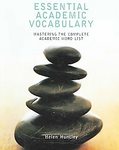 |
|
| Publisher: | Boston: Houghton Mifflin Company | ||
| Pages | ISBN | Price | |
|---|---|---|---|
| Pp. xii + 239 | 0-618-44542-0 (paper) | $25.77 US | |
Increased research into vocabulary acquisition has supplied teachers and materials writers with guidance about the vocabulary to teach and effective ways to teach this vocabulary. This advanced level vocabulary book incorporates suggestions from such pedagogical research while building upon Averill Coxhead’s (2000) academic word list, a list of 570 headwords of word families derived from a corpus of written texts from several academic disciplines. Using this base, Helen Huntley has written a textbook and provided support materials for teachers and students in community college, college preparatory, and university classes.
The textbook comprises 20 chapters, 16 devoted to academic disciplines — arts, sciences, and social sciences — with every fifth chapter serving as a review chapter. Chapters are constructed in a pattern, with some variations on the types of exercises in each (see below). Each chapter includes an academic reading, sometimes adapted, that provides a source for vocabulary in context, and reading comprehension exercises) as well as a theme for many of the subsequent exercises on dictionary skills, word forms, collocations, paraphrasing, and word parts. In addition, sidebars contain vocabulary learning strategies or guides to learning. Writing and speaking activities at the end of each chapter move the students away from closed exercises that often have a correct answer to open ended activities that challenge students to creatively use the vocabulary. The textbook’s construction gives students multiple opportunities to learn the vocabulary in a progressively open manner.
The final section of the book consists of six appendices:
- Getting the Most from Your Dictionary
- Suggestions for Learning and Reviewing Vocabulary
- Techniques for Paraphrasing
- Techniques for Summarizing
- Word Parts and Their Meanings
- The Academic Word List.
These appendices include both useful reference lists and guides for some exercises in the chapters such as paraphrasing and using a dictionary. They could be used by teachers as needed or preferred.
One of the more valuable assets Huntley provides is the variety of exercise types within the different parts of a chapter. The exercises engage learners by varying the activities while maintaining a predictable structure for each chapter. For example, in the exercises on word forms in sentences, students write their own sentences, complete sentences by choosing the correct grammatical form of the word, or complete sentences by supplying the correct form of a target word. These variations enhance the exercises by preventing a benumbing sameness from creeping in.
The vocabulary-in-context exercises reveal a thoughtful author anticipating student strategies while the collocation exercises provide various ways for students to gain awareness of words that tend to go together. First, a great strength of many of the vocabulary-in-context exercises in this book are when the author uses one or two choices from related dictionary meanings as distractors, so the students who resort to their dictionaries still must use the context to determine the appropriate meaning. With the collocation activities, the author uses diverse types: matching collocations to sentences with the same meaning, correctly combining verbs with adverbs and adjectives in sentences, and using word combinations that change according to the first or second word like passive smoking, passive restraints, and passive vocabulary. With the vocabulary-in-context and collocation exercises, as with most of the other exercises, the author creatively extends the possible ways to help students learn the vocabulary.
Supporting the textbook, the publisher hosts a website with additional exercises, tests, teaching guides, answer keys, and links to vocabulary resources. Internet support includes student and instructor support, and the support is very good. The student support includes ACE quizzes, flashcards, Internet resources, and crossword puzzles. The ACE quizzes for each chapter include true/false, multiple choice, and completion items. When a students finish one, they are provided feedback including information about incorrect items. The flashcards are a web based application written in Flash video that consists of words and definitions that can be viewed, reviewed (similar to regular flash cards), and the list and definitions can be printed out. The results can be also be emailed to the teacher. This site is accessible without a password.
The instructor support site requires a login and password, obtained from the publisher, to access the available resources. These resources consist of an instructor’s guide, answer key, review tests for three of the groupings of four chapters (at the time of this review) along with an answer key, sample syllabuses for a 10-week and 16-week semester, and the same vocabulary resources links as their students have.
This is not a supplemental book for a reading or writing class because either the focus skill would suffer or the vocabulary book would not be sufficiently used. It would not serve as a reading textbook, for though the reading exercises are good, they do not cover the skills for developing reading speed and accuracy.
Adapters may occasionally quibble with a definition or two. For example, I find it hard to fit “constitute” as meaning “are considered as” in the context of “Successful applications constitute more than a high GPA and test scores.” But that is the meaning in the Oxford Advanced Learner’s Dictionary (2005), and definitions in other dictionaries do not seem to quite fit in this sample sentence either. To me the more natural phrasing would be, Successful applications count more than. . . . or Successful applications carry more weight than . . . . Consequently, explaining this particular item and a few others would give me some trouble in class.
A further reservation arises in the appendix on note cards. The instructions direct learners to make their note cards using English only and an English-English dictionary. While this has been common practice, Folse (2005) argues, quite convincingly to me, that we should not deprive students of the valuable resource of their first language by seeing it as a crutch, and may even be doing them a disservice by disallowing this resource.
Helen Huntley has written a fine academic vocabulary textbook for advanced intermediate and advanced ESL/EFL learners. The support materials anticipate most teacher and student needs. The chapters comprise materials from different disciplines while including the words in unforced contexts. It is an ambitious book which realizes most of its ambitions, so it will give teachers and students a rich resource for developing and improving academic vocabulary. Teachers will find here a use-friendly textbook constructed around vocabulary students will see and use in their academic studies.
References
Coxhead, A. (2000). A new academic word list. TESOL Quarterly, 34, 213-238.
Folse, K. (2004). Vocabulary myths: Applying second language research to classroom teaching. Ann Arbor: University of Michigan Press.
John M. Graney
Santa Fe Community College, Florida
<john.graney sfcc.edu>
|
© Copyright rests with authors. Please cite TESL-EJ appropriately. Editor’s Note: The HTML version contains no page numbers. Please use the PDF version of this article for citations. |