

September 2006 — Volume 10, Number 2
|
|||
| Author: | Adrian Holliday (2005) | 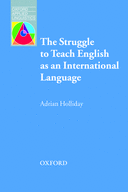 |
|
| Publisher: | New York: Oxford University Press | ||
| Pages | ISBN | Price | |
|---|---|---|---|
| Pp. xii + 187 | 10 0194421848 (paper) | $25.95 US | |
Everything is political, Adrian Holliday reminds us in this small volume, and when we teach ESL/EFL nothing less is at stake than ownership of the English language. We may not want to be reminded of this; it’s much like hearing, in a Marxist lecture, that, though you may have been happily married for many years, your relationship is still at its base a power struggle. Though there is more than a grain of truth to this–both teaching and marriage have their political elements–one would certainly hope that there is more to both than that.
Holliday starts out by defining the enemy: “native-speakerism,” the “established belief that ‘native-speaker’ teachers represent a ‘Western culture’ from which spring the ideals both of the English language and of English language teaching methodology” (p. 6). This is contrasted immediately with the “hope for a more common identity” as embodied by the NNEST (Non-native English speakers in TESOL) caucus of the TESOL organization, and the ideological position, implied by the title of the book, that we should wrestle English away from this confining and outdated perception of ownership.
In “Culturalist perceptions of ‘us’ and ‘them'” the author defines an “essentialist” view of culture as one in which cultures “are coincidental with countries, regions, and continents” (p. 17), whereas, in the non-essentialist view, “culture is not a geographical place which can be visited and to which someone can belong, but a social force which is evident wherever it emerges as being significant” (p. 23). In “Legacy of lockstep” he discusses “the residues of audiolingualism” as a historical force, brought from a colonial era, pressuring teachers into a kind of behaviorist training mindset: the idea that we have to make “them” think like “us.” In chapter four we learn how “the constraining forces of native-speakerism have hijacked learner-centredness” (p. 63). In chapter five he explores the concepts of social autonomy and authenticity; for example, with respect to the “potentially essentialist presumption–that a particular social group will have problems with autonomy because of previous schooling experience and expectations” (p. 86), he says that “I simply do not believe that the English-speaking West has a monopoly on the characteristics of individualism, critical thinking, and so on,” thus “it is not therefore a matter of imposing Western norms, but of appreciating that what ‘we’ might think are Western norms can in fact be found everywhere, though perhaps in forms which ‘we’ do not easily recognize” (p. 87).
The last three chapters, six through eight, deal with the world of teachers: “the way the matrix reduces ‘non-native speaker’ colleagues to suit its own structures; the way in which it devalues their realities; and the way in which these realities resist the matrix” (p. 115). His analysis of the dominant communicative methodology is not so much that it is ‘native-speakerist’ in its essence, but that it has elements of ‘native-speakerism’ in it that we should, by reflection and self-criticism, rid ourselves of. The book is a general call-to-arms to those who would make a new matrix, a new world order, a more inclusive TESOL world.
You may be sobered, as I was, by the fact that in your everyday teaching, “small culture formation is in many ways a factory for the production of ideology” (p. 45); thus, we are all responsible for the perpetuation of this destructive colonial legacy. However, I also found myself reacting to this characterization in other ways. For me, any “struggle” to teach English as an international language will always be overshadowed just by the struggle to teach English as a language and pay the bills at the same time–to make TESOL a profession which offers its teachers the respect they deserve, in a constantly evolving free market that lowers wages while raising the cost of living worldwide.
Politically, I have always seen myself as empowering students, by giving them skills that will help them make their way in the worlds of, for example, international business or diplomacy, and within society in general. But it’s the free market that, at any point, can take that job from me, can determine that I should teach one variety of English as opposed to another, or can give hiring preference to a native speaker over an equally-competent, or more competent, non-native. Holliday’s quarrel should be not with the echoes of colonialism in inherited methodology, but with ruthless forces in world economic markets that, regardless of one’s educational qualifications or provenance, determine that few qualified people can afford to continue teaching ESL/EFL.
Nevertheless, Holliday is right that the legacy of linguistic and cultural imperialism has been a divisive force in the field in general, and that English is not inherently owned by a single culture in a single place. Also, without question, there is no reason that an applicant generically labeled ‘non-native’ cannot be as good a teacher or a better one than a fellow teacher who is seen as ‘native’. Eliminating such a distinction is a complicated process, but not only can a non-native acquire a native instinct with English crucial to effective teaching, he/she can also empathize with the learner’s frustration with the target language in a way the native-speaker never can. Unfortunately, saying these things, even saying them repeatedly, changes little in the worlds of economics, hiring, and decision-making Holliday would like to change.
As a day-to-day teacher struggling primarily to teach students a language they’ve paid good money to learn, I’ll admit to teaching culture: it’s inevitable; it’s transmitted as part of the teacher-student relationship, even if I avoid it rigorously elsewhere; but, most important, it is often an essential underpinning to understanding the language itself. It is possible to for me to teach as I do, and do it every day, without perpetuating superiority, without being what Holliday would call ‘culturist’–but rather, by just teaching, just giving the learners what they want and need, just telling the whole story. Teaching may have its political element, but, as in marriage, I would hope there’s also more to it. Along with Holliday, I’ll also hope that by working to expand the ownership of English, teachers can watch the shadow of colonialism, and the necessity of a struggle to break free of it, recede into the past.
Thomas Leverett
Southern Illinois University-Carbondale
<leverett siu.edu>
|
© Copyright rests with authors. Please cite TESL-EJ appropriately. Editor’s Note: The HTML version contains no page numbers. Please use the PDF version of this article for citations. |