

September 2006 — Volume 10, Number 2
|
|||
| Author: | Rebecca Hughes (2005) | 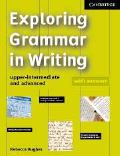 |
|
| Publisher: | Cambridge: Cambridge University Press | ||
| Pages | ISBN | Price | |
|---|---|---|---|
| Pp. viii + 168 | 0-521-66994-9 | £12.30 GBP | |
Given the similarities in cover, layout and design, Exploring Grammar in Writing seems to be intended as a sister publication to Exploring Grammar in Context (Carter, Hughes and McCarthy, 2000). Both are pitched at a broadly defined upper-intermediate to advanced level [1]. Both provide equally rich sources for dip-in supplementary materials. In addition, where the latter goes from Grammar to Context, and is thus perhaps more suitable for reference, this textbook reverses the sequencing and goes from Writing (Context) to Grammar, making it equally suitable as a course book — particularly for a short intensive writing course or as a writing component within a larger course.
The emphasis throughout the book is on choices open to the writer as governed by “real-world writing constraints and influencing factors” (p. vii). In the introduction Hughes announces her book’s approach as Why not What, identifying three factors as crucial to a writer’s grammar and style choices: the text’s purpose, audience, and anticipated shelf-life. While the first two are widely recognised, the question of a text’s expected lifespan is a thought-provoking yet rarely discussed element (at least in this type of book).
From an organisational perspective, the book is divided into four umbrella parts: Part One ‘Writing for Different Readers’; Part Two ‘Building Noun Phrases’; Part Three ‘Adding More Information to the Sentence’ and Part Four ‘Sequencing and Focusing’. The sections are sub-divided into 20 units, covering a wide range of genres/text types. Along with the more traditional – Essays, Reports, Advertisements, and Business Letters, we can find Everyday Notes, Hobby Books, Blurbs, Encyclopaedias, and Greetings Cards [2]. It is also worth noting that separate units cover the particular characteristics of genres which although topic-related are stylistically distinctive. Aside from the more predictable distinction between Formal and Informal Correspondence, one unit deals with Holiday Brochures while another looks at Travel Guides. We can also find Everyday Instruction Booklets and Technical Manuals, while Catalogues are addressed separately from Advertisements.
This book is not (nor does it claim to be) a definitive guide to any of the highlighted genres, nor indeed to grammar or writing. Rather it is a convincingly pertinent collection of information, describing salient features in a varied and interesting selection of text types. Thus, it is probably safe to say there is appealing content here for everyone.
From a methodological perspective, Exploring Grammar in Writing combines a classic PPP (Presentation-Practice-Production) model with task-based activities and a guided discovery/awareness-raising approach. Each unit follows the same format: focusing on one genre and several features deemed relevant therein. Each opens with a question designed to focus the user on the type of text featured. Some of these ‘warmers’ also address cultural aspects of the genre. In the unit on Policies and Agreements (p. 21), for instance, legal responsibilities pertaining to insurance, and how they might vary from one country to another, are discussed. The opening sentences of Unit 14 ‘Direct Mail’ (p. 85) neatly illustrate the distinction between text production and reception. From the writer’s perspective, the unit opens with a question about ‘junk mail’, thereby positioning the book’s users as readers before asking them to write, and really encouraging reflection about target audiences. (The Introductions to each unit continue with example texts from the given genre, accompanied by some kind of discovery or awareness raising task focusing on considerations such as purpose — see Business Letters (p. 29); or target audience — e. g., the distinction between expert and non-expert readers in Technical Manuals (p. 53); or on identifiable features such as the prevalence of -ing forms as headings in Everyday Instruction Booklets (p. 93).
The following section of each unit, Language Working in Context, singles out specific features of the genre and alternates a range of more narrowly focused exercises with explicit bullet-pointed summaries. Although the prevailing logic of the book leans heavily towards inductive guided discovery, the summaries, in their pale green boxes , are easily identifiable and users preferring to work more deductively can simply consult them first. Use of complicated metalanguage is mostly kept in check and there is both a glossary and an index at the end of the book.
Although Hughes does not use the term ‘lexico-grammar’, many of the summary boxes — see authority in legal documents (p. 23); vague language (p. 43); the distinction between factual and evaluative adjectives (p. 76); or adverb phrases starting with prepositions (p. 102) — are arguably just as much about lexical choice as they are about grammar. Indeed, one of the strengths of the book lies in its rich use of contextualised lexis, much of which will quite possibly be acquired along with the writing know-how.
As might be expected within the paradigm, the Language Practice section begins with more controlled practice and gradually loosens the constraints. The blurb proclaims ‘lively’ grammar practice exercises, which seems a strange choice for a modifier. These are not TPR (Total Physical Response) exercises and there is no need to shift tables (unless you like to do so for group work). What they are is a representative yet varied selection of classic grammar practice, tried and true: cloze in its various manifestations, matching, error correction, jigsaws, insertion, transformations, phrase building et al. There is a fairly even distribution of sentence and text level practice.
Closing each unit, follow-up tasks provide the opportunity for production (albeit still rather controlled at times) and, perhaps more interestingly, encourage the reader to further investigate via a selection of informal research topics and analytical tasks including translation (p. 98), L1 comparison (p. 110), mini-corpus compilation (p. 34) and web-based enquiry (p. 78); as well as some real-life tasks such as correspondence (p. 46) and even cookery (p. 40).
The back cover of the book carries a ‘Real English Guarantee’ informing the reader that the Cambridge International Corpus [3] was used in its production. The exact role of the corpus is not clarified, so it might be worth pausing to reflect upon this. In some of the units the grammatical foci are absolute classics such as defining and non-defining clauses (pp. 62-63); their treatment is similar to that in many other (competing) texts, so we can probably assume that the corpus served mainly to inform exemplification. In other instances a classic feature is presented in a slightly new light: the (un)countable distinction (p. 36), for example, is presented as choice rather than pre-ordained fact; and article use (p. 42) is viewed as dependent on degrees of ‘shared knowledge’. Such guidance, alongside other features perhaps not so typical in a grammar reference book — for example the discussion of so, only and even in Advertisements (pp. 111-116), the positioning of adverbs in Newspaper Stories (p. 101), and possibly the reduced imperatives in Packaging (pp. 108-109) — may very well have been prompted by the findings of corpus-based research.
In Hughes’ book, both teacher and learner will find a comfortable mix of old and new, though the book is refreshingly weighted toward the new. The treatment of the ‘standard’ items — adverbs and adjectives, imperative forms, conditionals and suchlike — does not adhere to more traditional patterns found in grammar textbooks or references. Rather than an isolated unit devoted to a grammatical point, features of it are found repeatedly, and in different guises, in succeeding units. Various aspects of adverb use, for example, feature in six different units. Such a distribution mirrors prevalent views on the cyclical nature of language learning.
Other factors bearing on writing decisions such as formality, attitude, and intent are constantly being re-examined in different contexts and from different perspectives. It’s safe to assume that the learner’s understanding, both of the concepts in themselves and of their importance and affect, will deepen with repeated exposure. Hughes herself states that success when using the book will depend far more on the discussions it generates (and here we should include reflection as a kind of internal discussion) than in successfully completing the exercises (p. viii). If such an approach to teaching or explaining grammar catches on, it could have far-reaching consequences, inculcating an active inquisitive approach to an often passive learning endeavour.
Notes
[1] Although this is strangely equated with a ‘strong’ five in IELTS writing. Here is not the place to begin a discussion regarding levels of equivalence between differing grading systems yet Taylor (2004) – to cite research which also comes from Cambridge – rates IELTS 5 as pre-FCE.
[2] The use of ‘greetings’ rather than ‘greeting’ caused me pause for thought. I checked Google. ‘Greeting cards’ got 37m raw hits while ‘greetings cards’ got 12m and an enquiry from the search engine: ‘Did you mean greeting cards?’
[3]http://www.cambridge.org/corpus
References
Carter, R., Hughes, R., & McCarthy, M. (2000). Exploring Grammar in Context Cambridge: Cambridge University Press.
Taylor, L. (2004). IELTS, Cambridge ESOL examinations and the Common European Framework. Research Notes (University of Cambridge ESOL Examinations) 18(1), 2-3.
Pat Moore
Universidad Pablo de Olavide,
Seville, Spain
<pfmoox upo.es>
|
© Copyright rests with authors. Please cite TESL-EJ appropriately. Editor’s Note: The HTML version contains no page numbers. Please use the PDF version of this article for citations. |