

September 2006 — Volume 10, Number 2
The Language of Language: Core Concepts in Linguistic Analysis |
|||
| Author: | Madalena Cruz-Ferreira & Sunita Anne Abraham (2006) | 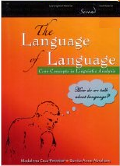 |
|
| Publisher: | Singapore: Pearson Education South Asia | ||
| Pages | ISBN | Price | |
|---|---|---|---|
| Pp. xvii + 260 | 981-06-7618-2 (paper) | $33.50 U.S. | |
The Language of Language: Core Concepts in Linguistic Analysis is a text intended to serve in foundation courses in linguistics at the undergraduate level. Cruz-Ferreira and Abraham clearly set out their purpose, which is to introduce students to the field of linguistics and “linguists’ agreed-upon ways of talking about the object of their investigations” (p. xiii). Through this, they hope to provide a “flavor” (p. xiv) of what it is that linguists do.
Following the traditional sequence of topics, the book has twelve chapters: the authors begin with an introduction to the field and the concept of language and language families (Chapters 1 and 2), and then move on to morphology and phonology (Chapters 3-6), the grammar of sentences (Chapter 7-8), semantics (Chapter 9), pragmatics (Chapter 10) and broader issues of discourse (Chapter 11). The final chapter tackles such topics as language acquisition, language death, bilingualism, and the concept of the “native speaker”.
Each chapter begins with a “Chapter Preview” offering focus questions which the authors suggest can also serve as a review. The chapters have a variety of brief language analysis activities interspersed throughout the discussion activities, which allow for practical application of the topics under discussion. These are well chosen, focused and engaging; while some require work outside of class, others could easily be incorporated into a large lecture class to allow students to discuss and grapple with the language issue at hand. A number of these tasks are traditionally linguistic in nature (such as morpheme or sentence constituent analyses), while others are more “real-world” oriented, such as activities prompting students to analyze the use and effect of connotation or passive constructions in print advertisements. A brief discussion of many of these activities (though not all) can be found in the appendix. (A companion website to the book, with more substantive activities, was referenced in the preface; however, I was unable to locate this site and so cannot comment on its usefulness as an adjunct to the book’s activities.)
Another recurring feature is the concluding “Food for Thought” section of each chapter, which pulls together relevant quotes on the topic at hand. For instance, “The structure of every sentence is a lesson in logic” (John Stuart Mill, p. 162) is included in the chapter on sentence syntax; the Kipling quote “And what should they know of English who only English know?” (p. 233) appears after a discussion of global language varieties. This feature provides a particularly useful resource for teachers (as we can never find seem to find that perfect quote when we need it!) but such quotes would also serve as excellent starting points for more substantive discussion among students.
Each chapter ends with a list of suggestions for further reading (summarized in “Reading and Resources” at the end of the book). The readings seem appropriately chosen and offer a reasonable amount of outside reading to supplement this core text.
Cruz-Ferreira and Abraham teach in Singapore, so clearly have a multilingual student population for some of whom English is not necessarily the primary language. The book references multiple varieties of English (such as Jamaican or Singaporean) and its activities sometimes draw upon the experience of a multilingual student, e.g., “Consider the personal pronoun systems in the languages you are familiar with” (p. 167). Another feature that offers support for this student population is the chart entitled “Technical Terms and How to Use Them Appropriately,” included as an appendix. For every linguistic term listed, the chart provides its noun, verb, adjective, adverb, and agent form (e.g., grammar, grammaticise, grammatical, grammatically, grammarian), thus helping students to “talk like a linguist” as they master the concepts. For these reasons, this text seems particularly well suited to university settings where English is not the dominant language.
In their explanatory preface, the authors state clearly that, given the broad scope of an introductory text, they have used a selective approach and deliberately restricted sets of data. Their hope is that the suggested readings at the end of each chapter will provide students with a guide to further explore some of the topics they address only cursorily in this book. Indeed, given the territory they cover, it would be difficult to provide more than an overview of some of the key concepts. For example, in a mere 15 pages Chapter 10 discusses pragmatics, speech act theory, Grice’s Maxims, adjacency pairs, and politeness strategies. The final chapter (as noted above) also attempts to cover extremely challenging topics in a few pages each. This is unfortunate, since these are the concepts that would seem most intriguing and relevant–and most worth pursing in depth–in an international and multilingual environment. While I applaud the authors’ concern with thorough coverage of the field, I do worry that this approach does a disservice to very complex topics.
Nevertheless, Cruz-Ferreira and Abraham deliver what they promise: an introduction to the key concepts of linguistics and the language linguists use to talk about their field. It is written in a clear and engaging style, and doesn’t rely on jargon that might alienate an undergraduate audience, particularly one for whom English is not the primary language. My only concern is that with so much to cover would a course based on this textbook provide more than a fleeting introduction to linguistic concepts? The answer to that question, of course, lies in the teaching approach. In my view, this text could easily serve as the basis for an entire year’s coursework. Supplemented by more fieldwork, linguistic analyses and language exploration tasks, it could indeed offer undergraduate students an intriguing glimpse into the world of linguistics and, we hope, encourage them toward further study.
Greta Vollmer
Sonoma State University, California
<greta.vollmer sonoma.edu>
|
© Copyright rests with authors. Please cite TESL-EJ appropriately. Editor’s Note: The HTML version contains no page numbers. Please use the PDF version of this article for citations. |