

September 2006 — Volume 10, Number 2
Linguistic Diversity and Teaching |
|||
| Author: | Nancy L. Commins & Ofelia B. Miramontes (2005) | 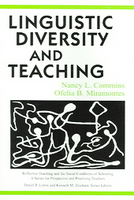 |
|
| Publisher: | Mahwah, New Jersey: Erlbaum | ||
| Pages | ISBN | Price | |
|---|---|---|---|
| Pp. xviii + 186 | 0-8058-2736-6 (paper) | £17.94 GBP | |
Linguistic diversity is the natural state of society, the majority of people being bilingual, though because of the present migratory movements such diversity is the focus of various political, social and educational debates. Immigrants’ assimilation and acculturation processes are issues of great significance in multicultural societes, sometimes generating fierce controversy. Migration usually occurs as a result of difficult adult decisions; but for children it is not a choice. For such children to be succesful in their new land it is important to study, to get an undergraduate or even a postgraduate degree. Schools create a social and cultural context for such mastery while training their students to use the necessary tools. Thus classroom tasks and activities encompass both society and the individual learner.
There are significant research studies on migrant children’s education in the U. S., but it is difficult to find a book, such as this one, which prompts teachers and other educators to reflect on their teaching methods and principles through cases from real classroom situations. It would be desirable if all teachers who have had experiences with any kind of linguistic diversity would articulate their views, responses, and responsibilities to students, parents and decision-makers. Such open dialogue could lead to substantial changes in language education in the U.S. and in other countries.
Linguistic Diversity and Teaching is the fourth in the series Reflective Teaching and the Social Conditions of Schooling, all of which follow a three-part structure.
Part One consists of four cases, each exhibiting for the reader different aspects of linguistic diversity and teaching. All of the cases describe situations monolingual English speaking teachers might face in an American elementary, middle, or high school with a diverse student body. Case presentation follows the same format: a brief background to the case (Introduction to Case), followed by a detailed description of the case (Case). After reading the case presentation, readers can put down their first impressions and reflections (Reader Reactions) about the case (a page is left blank for these). Readers’ reactions are followed by a set of reactions to the cases written by future and practicing teachers, administrators and professors (Reactions). Here another blank page is provided to record reconsiderations of our initial reflections in light of other educators’ opinions. Each case ends with questions of a social or educational nature further exploring the questions raised in the introduction (Additional Questions).
The four cases follow the bottom-up approach, from a series of student-teacher dialogues we can induce some common practices of the American educational system.
In Case 1 “The Cycle: Frank and Vu” we can examine one teacher’s experience in trying to respond to the educational needs of a second language learner who has been in the United States for a year and a half. Questions raised include: How can a monolingual teacher understand the importance of ESL classes for the progress of a linguistically diverse student? What are the consequences of fragmented second language instruction? How can communication among teachers about the make-up of ESL programs be improved?
In Case 2 “Marisa’s Prospects” we can focus on a junior high school Latina student and her teacher, who makes an extra effort to understand the role of primary language in Marisa’s school performance. While visiting Marisa’s family this teacher encounters the myth that migrant parents are not interested in their children’s education. This personal experience makes her revise many of her prejudicies about linguistically diverse students.
In Case 3 ”Friendship, Professionalism and Programs” a teacher attempts to change the structure of her school to better fulfill the needs of its linguistically diverse student population, which has dramatically increased within a few years. Not every teacher feels ready to adapt his educational approach to students’changing needs, a reluctance which can cause frustration and alienation between students and teaching staff. The authors ask, How can a school support its team to become more confident teaching linguistically different students?
In Case 4 “What is Equal Treatment?” we can explore the issue of national performance assessment and how increasing linguistic diversity challenges teachers and schools to meet parents’ concerns about the educational qualifications of their children’s school. If it is appropriate to test second language learners, how can linguistically diverse students be assessed to show their real subject knowledge despite their lack of proficiency in English? This question leads to an even more challenging one the authors pose: What would be an ideal system to measure and document such students’progress while still conforming to the accountability systems?
From the four cases we arrive at Part Two, Public Arguments. In this section the reader can focus on various social debates about education of linguistically diverse students. The authors advocate including such societal debates into teacher preparation and in-service programs.
Presented here are three typical public arguments centered on linguistic diversity, teaching and education, which also incorporate and interpret the four cases of Part 1 within the frame of each argument. The first is the English-only position, “English Is the Glue That Holds Our Nation Together.” The supporters of this idea think that English should be the only language of instruction. The second public argument is that bilingual education should be provided for immigrant children (“Bilingual Education is a Must”). It maintains that all children should receive instruction in both their first language and English. According to some surveys, letting immigrant students use their native language in school increases the likelihood that students will stay in school. The third public argument, “A Pragmatic Approach,” is a compromise between the other two, its proponents advocating working with school staff to decide what kind of program to offer their students.
While explicating these debates, Commins and Miramontes specifically ask educators to consider some of the most difficult questions currently being raised in the public sphere: How do you respond to the proposition that to maintain a language other than English is divisive to the nation? (p.111); Do advocates of bilingual education adequately address the need of immigrants to learn English? (p. 120); and lastly, Is it realistic to be pragmatic? Can every school really decide for itself what kind of program to offer? (p. 133).
In Part Three, Final Arguments and Some Suggestions and Resources for Further Reflection the authors present their concluding statements about some of the issues raised throughout the volume. Although the main purpose of this book is to provide a framework for teachers to reflect on the challenges of linguistic diversity, in this final section ten recommendations are also made to promote the success of linguistically and culturally diverse students. Working through these steps might extend teachers’ thinking about their students’ needs and even move them beyond their comfort zone.
At the end of the book we can find a Glossary of Terms and a list of References, the latter resouces usefully arranged by topis: for example, Bilingual Education/English-only debate, Teaching with linguistic and cultural diversity in mind, Strategy for second language instruction.
What I like most about this book is its focusing on the practical side of the problematics of linguistic diversity and teaching. Although the authors are well-known for their contribution to the education of English language learners and their familiarity with the theoretical issues behind bilingualism, SLA, and education policies, they give the reader a very clear and easy-to-follow guide through this complex area. I would suggest using Linguistic Diversity and Teaching as a coursebook in practicum classes, no matter what the subject focus. In-service teachers, curriculum committees, and school administrators can use this highly informative book as a guide in creating their policies and curriculum.
This book also deserves the close attention of researchers, politicians and parents if we really want to give all students equal opportunity. As the first Hungarian king, Saint Stephen, wrote in his Book of Wisdom for his son, Prince Imre: Immigrants must be treated well, because they are the ornaments of a state, and they are the ones who can enrich the country through their culture and their knowledge.
Dorottya Nemeth
University of Pécs, Hungary
<dorinemeth gondola.hu>
|
© Copyright rests with authors. Please cite TESL-EJ appropriately. Editor’s Note: The HTML version contains no page numbers. Please use the PDF version of this article for citations. |