

December 2006 — Volume 10, Number 3
Longman Social Studies |
|||
| Author: | LeeAnn Aguilar Lawlor & Julie Mariscal (2005) | 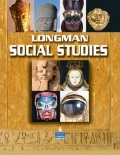 |
|
| Publisher: | White Plains, NY: Pearson Education | ||
| Pages | ISBN | Price | |
|---|---|---|---|
| Pp. iii+ 294 | 0-13-193025-7 (hardcover) | $39.95 U.S. | |
| Pp. iii + 135 | 0-13-193027-3 (paper) | $11.00 U.S. | |
| Pp. iii + 280 | 0-13-193028-1 (paper) | $35.00 U.S. | |
Longman Social Studies, a set of three books including a Student Book, a Student Workbook, and a Teacher’s Guide, work together to prepare beginning English language learners (ELLs) and struggling readers to handle advanced academic skills and content knowledge in later mainstream social studies classes. This set emphasizes academic language, content reading strategies, and social studies skills, incorporating the best practices of CALLA, an instructional model for second and foreign language learners based on cognitive theory and research (Chamot & O’Malley, 1990).
Thematically and chronologically organized, the seven-unit Student Book briefly surveys seven important historical periods from ancient to modern times: Early Civilizations, The Classical World, Middle Ages, Renaissance, Early United States, A New Nation, and the Modern World. With a clear layout, each unit consists of a brief overview of “Unit Content,” “Lesson 1” and “Lesson 2”, followed by “Review and Practice” for each lesson and a “Unit Review”. Within each lesson, there is a useful section called ‘Before You Read’, where (1) key words are elucidated with pictures and simplified language, and (2) social studies skills including content reading strategies and the use of visuals (e.g., maps, time lines, charts, graphs) are explained and exemplified. This can help students build up background knowledge and scaffold it for upcoming content reading materials.
One of this book’s appealing attributes is its frequent use of pictures, realia, maps, charts, historical materials (e.g., posters, diary excerpts, and speeches), and graphic organizers to demonstrate concepts, terms, and historical events. For example, in the readings about The Bronze Age, authentic pictures of Bronze Age tools, pins, and razors (p. 39) are shown to establish authenticity and to pique students’ interest. Using such visual documentation and graphic organizers in improving students’ recall of content information has already been supported by research on discourse comprehension (Grabe & Stoller, 1997).
Another distinguishing feature of the Student Book is all the useful information boxes linked to the main readings, such as More About It, Connect to Today, Elsewhere in the World, Curriculum Connection, Language Tip, As You Read, Profiles, Primary Sources, and Before You Go On. These boxes are intended to expand students’ knowledge of particular topics, and get them to practice their critical thinking skills, relate readings to other content curricula, and notice important historical figures. Again, such links reinforce the authenticity of the book by connecting the readings to real-world issues or current events and make the readings more interactive and engaging. Such engagement naturally leads to writing, another important social studies skill emphasized in the book. A range of well-sequenced writing activities progress from the simple task of making a plan and writing a paragraph, to writing a draft and revising a three-paragraph essay up to editing it for the final draft. The process approach to writing will be sure to facilitate students’ writing development.
The Student Workbook, an exercise book, is meant to help students reinforce and extend important academic language, reading strategies, social studies skills, and writing skills learned in the Student Book. It can also help teachers measure students’ grasp of concepts–or help students themselves check their grasp before moving on. As in the Student Book, pictures, timelines, maps and charts make exercises visually stimulating and enjoyable. A wide variety of exercises, such as writing the secret word, matching words with definitions, drawing pictures and completing word puzzles, will keep students alert and engaged. Teachers might also use the Student Workbook for class quizzes at the end of each lesson or unit since the pages are perforated.
The Teacher’s Guide is a very teacher-friendly resource book. It provides detailed step-by-step instructional procedures and suggestions for presenting and teaching key vocabulary, social studies skills, and academic content covered in the Student Book. For instance, it suggests when to call on students to read aloud new vocabulary, when to use pictures to aid comprehension, what questions to ask to introduce a new topic, and what exercises to assign in the Student Workbook to reinforce what students have been taught. “Teach Pages” provide teachers with reading strategies, comprehension checks, and graphic organizers to help beginning and high beginning ELLs understand, analyze and synthesize readings. This is a crucial step in helping students build up confidence in their ability to comprehend cognitively complex readings instead of being overwhelmed by them. “Working with Timelines”, “Reaching All Students”, ” Optional Activities”, and “Websites” are some additional teacher resources available to help students enhance their learning experiences.
What makes this set of books stand out from the other Content-based Instruction (CBI) books available in the market is the excellent job it does making advanced academic knowledge accessible to beginning ELLs and struggling readers. This has been achieved by providing scaffolding (restating key concepts or vocabulary in simplified language), graphic organizers (presenting main information visually), and illustrations (e.g., pictures, charts, maps, timelines, etc.) throughout the texts. Yet, the most distinguishing feature is the authenticity of content, texts, language, and exercises used: a powerful force in propelling ELLs to a higher level of both language proficiency and content knowledge (Stryker and Leaver, 1997a). When students successfully negotiate the meaning encountered in authentic language and situations, they can relate what they have learned to real-life experiences, and thus increase their self-confidence, which in turn leads to gains in motivation and achievement. Furthermore, as Grabe and Stoller (1997) maintain, motivation is one of the critical factors which support student success in challenging informational activities and which help them learn complex skills–two important goals of CBI.
Evaluating content and language is an important part of CBI. In this regard, this set is exemplary in assessing targeted vocabulary, reading strategies, and social studies skills on a regular basis, such as at the end of each lesson and each unit in the Student Book, and also in the Student Workbook. Moreover, Lawlor and Mariscal take students’ lack of language skills into consideration by making all the activities accessible while still setting high expectations for learners. Lastly, each “Unit Review” includes applications of social skills learned, an extension project, and suggested extra readings. As such, this set represents an effective synergy among teaching, learning, and assessment.
However, one potential weakness is the way grammar is dealt with in this set. Relevant grammatical features are only presented briefly in some Language Tip information boxes interspersed in the Student Book. What seems odd is that out of many grammatical features, only one feature, simple past tense, is selected for discussion at great length. The importance of knowing this feature in social science classes is granted readily. However, there are other grammatical features essential for students’ future content-course success, such as the use of pronouns, comparatives and superlatives, phrasal verbs, all of which are only touched upon in the set. In fact, Stryker and Leaver (1997b) report that some ESL learners, particularly adult learners (high school students in this case), are eager to receive explicit grammar teaching. This is probably due to the influence of their previous English learning experiences at their home countries. Thus, more detailed grammar explanations of a wider range of points might capture this segment of the books’ audience.
Both language and content instructors face an increasing number of ethnically and linguistically diverse students from non-English speaking countries enrolled in English-medium classes. Against such a backdrop, Longman Social Studies will prove to be a valuable resource to help these ELLs thrive in such mainstream social studies classes. Additionally, for this reviewer, reading this set of books was a truly enjoyable learning experience.
References
Grabe, W., & Stoller, F. L. (1997). Content-based instruction: Research foundations. In T. A. Snow, & D. T. Brinton. (Eds.), The content-based classroom: Perspectives on integrating language and content (pp. 5-21). White Plains, NY: Longman.
O’Malley, J. M., & Chamot, A. U. (1990). Learning strategies in second language acquisition. New York: Cambridge University Press.
Stryker, S. B., & Leaver, B. L. (1997a). Content-based instruction: From theory to practice. In S. B. Stryker & B. L. Leaver (Eds.), Content-based instruction in foreign language education: Models and methods (pp. 3-28). Washington, D. C.: Georgetown University Press.
Stryker, S. B., & Leaver, B. L. (1997b). Content-based instruction: Some lessons and implications. In S. B. Stryker & B. L. Leaver (Eds.), Content-based instruction in foreign language education: Models and methods (pp.285-312). Washington, D. C.: Georgetown University Press.
Jingjing Qin
Northern Arizona University
<jinging.qin nau.edu>
|
© Copyright rests with authors. Please cite TESL-EJ appropriately. Editor’s Note: The HTML version contains no page numbers. Please use the PDF version of this article for citations. |